
Logo

American Heart Association

  43
  0


Final ID: 047

High Salt-Induced Increases in Renal Interstitial Osmolarity Induces Renal Sensory Nerve Activation

Abstract Body: Consumption of a high salt (HS) diet is linked to a pro-inflammatory milieu, including increased systemic and intra-renal levels of immune cell activation, proliferation and cytokine production. Together, HS and inflammation are linked to resistant and salt-sensitive hypertension (SS-HTN). The role of the sympathetic nervous system (SNS) in HTN has been well-documented, but more recently a role for renal sensory nerves has emerged. Data from our lab suggests that sensory nerves affect downstream changes in renal inflammation and HTN; however, mechanisms understanding what activates renal sensory nerves is unknown. We hypothesize that HS increases sensory nerve activation.

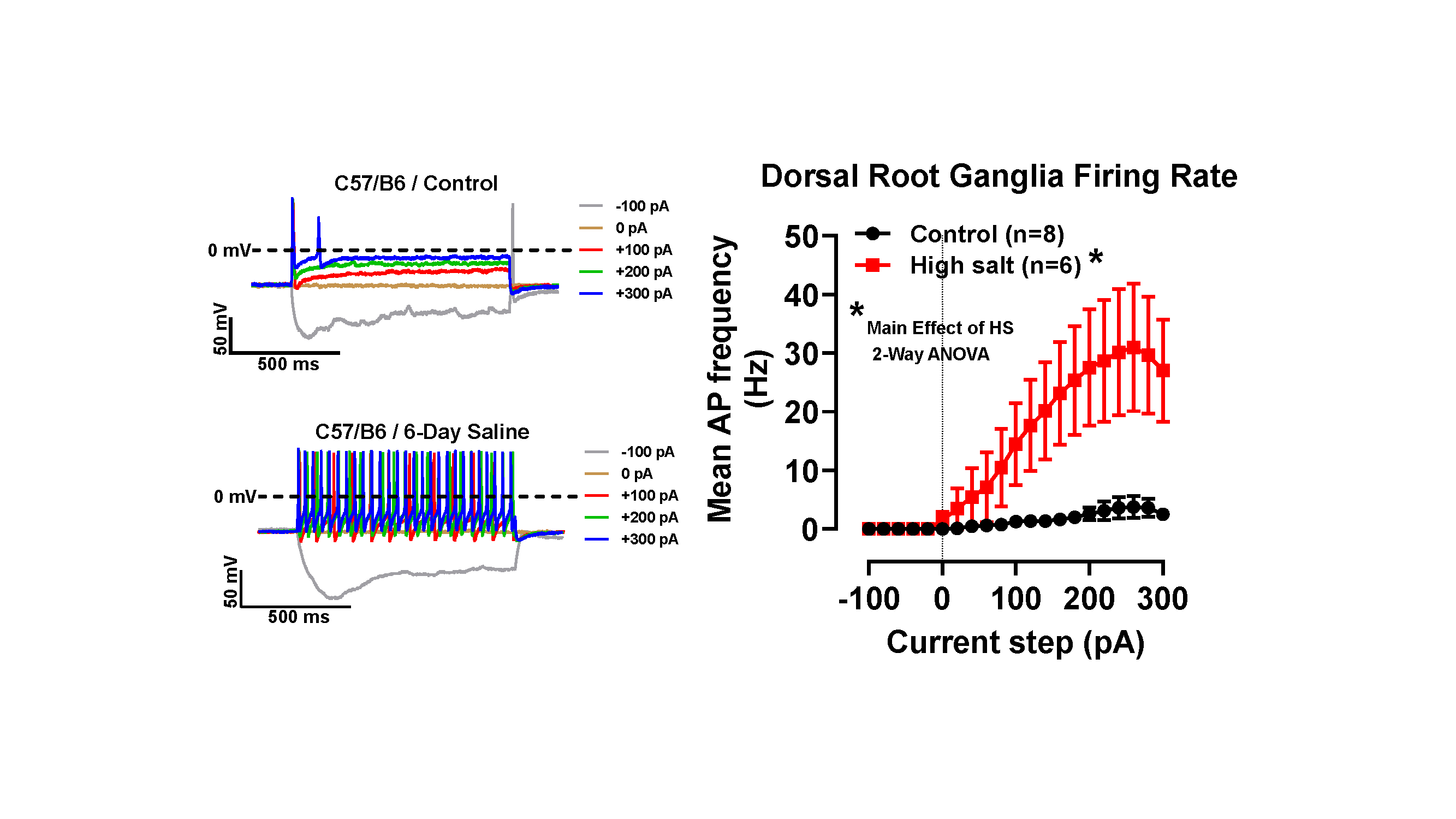
Wt (male, C57) mice were given a hyperosmolar saline (HS, 1%) diet to drink with normal chow (NC) food or control (NC) for 6 days. Kidneys were isolated and dissected (cortex, outer medulla or inner medulla) for renal interstitial osmolarity (n=6-13). T10-L1 dorsal root ganglia (DRG) were isolated, digested, and cultured overnight (n=6-8) for whole-cell current patch clamp recording (0-300pA steps) the next day to quantify baseline sensory nerve firing rate. Data were analyzed by Students’ t-test or two-way ANOVA and presented as mean±SEM.

We observed an increase in outer medullary interstitial osmolarity (347.3±3.7 vs. 329.8±6.6 mOsm; p<0.05) following only 6 days of 1% hyperosmolar saline, with no changes to cortical or serum osmolality. Inner medullary osmolarity was also increased in HS vs. NC (803.6±45.1 vs. 622.1±36.1 mOsm ; p<0.01), likely due maximal water conservation when drinking 1% saline. Importantly, DRG firing rate was profoundly increased vs. NC (27.0±8.7 vs. 2.5±0.7; p<0.05), suggesting that increased renal interstitial osmolarity serves as a stimulus for sensory nerve activation.

Here, we are the first to show that slightly hyperosmolar saline consumption, in mice, contributes to an increased interstitial osmolar gradient and increased sensory nerve activation. Together, these data are the first to link HS diet with osmolarity-induced increases in sensory nerve activation.
  • Cowley, Craig  ( University of Utah , Salt Lake City , Utah , United States )
  • Hayoz, Sebastien  ( University of Minnesota , Minneapolis , Minnesota , United States )
  • Banek, Christopher  ( University of Minnesota , Minneapolis , Minnesota , United States )
  • Wynne, Brandi  ( University of Utah , Salt Lake Cty , Utah , United States )
  • Author Disclosures:
    Craig Cowley: DO NOT have relevant financial relationships | Sebastien Hayoz: No Answer | Christopher Banek: DO NOT have relevant financial relationships | Brandi Wynne: DO NOT have relevant financial relationships
Meeting Info:
Session Info:

Concurrent B: Neurogenic Mechanisms

Friday, 09/05/2025 , 01:30PM - 03:00PM

Oral Abstract Session

You have to be authorized to contact abstract author. Please, Login
Not Available