
Logo

American Heart Association

  45
  0


Final ID: FR568

Increased Interstitial Osmolarity in Early Salt-Sensitivity Contributes to Renal Damage and Cytokines

Abstract Body: Salt-Sensitive hypertension (SS-HTN) is associated with an increase in immune cells and pro-inflammatory cytokines, such as IL-6. Additionally, consuming a high salt (HS) diet contributes to the development of SS-HTN, as well as induces renal immune cell activation. We previously showed that intra-renal IL-6 is increased in SS-HTN and can increase blood pressure via reduced sodium excretion. However, no data show a mechanistic link between dietary HS in SS-HTN and inflammation. We hypothesize that HS increases renal osmolarity and IL-6 levels, which precedes the development of SS-HTN.

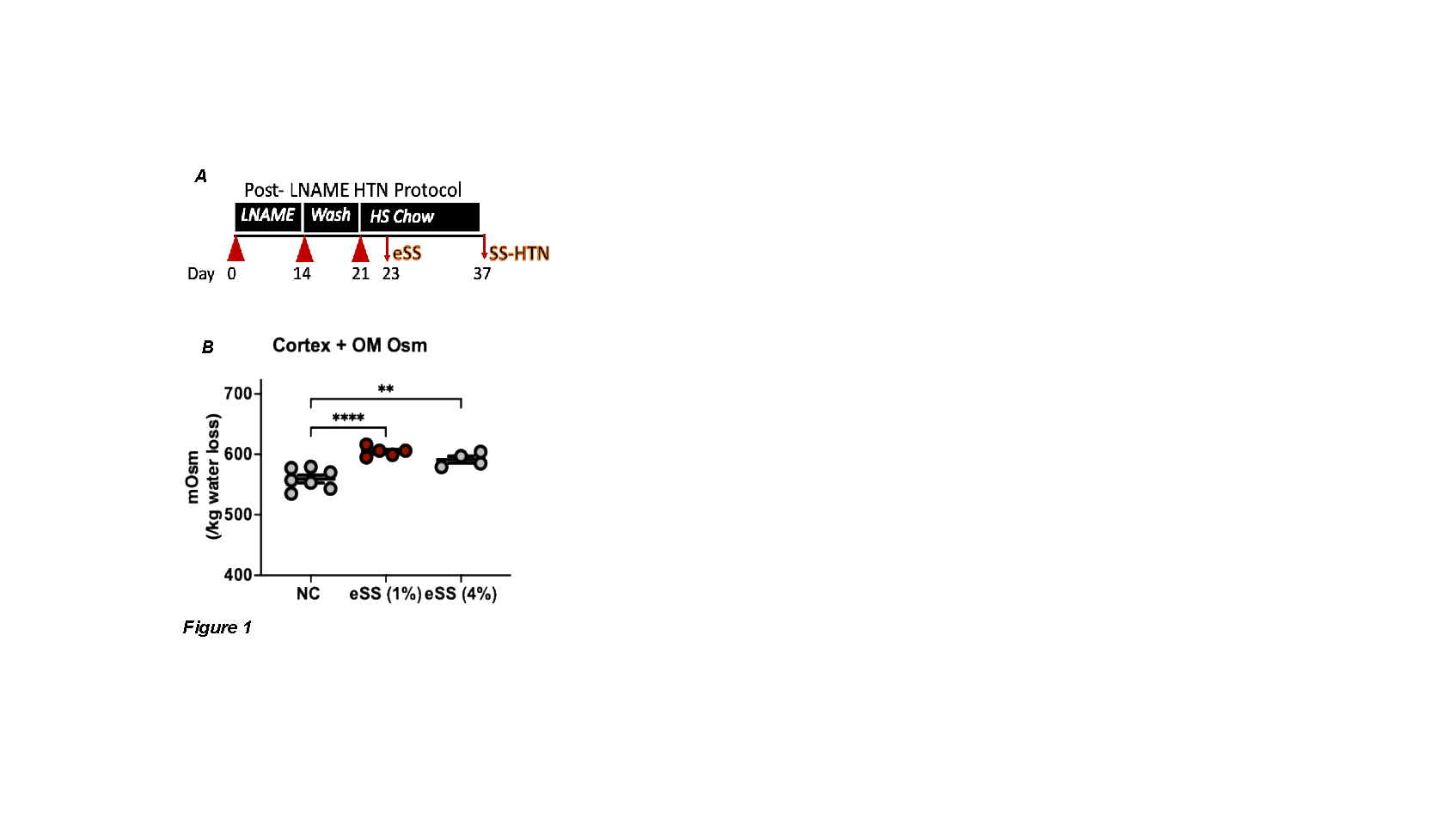
Wt (male) mice were given L-NAME (0.5mg/mL, 2 wks) and then washed-out (1-2wks, Fig 1A). Mice in early phase (early salt-sensitive, eSS) were then given 1% saline + normal chow (NC) or HS chow (4%) + tap water for 2 days. To develop SS-HTN, mice were given HS for the remainder of the study (SS-HTN, Fig 1A). Control mice were given NC or HS only. Kidneys were isolated and dissected (cortex + outer medulla) for osmolarity or used for RT-PCR. Serum was used for cytokine analysis (Meso-Scale Discovery).

To determine how and where immune cells may be exposed to HS, we assessed the interstitial osmolarity of the renal cortex + outer medulla in both models of eSS. We observed a significant increase in interstitial osmolarity at the eSS stage following 2 days of 1% saline or 4% HS chow, as compared to NC (Fig 1B). This increase was not present during SS-HTN. This corresponds with early increases in serum IL-6 levels (1.82±0.3 pg/mL eSS vs. 0.81±0.14pg/mL HS vs. 1.1±0.27pg/mL NC; p<0.05) and renal CD8+ T-cells. We then assessed kidney injury molecule 1 (KIM-1) mRNA levels and saw the greatest increase was also at eSS (4%) (DCt 9.58±0.17 eSS vs. DCt 9.58±0.17, p<0.01).

Here, we are the first to show that salt-sensitivity (eSS) promotes increased osmolarity accumulation in the renal interstitium. This also corresponds with the greatest increase in IL-6 and KIM-1, all preceding the development of SS-HTN. These data suggest that HS-induced increases in IL-6 and KIM-1, via increased renal osmolarity, may contribute to the early development of SS-HTN.
  • Cowley, Craig  ( University of Utah , Salt Lake City , Utah , United States )
  • Banek, Christopher  ( University of Minnesota , Minneapolis , Minnesota , United States )
  • Wynne, Brandi  ( University of Utah , Salt Lake Cty , Utah , United States )
  • Author Disclosures:
    Craig Cowley: DO NOT have relevant financial relationships | Christopher Banek: DO NOT have relevant financial relationships | Brandi Wynne: DO NOT have relevant financial relationships
Meeting Info:
Session Info:

Poster Session 2 with Breakfast Reception

Friday, 09/05/2025 , 09:00AM - 10:30AM

Poster Session

More abstracts on this topic:
Analysis of First Morning Urine Transcriptomes in Normotensive and Hypertensive Patients Identify Upregulated Inflammatory and Signaling Pathways Associated with Hypertension

Umanath Kausik, Ortiz Pablo, Sohaney Ryann, Atchison Douglas, Abraham Emmy, Meng Ze, She Ruicong, Adrianto Indra, Levin Albert, Wu Andrew

Assessing Coronary Artery Disease Severity: Leveraging Inflammatory Markers As a Prognostic Indicators

Turnbull Scott, Dugal Jasmine, Gill Randeep, Wang Shawn, Cross Chad, Mubder Mohamad

More abstracts from these authors:
You have to be authorized to contact abstract author. Please, Login
Not Available