Dietary Sodium-to-Potassium Ratio Modifies Diuretic-Associated Hypokalemia Risk in Adults with Hypertension
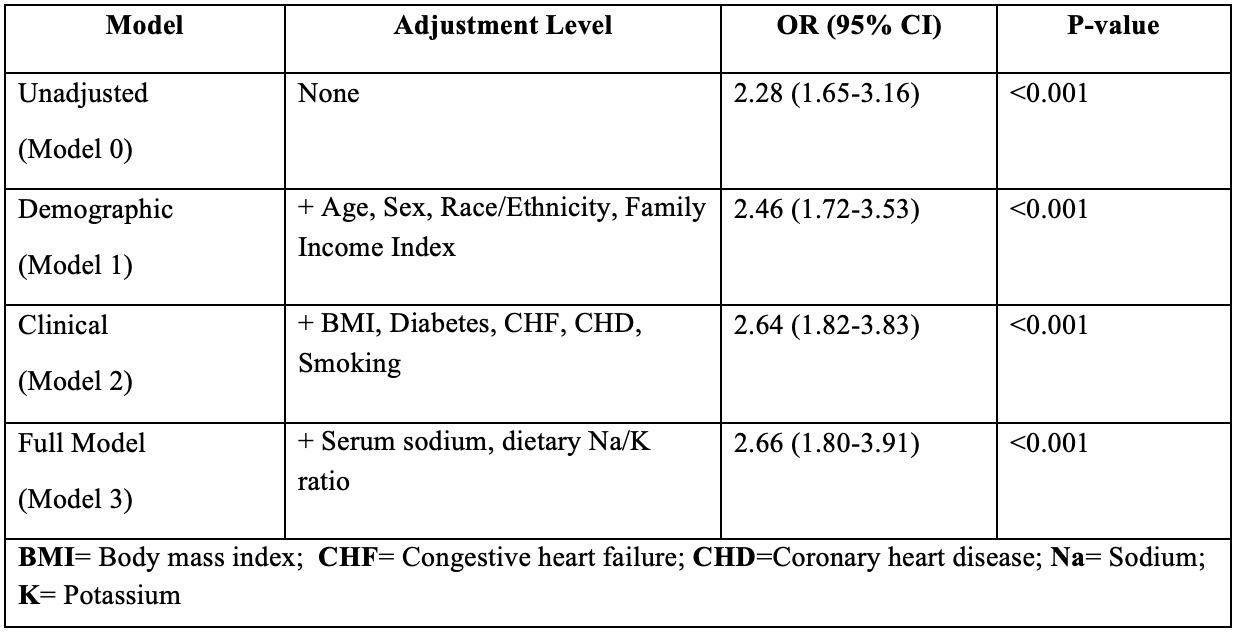
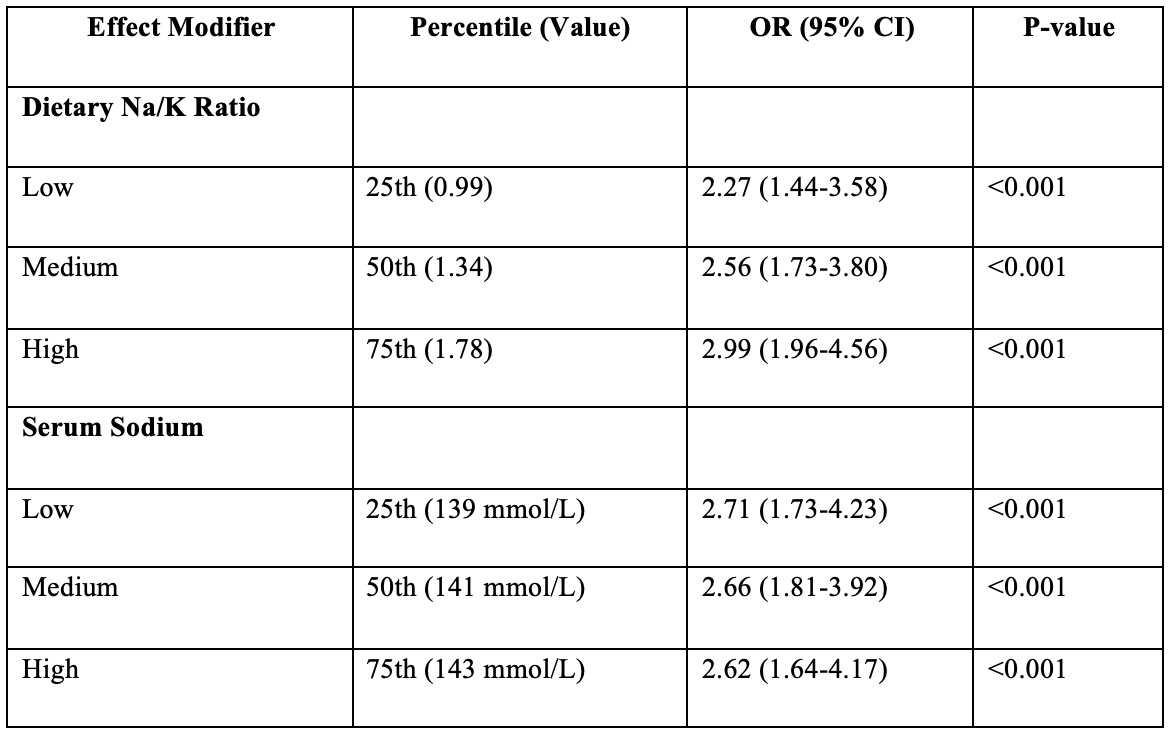
Abstract Body: Background: Diuretics are widely used for hypertension but may raise hypokalemia risk. Dietary sodium-to-potassium (Na/K) ratio is key for potassium homeostasis. The DASH (Dietary Approaches to Stop Hypertension) diet, promoting low sodium and high potassium intake, is recommended for blood pressure control, yet its role in modifying diuretic-related electrolyte effects remains underexplored. This study examined (1) the association between diuretic use and hypokalemia and (2) whether dietary Na/K ratio or serum sodium modifies this association in treated hypertensive adults. Methods: We analyzed cross-sectional data from the 2017- 2020 National Health and Nutrition Examination Survey. Hypokalemia was defined as serum potassium <3.5 mEq/L. First-day dietary Na/K ratio was calculated. Logistic regression models estimated hypokalemia odds associated with diuretic use, adjusting sequentially for demographic, clinical, and biochemical factors (serum sodium, dietary Na/K ratio). Effect modification by dietary Na/K ratio and serum sodium was assessed using interaction terms, with marginal effects estimated at 25th, 50th, and 75th percentiles. Results: Among 3,426 U.S. adults treated for hypertension, 16.2% (n = 554) reported diuretic use. Hypokalemia was more prevalent in diuretic users than non-users (10% vs. 4.7%, p < 0.001). In unadjusted analyses (Table 1), diuretic use was linked to higher hypokalemia odds (Model 0: OR = 2.28, 95% CI: 1.65–3.16), remaining consistent after adjusting for demographics (Model 1: OR = 2.46, 95% CI: 1.72–3.53), clinical factors (Model 2: OR = 2.64, 95% CI: 1.82–3.83), and serum sodium and dietary Na/K ratio (Model 3: OR = 2.66, 95% CI: 1.80–3.91). In stratified analyses (Table 2), the association strengthened across increasing dietary Na/K ratio percentiles: OR = 2.27 at 25% (0.99), 2.56 at 50% (1.34), and 2.99 at 75% (1.78). In contrast, the association remained stable across serum sodium percentiles: OR = 2.71 at 25% (139 mmol/L), 2.66 at 50% (141mmol/L), and 2.62 at 75% (143mmol/L). Conclusion: Among treated hypertensive adults, diuretics were associated with significantly higher odds of hypokalemia. This risk was more pronounced in individuals with higher dietary Na/K ratios, underscoring the potential protective role of DASH-aligned diets in mitigating electrolyte-related side effects of antihypertensive therapy.
Owusu-ansah, Raymond
(
Johns Hopkins University
, Baltimore , Maryland , United States )
Song, Shanshan
(
Johns Hopkins School of Medicine
, Baltimore , Maryland , United States )
Obiri-yeboah, Kwabena
(
Johns Hopkins University
, Baltimore , Maryland , United States )
Washington, India
(
Johns Hopkins University
, Boston , Massachusetts , United States )
Olatunji, Gbolahan
(
Montefiore St. Luke's Cornwall
, Newburgh , New York , United States )
Ogungbe, Bunmi
(
Johns Hopkins University
, Baltimore , Maryland , United States )
Author Disclosures:
Raymond Owusu-Ansah:DO NOT have relevant financial relationships
| Shanshan Song:DO NOT have relevant financial relationships
| Kwabena Obiri-Yeboah:No Answer
| India Washington:DO NOT have relevant financial relationships
| Gbolahan Olatunji:DO NOT have relevant financial relationships
| Bunmi Ogungbe:DO NOT have relevant financial relationships
Ali Eman, Hall Michael And Jo Alice, Latif Fakhar, Ali Kumail Mustafa, Perswani Prinka, Janjua Hamza, Ansari Yusra, Vipparthy Sharath, Ali Farman, Siddiqi Tariq Jamal