Artificial Intelligence-Enhanced Electrocardiography for the Detection and Prediction of Arterial Hypertension: A Systematic Review
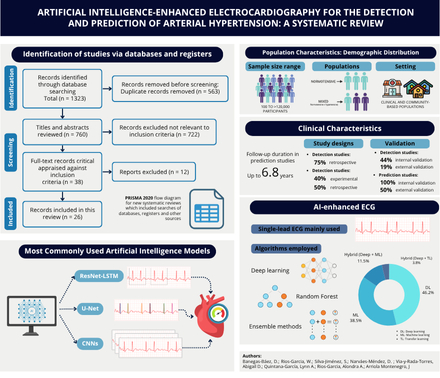
Abstract Body: Background: Early detection and prediction of arterial hypertension (HTN) are vital to reduce cardiovascular morbidity and mortality. AI has enhanced ECG diagnostic capabilities, enabling detection of latent cardiovascular abnormalities. Aims: This systematic review evaluates current evidence on AI-enhanced ECG for detection and prediction of HTN in in both clinical and subclinical populations. Methods: A search was conducted on April 28, 2025, in PubMed, Scopus, and Web of Science. Gray literature and study reference lists, plus the first 10 pages of Google Scholar, were screened. The review followed PRISMA 2020 guidelines. Bias risk was assessed using PROBAST (for prediction models) and QUADAS-2 (for diagnostic studies). Two reviewers independently performed study selection and data extraction after pilot training. Results: A total of 26 studies were included: 16 focused on detection and 10 on prediction of HTN using AI-enhanced ECG. Overall, 96% reported successful outcomes, underscoring the strong diagnostic and prognostic potential of this approach. Among detection studies, 94% successfully identified hypertensive individuals, classified blood pressure (BP) levels, or evaluated cardiovascular risk. Most were retrospective in design (75%), with internal validation in 44% and external validation in 19%. Sample sizes ranged from 100 to over 120,000, including healthy and cardiovascular patients. Commonly used algorithms included deep Learning, random forest, and ensemble methods, often using single-lead ECG data, highlighting the feasibility of wearable technologies. QUADAS-2 identified 56% of studies had low risk of bias. All prediction studies achieved accurate estimation of systolic/diastolic BP or predicted future HTN onset. Designs were 40% experimental and 50% retrospective. All studies reported internal validation, and 50% included external validation. AI models such as CNNs, ResNet-LSTM, and U-Net were used across clinical and community-based populations, with follow-up periods of up to 6.8 years. Populations were predominantly normotensive or mixed. PROBAST assessments showed 60% low and 40% moderate risk of bias. Conclusion: AI-enhanced ECG is a promising, non-invasive tool for early detection and prediction of HTN. However, external validation and clinical trials are needed to support integration and generalizability.
Banegas Baez, Daniel
(
Universidad de Cuenca
, Cuenca , Ecuador )
Rios-garcia, Wagner
(
University of San Luis Gonzaga
, Pisco , Peru )
Silva-jimenez, Sashenka
(
Universidad de Cuenca
, Cuenca , Ecuador )
Via Y Rada Torres, Abigail
(
Universidad Científica del Sur
, Lima , Peru )
Narváes, Doménica
(
Universidad de Cuenca
, Cuenca , Ecuador )
Quintana, Lynn
(
Universidad Ricardo Palma
, Lima , Peru )
Rios-garcia, Alondra A.
(
Digital Network for Research in Health, Education and Artificial Intelligence (NET-IA HEALITHI)
, Lima , Peru )
Arriola-montenegro, Jose
(
Division of Nephrology and Hypertension, Mayo Clinic
, Minnesota , Minnesota , United States )
Gonzalez Suarez, Maria
(
Mayo Clinic
, Rochester , Minnesota , United States )
Author Disclosures:
Daniel Banegas Baez:DO NOT have relevant financial relationships
| Wagner Rios-Garcia:DO NOT have relevant financial relationships
| Sashenka Silva-Jimenez:No Answer
| Abigail Via y Rada Torres:No Answer
| Doménica Narváes:No Answer
| Lynn Quintana:No Answer
| Alondra A. Rios-Garcia:No Answer
| Jose Arriola-Montenegro:DO NOT have relevant financial relationships
| Maria Gonzalez Suarez:No Answer
Silva-jimenez Sashenka, Rios-garcia Wagner, Via Y Rada Torres Abigail, Fuentes-mendoza Jenyfer, Perales-ledesma Diana Alejandra, Quintana Lynn, Váscones-román Fritz Fidel
4358709_File000000.jpg
You have to be authorized to contact abstract author. Please, Login