Mortality Trends in Hypertensive Heart Disease Versus Hypertensive Renal Disease: A Population-Based Analysis Using the CDC WONDER Database
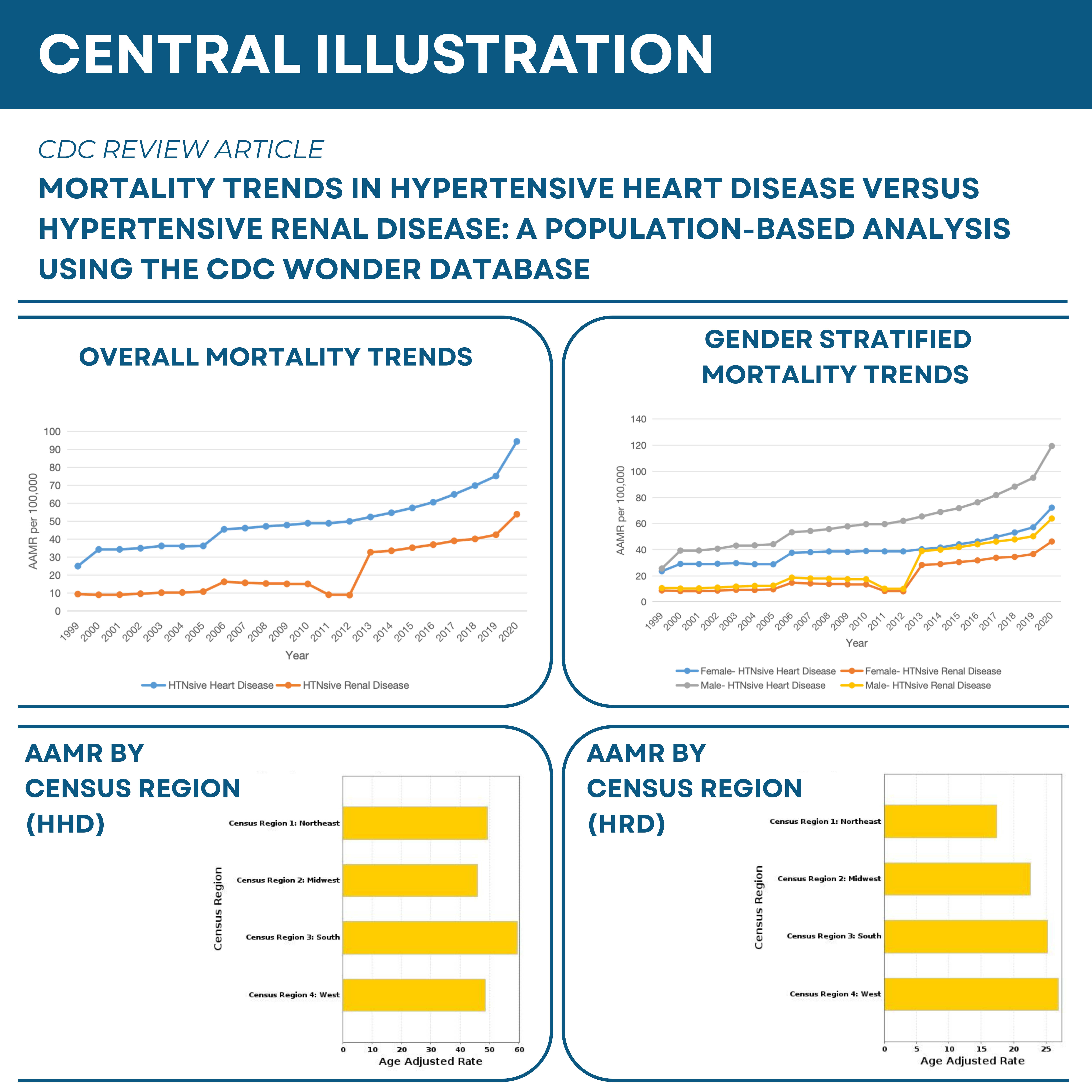
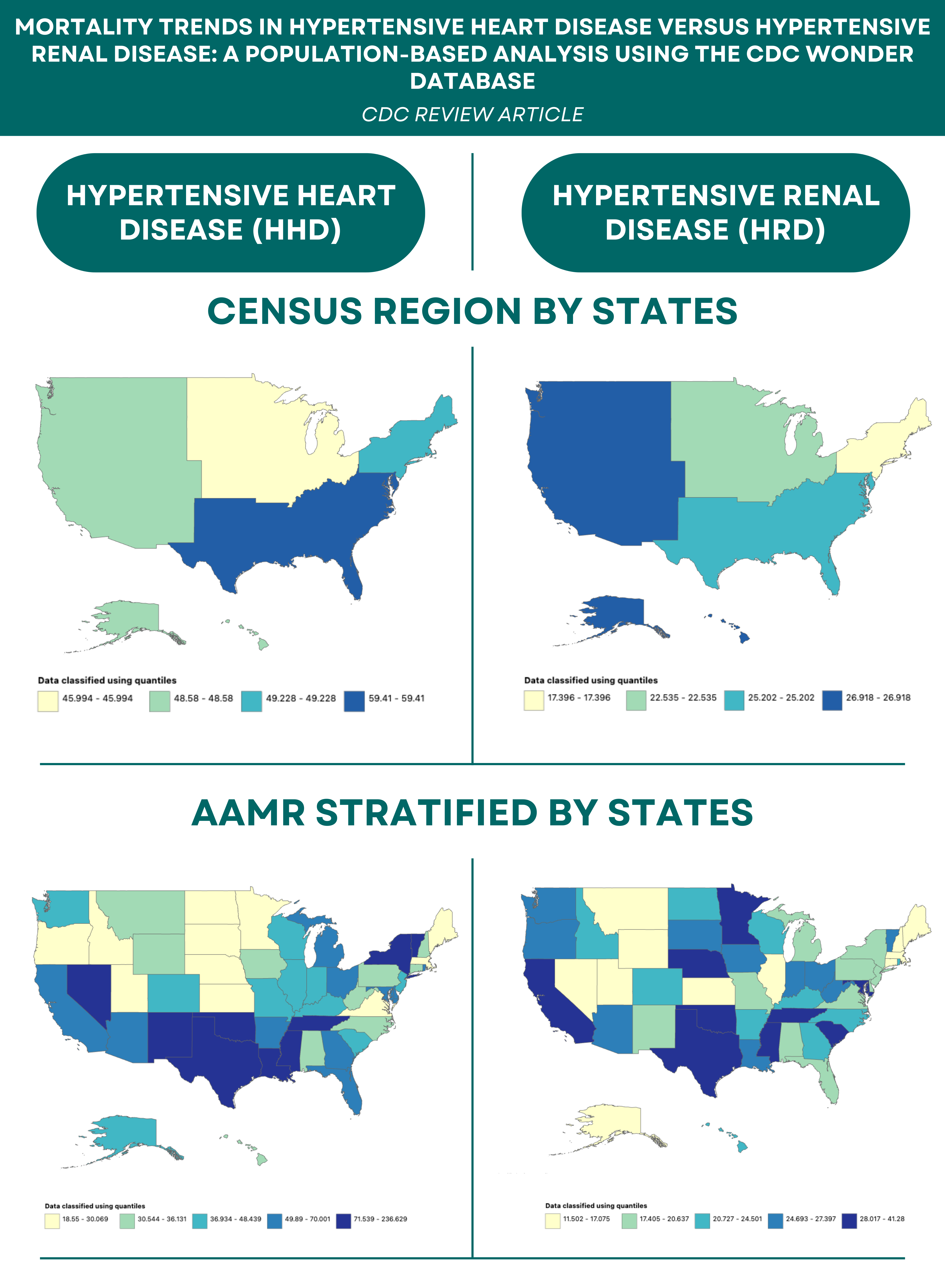
Abstract Body: Introduction: Hypertension is the leading cause of morbidity and mortality globally. Its two major complications hypertensive heart disease (HHD) and hypertensive renal disease (HRD) contribute significantly to the burden of cardiovascular and renal mortality. This study aims to analyze and compare national mortality trends for HHD and HRD in the United States using the CDC WONDER database. Methods: A retrospective analysis was conducted using CDC WONDER Multiple Cause of Death data from 1999 to 2023. Mortality attributed to HHD (ICD-10 codes I11.0–I11.9) and HRD (ICD-10 codes I12–I12.9) were extracted. Age-adjusted mortality rates (AAMRs) per 100,000 standardized to the U.S population were calculated for different subgroups, including years, gender, age, race, 2013 Census Regions and Urbanization zones. Average annual percent change (AAPC) was estimated using Joinpoint regression analysis to determine temporal trends, with statistical significance set at p < 0.05. Results: From 1999 to 2020, HHD caused nearly twice as many deaths as HRD (1,188,467 vs. 606,200). AAMR for HHD increased significantly from 24.99 to 94.53 (AAPC: 5.39%, p<0.0001), with a sharp acceleration post-2018 (APC: 18.10%, p=0.008). HRD mortality rose more rapidly (AAPC: 9.95%, p<0.0001), increasing from 9.40 to 53.93. Regional disparities were notable, with the South having the highest HHD burden (AAMR: 112.88 in 2020). Males exhibited higher HHD mortality than females, though females saw a steeper post-2018 surge (APC: 18.97%, p=0.012). Rural areas had higher mortality increases for both conditions (HHD APC: 13.97%; HRD APC: 11.72%, p<0.000001). Age-stratification revealed a mortality rise in the 45–64 and 65+ age groups post-2017, with the latter experiencing a sixfold increase in HRD mortality. American Indian or Alaska Natives had the highest HHD AAPC (9.51%, 95% CI: 8.18–10.85, p<0.0001), and African Americans showed elevated HHD mortality rates (169.92) in 2020 with AAPC: 2.82% (95% CI: 1.56–4.10, p<0.0001). Whites led HRD AAPC was 11.89% (95% CI: 9.76 -- 14.05, p<0.0001). Conclusions: This study reveals a significant and accelerating rise in mortality from hypertensive heart disease (HHD) and hypertensive renal disease (HRD) in the U.S., with HRD increasing at a faster rate. Striking disparities were observed across regions, sexes, age groups, and racial/ethnic populations, with rural areas and American Indian/Alaska Native and African Americans being disproportionately affected.
Sabri, Muhammad
(
Abington Jefferson Hospital
, Horsham , Pennsylvania , United States )
Siddiqui, Erum
(
jinnah sindh medical university
, KARACHI , Pakistan )
Zubair, Ali
(
Sheikh Zayed medical college
, Khanewal , Pakistan )
Iqbal, Muhammad
(
Sheikh Zayed medical college
, Khanewal , Pakistan )
Dad, Allah
(
Shiekh Zayed Medical College
, Rahim Yar Khan , Pakistan )
Arham, Muhammad
(
Sheikh Zayed Medical College, RYK
, Rahim Yar Khan , Pakistan )
Hamdani, Syed Shah Qasim
(
Southern Illinois University
, Springfield , Illinois , United States )
Tareen, Muiz Khan
(
HCA Medical City Arlington
, , Arlington , Texas , United States )
Akram, Muhammad Rizwan
(
Bronxcare Health System
, , Bronx, , New York , United States )
Bakht, Kinza
(
Sheikh Zayed Medical college Ryk
, Rahim yar khan , Pakistan )
Shehryar, Muhammad
(
Icahn school of medicine at Mount Sinai / NYC Health and Hospitals
, Queens , New York , United States )
Collins, Matthew
(
Abington Jefferson Hospital
, Horsham , Pennsylvania , United States )
Haas, Donald
(
Abington Jefferson Health
, Abington , Pennsylvania , United States )
Author Disclosures:
Muhammad Sabri:DO NOT have relevant financial relationships
| Muhammad Rizwan Akram:No Answer
| Kinza Bakht:DO NOT have relevant financial relationships
| Muhammad Shehryar:No Answer
| Matthew Collins:No Answer
| Donald Haas:DO NOT have relevant financial relationships
| Fahad Saleem:DO NOT have relevant financial relationships
| Erum Siddiqui:DO NOT have relevant financial relationships
| Ali Zubair:DO NOT have relevant financial relationships
| Muhammad Iqbal:No Answer
| Allah Dad:No Answer
| Muhammad Arham:DO NOT have relevant financial relationships
| Syed Shah Qasim Hamdani:DO NOT have relevant financial relationships
| Muiz Khan Tareen:DO NOT have relevant financial relationships
Sabri Muhammad, Akram Muhammad Rizwan, Abdul Malik Mohammad Hamza Bin, Ramirez Rachel, Collins Matthew, Ahmad Malik Maaz, Raza Soban, Saleem Fahad, Arham Muhammad, Dad Allah, Haider Faseeh, Hamdani Syed Shah Qasim, Tareen Muiz Khan
4358683_File000000.jpg
4358683_File000001.jpg
You have to be authorized to contact abstract author. Please, Login