
Logo

American Heart Association

  53
  0


Final ID: FR558

Effect of Rice Diet on Survival and Retinal Healing in Patients with Malignant Hypertension

Abstract Body: Background
Malignant hypertension (MH)—severe hypertension accompanied by retinal hemorrhage (Class III), or both hemorrhage and papilledema (Class IV)—was highly lethal. In 1939, median survival of untreated Class III and IV MH were 520 and 160 days, respectively. Walter Kempner introduced a strict, very low sodium (~200 mg/day), protein (~5% calories), and fat (~5% calories) “Rice Diet” (RD) in the 1940s. Patients were longitudinally documented, also with retinal images. We retrospectively assessed survival in MH patients treated with RD and how systolic blood pressure (SBP) reduction and diet adherence associate with survival.
Methods
We curated a cohort of 544 adults treated from 1942-1988 (aged 19–81) with SBP ≥170 mmHg and retinal hemorrhage and/or papilledema. Patients with diabetes, brain tumor, sympathectomy, or who consumed the RD for <7 days were excluded. Urinary chloride (UCl) was monitored regularly for RD adherence. Survival data was available in 452 patients and retinal outcomes in 369.
Results
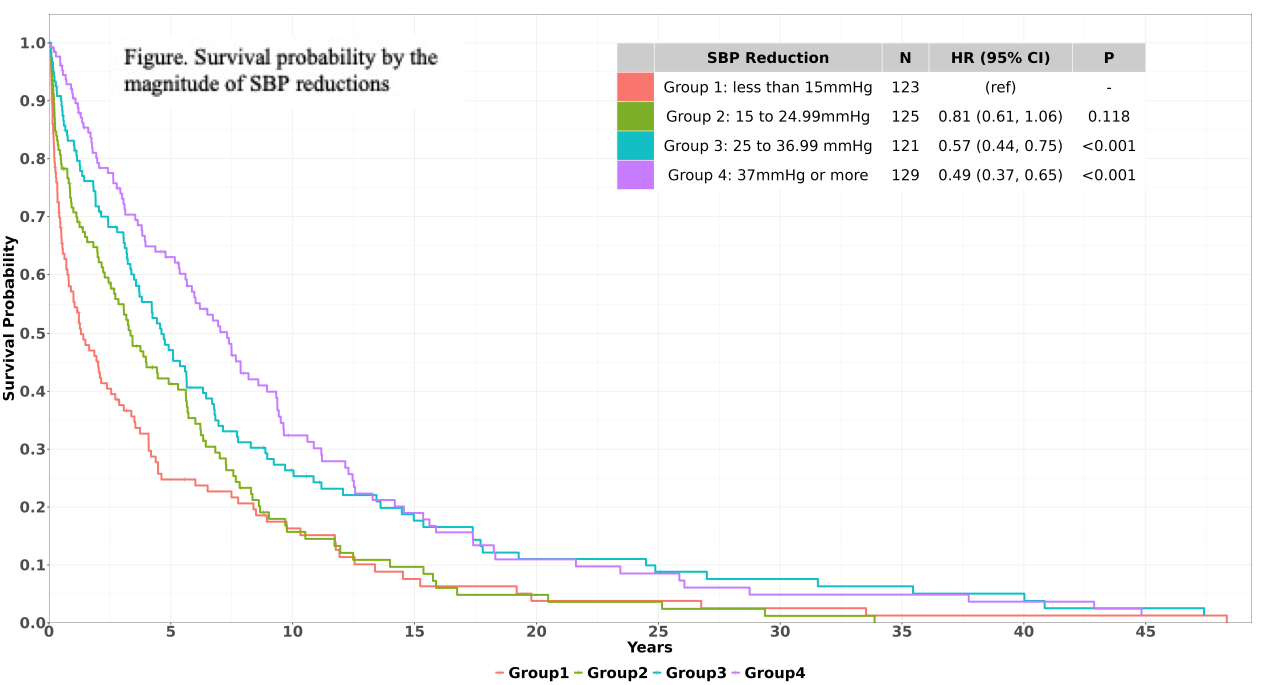
Patients were mostly male (68.9%) with median baseline SBP 213 mmHg and BMI 23.7 kg/m2. Retinal hemorrhage resolved in nearing 90% of patients by 360 days after starting the RD; hemorrhage failed to resolve in ~10% of patients. Papilledema cleared in 108 of 112 patients (96.4%) who survived >=one year. Class IV had clearly shorter median survival (~510 days) than Class III (~1860 days), but both groups survived longer than similar patients described by Keith, Wagener and Barker in 1939 (median survivals were ~180 and ~540 days, respectively). UCl dropped from 217 to 21 mg/dL within 4 weeks, indicating good diet adherence, and greater UCl reduction was associated with greater SBP reduction. Figure shows the hazard ratio (HR) for mortality over entire follow-up versus the magnitude of SBP change over the first 28 days of RD. In comparison to those with <15mmHg SBP reduction, patients with >=25mmHg reduction had significantly lower HR for mortality. Survival was significantly worse in Class IV with both hemorrhage and papilledema than with either alone, suggesting additive impact of vascular and optic nerve injury.
Conclusions
The RD intervention improved survival and retinal recovery in MH, even without the use of antihypertensive medications. Diet adherence was associated with SBP reduction. The survival benefit improved as SBP reduction increased. These findings underscore the effectiveness of intensive dietary intervention in managing severe hypertension.
  • Neelon, Francis  ( Duke University School of Medicine , Durham , North Carolina , United States )
  • Luft, Friedrich  ( EXPERIMENTAL AND CLINICAL RESEARCH , Berlin , Germany )
  • Klemmer, Philip  ( University of North Carolina at Chapel Hill , Chapel Hill , North Carolina , United States )
  • La, Jong Ok  ( Duke University School of Medicine , Durham , North Carolina , United States )
  • Li, Yi-ju  ( Duke University School of Medicine , Durham , North Carolina , United States )
  • Mcdowel, William  ( Duke University School of Medicine , Durham , North Carolina , United States )
  • Bohannon, Anastacia  ( Duke University School of Medicine , Durham , North Carolina , United States )
  • Sanoff, Scott  ( Duke University School of Medicine , Durham , North Carolina , United States )
  • Lin, Pao-hwa  ( Duke University School of Medicine , Durham , North Carolina , United States )
  • Author Disclosures:
    Francis Neelon: No Answer | Friedrich Luft: DO NOT have relevant financial relationships | Philip Klemmer: DO NOT have relevant financial relationships | Jong ok La: DO NOT have relevant financial relationships | Yi-Ju Li: No Answer | William McDowel: No Answer | Anastacia Bohannon: DO NOT have relevant financial relationships | Scott Sanoff: DO NOT have relevant financial relationships | Pao-Hwa Lin: DO NOT have relevant financial relationships
Meeting Info:
Session Info:

Poster Session 2 with Breakfast Reception

Friday, 09/05/2025 , 09:00AM - 10:30AM

Poster Session

More abstracts on this topic:
Co-Created Intervention Promotes Uptake of Low Sodium Iodized Salt Substitute to Control Hypertension: Results from a Large Community-based Quasi-Experimental Study from India

Srinivasapura Venkateshmurthy Nikhil, Mohan Sailesh, Dubey Manisha, Sehgal Reena, Jarhyan Prashant, Khatkar Rajesh, Konkati Shiva Prasad, Sharma Manika, Ide Nicole, Prabhakaran Dorairaj

Adherence to Dutch dietary guidelines and long-term mortality risk in post-myocardial infarction patients of the Alpha Omega Cohort

Cruijsen Esther, Van Damme Iris, Visseren Frank, Geleijnse Johanna

More abstracts from these authors:
Lifelong Training Mitigates Age-Related Vascular Stiffness Independent Of Blood Pressure

Kloesges Lukas, Tank Jens, Moestl Stefan, Giri Badri, Draeger Rabea, Kennes Lieven, Pesta Dominik, Luft Friedrich, Jordan Jens, Gollasch Maik

Survival trajectories of the patients with malignant hypertension in the Rice Diet Program

Luft Friedrich, Neelon Francis, Klemmer Philip, Mcdowel William, Bohannon Anastacia, Sanoff Scott, Lin Pao-hwa

You have to be authorized to contact abstract author. Please, Login
Not Available