
Microglia Depletion Mitigates Sympathetic Hyperactivity in Chronic Kidney Disease
Abstract Body: Introduction Excess sympathetic nerve activity (SNA) is a key contributor to cardiovascular mortality in chronic kidney disease (CKD). However, the mechanisms driving excess SNA in CKD remain unclear. Emerging evidence links CKD to immune and cerebrovascular dysfunction. However, the role of microglia activation and subsequent neuroinflammation has never been explored.
Hypothesis We hypothesize that microglial activation drives SNA in CKD.
Methods C57/BL6 mice (18-22gm, 8-11 weeks old) were randomized into groups as below: 0.2% adenine in casein (CKD), casein-only diet (Control), and 0.2% adenine + PLX 3397 (CKD and microglia depletion) for 2/4 weeks. Serum creatinine and cystatin C levels were used for assessing renal function. SNA was assessed by heart rate variability (Low Frequency/High-Frequency ratio) and catecholamine levels (ELISA). Cerebral perfusion and neurovascular coupling were assessed by Laser speckle contrast imaging (LSCI) and whisker stimulation test. Microglia phenotyping was done via flow cytometry. Neuroinflammation was evaluated by immunofluorescence and Luminex cytokine/chemokine array.
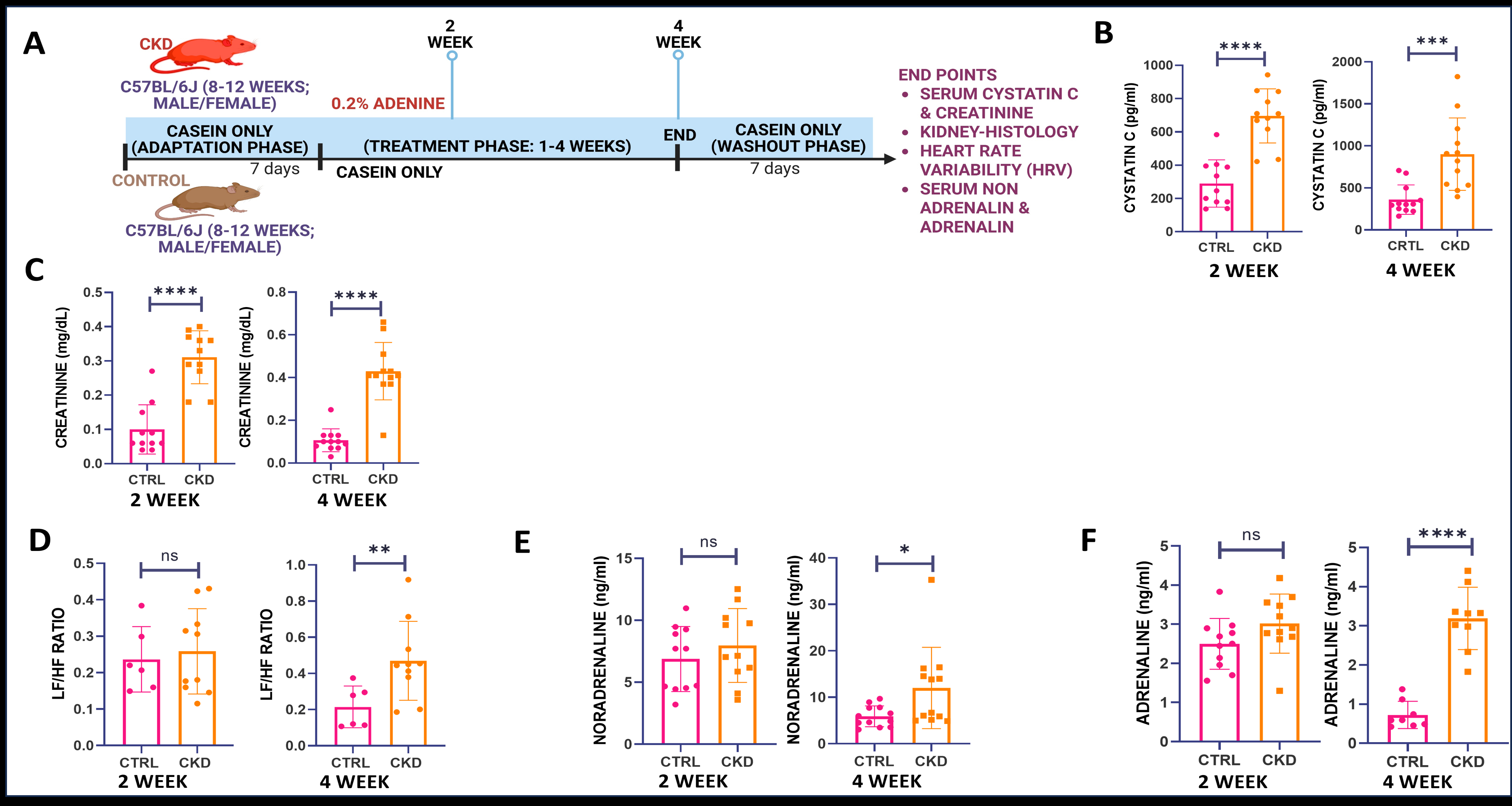
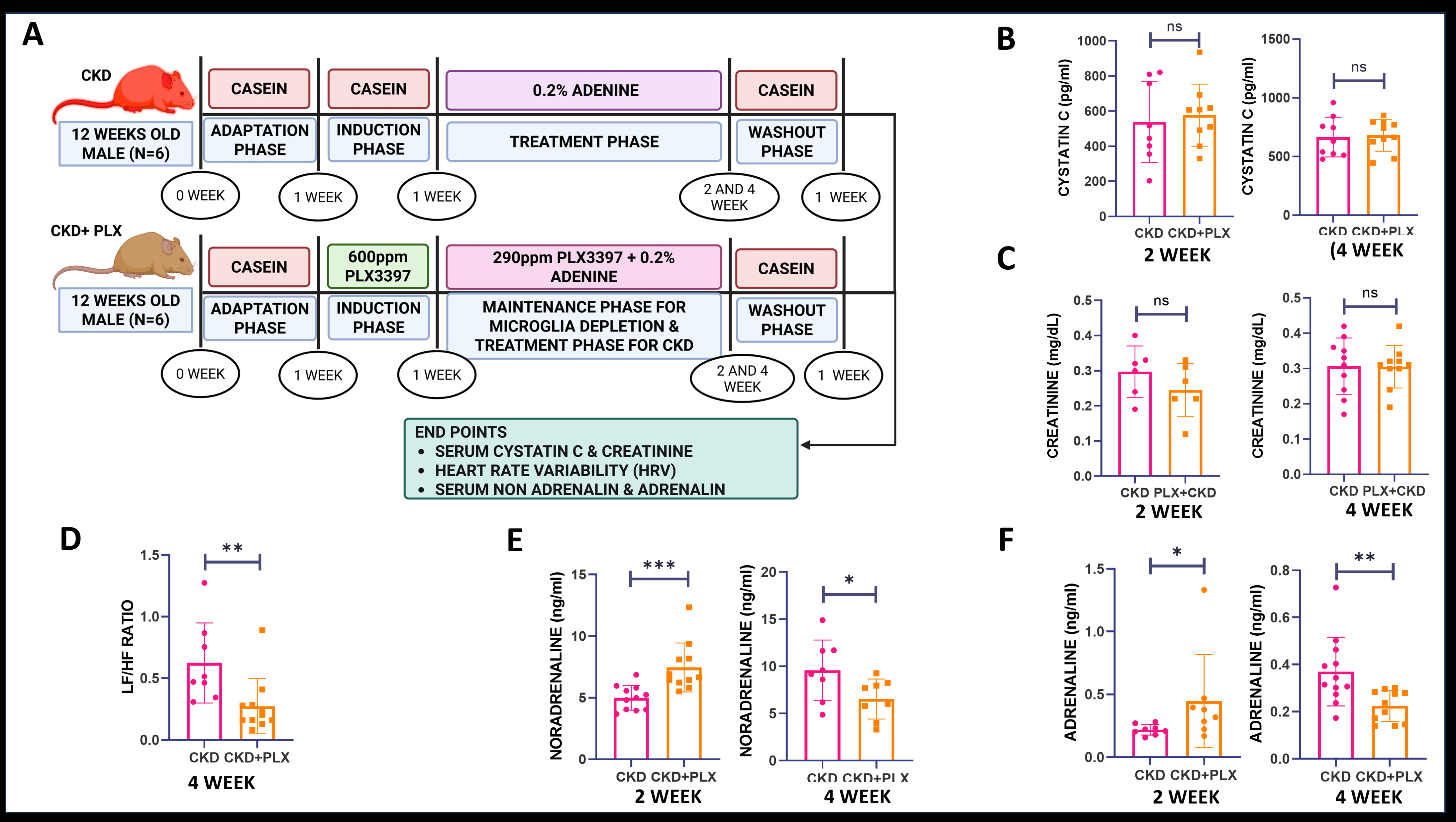
Results The adenine diet induced significant CKD by 2 weeks. No significant differences in SNA were observed at 2 weeks but by 4 weeks SNA was significantly increased in CKD mice LF/HF ratio (0.46 ± 0.10 in CKD vs. 0.21 ± 0.05 in controls; P = 0.02). Importantly, LSCI and whisker stimulation testing revealed no significant changes in cerebral perfusion or neurovascular coupling between CKD and control groups. Changes in microglia were evident as early as 2 weeks with CKD mice showing an activated microglia phenotype (CD11b+ P2RY12+ CD86+ / CD11b+ P2RY12+ CD45HIGH CD86+) (P = 0.001/0.045). Microglial accumulation was particularly evident in brain regions governing sympathetic output. Microglia specific chemokine, RANTES significantly increase in CKD by 2/4 week. Notably, microglial depletion significantly reduced SNA in CKD mice by week 4 (LF/HF: 0.23 ± 0.11 in CKD + PLX3397 vs. 0.54 ± 0.22 in CKD alone; P = 0.0087).
Conclusion(s) These findings demonstrate that CKD is associated with early microglial activation and subsequent neuroinflammation in brain regions regulating sympathetic tone. This neuroimmune activation precedes and contributes to heightened SNA, independent of neurovascular dysfunction. Microglial depletion attenuates sympathetic overactivity, identifying microglia as a mechanistic driver of excess SNA in CKD and a potential therapeutic target.
Sharma, Swati
( Louisiana State Uni Health Sci Ctr
, New Orleans
, Louisiana
, United States
)
Zahra, Walia
( LSU-HSC
, New orleans
, Louisiana
, United States
)
Mcternan, Patrick
( LSUHSC
, New Orleans
, Louisiana
, United States
)
Paloczi, Janos
( NIH
, New Orleans
, Louisiana
, United States
)
Biose, Ifechukwude
( LSU Health Sciences Center
, New Orleans
, Louisiana
, United States
)
Dhanesha, Nirav
( LSU Health Shreveport
, Shreveport
, Louisiana
, United States
)
Mohandas, Rajesh
( LSU Health Science Center NO
, New Orleans
, Louisiana
, United States
)
Author Disclosures:
Swati Sharma:DO NOT have relevant financial relationships
| Walia Zahra:DO NOT have relevant financial relationships
| Patrick McTernan:No Answer
| Janos Paloczi:No Answer
| Ifechukwude Biose:No Answer
| Nirav Dhanesha:DO NOT have relevant financial relationships
| Rajesh Mohandas:No Answer