Adherence to Antihypertensive Medication Varies by Insurance Status in US Adults: The Behavior Risk Factor Surveillance System (BRFSS) Study (2019-2023)
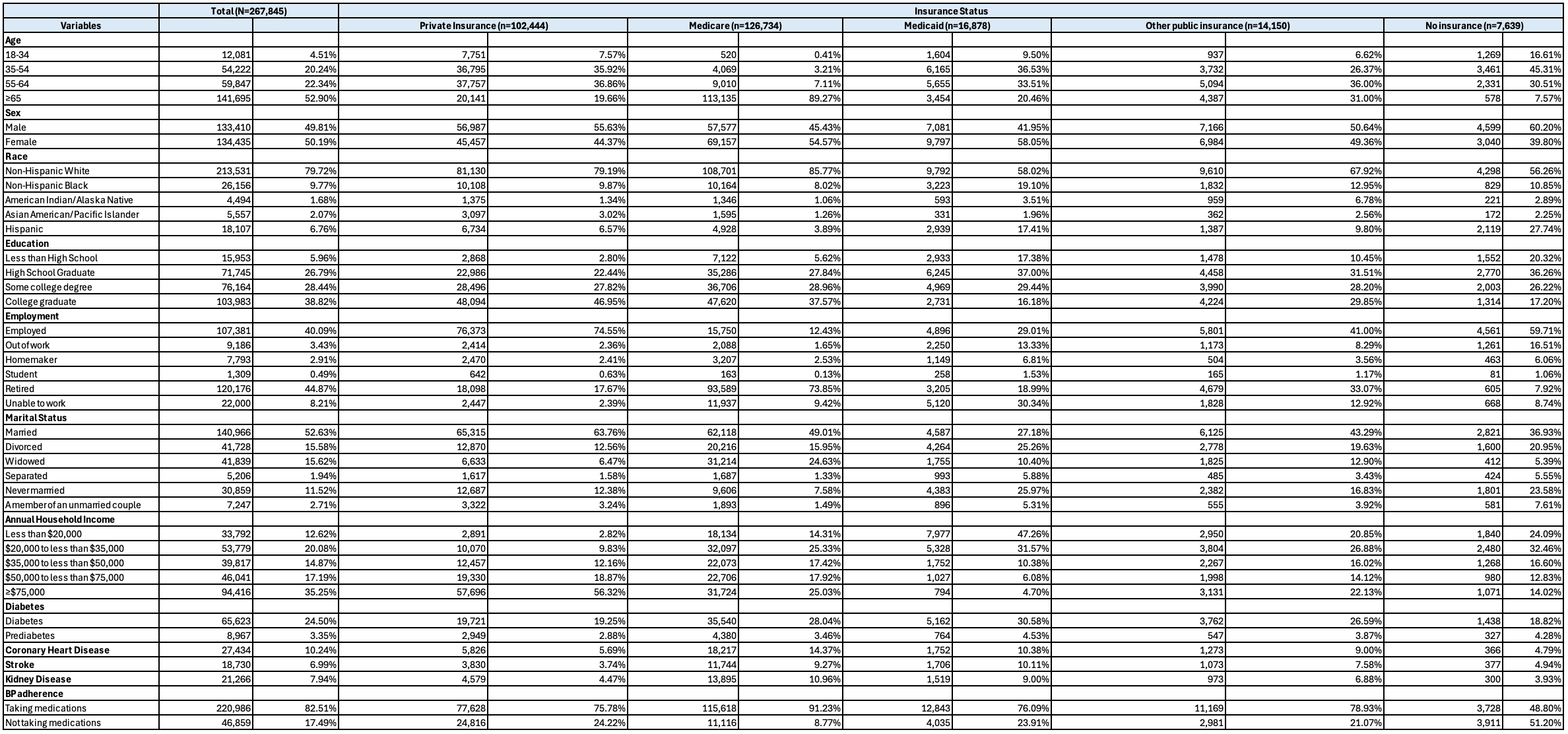
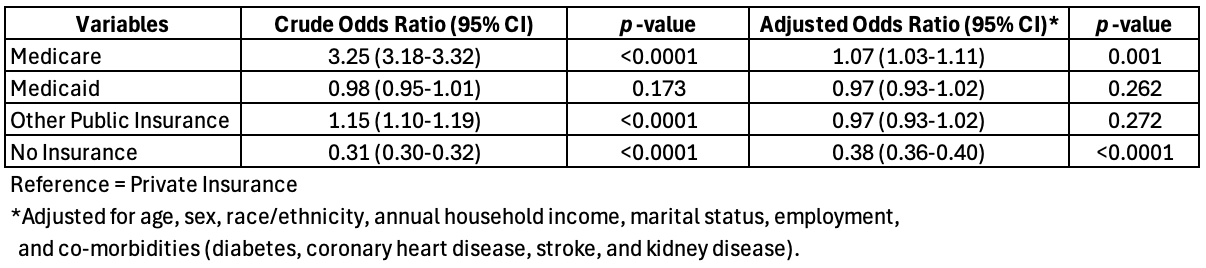
Abstract Body: Introduction: Hypertension (HTN) is a common cardiovascular disease that may require individuals to take multiple daily medications. Medication adherence may be associated with an individual’s access and their insurance status. Objective: To examine whether adherence to antihypertensive medications varies by insurance status among adults with HTN in the 2019-2023 Behavior Risk Factor Surveillance System (BRFSS) Study. Methods: We conducted a cross-sectional analysis of U.S. adults enrolled in BRFSS surveys in 2019, 2021, and 2023, years in which medication adherence questions were asked. The primary outcome was self-reported adherence to antihypertensive medications. Insurance status was our primary exposure and was categorized as private insurance (employer- or self-provided), Medicare, Medicaid, other public insurance, or no insurance. We preformed descriptive statistics for the study population and by insurance status. We used multivariable logistic regression to estimate crude and adjusted odds ratios, controlling for age, sex, race/ethnicity, annual household income, marital status, employment, and co-morbidities (diabetes, coronary heart disease, stroke, and kidney disease). The model was assessed for multicollinearity. The STATA 18.5 software was used for data analyses. Results: Among 267,845 participants with HTN, 38.25% had private insurance, 47.32% had Medicare, 6.30% had Medicaid, 5.28% had other public insurance, and 2.85% had no insurance. Non-adherence rates were highest among participants without insurance (51.20%), compared to 24.22% on private insurance, 8.77% on Medicare, 23.91% on Medicaid, and 21.07% on other public insurance (p < 0.0001). After adjustment, Medicare beneficiaries had higher odds of adherence (OR 1.07, 95% CI 1.03-1.11, p = 0.001), while underinsured individuals had lower odds (OR 0.38, 95% CI 0.36-0.40, p < 0.0001) compared to participants with private insurance. No statistically significant differences in adherence were observed between private insurance and Medicaid or other public insurance groups. Conclusions: Individuals with HTN on public insurance have similar or better adherence to antihypertensive medications compared to those with private insurance. However, individuals without insurance have a significantly lower odds of adherence. Insurance status plays an important role in determining adherence to antihypertensive medications, reinforcing the benefits of expanding insurance coverage.
Jurado Velez, Javier
(
UAB Heersink School of Medicine
, Birmingham , Alabama , United States )
Hidalgo, Bertha
(
UAB Ryals School of Public Health
, Birmingham , Alabama , United States )
Author Disclosures:
Javier Jurado Velez:DO NOT have relevant financial relationships
| Bertha Hidalgo:No Answer