
Logo

American Heart Association

  43
  0


Final ID: FR553

Sympathetic Transduction is not Augmented in Veterans with Post-Traumatic Stress Disorder

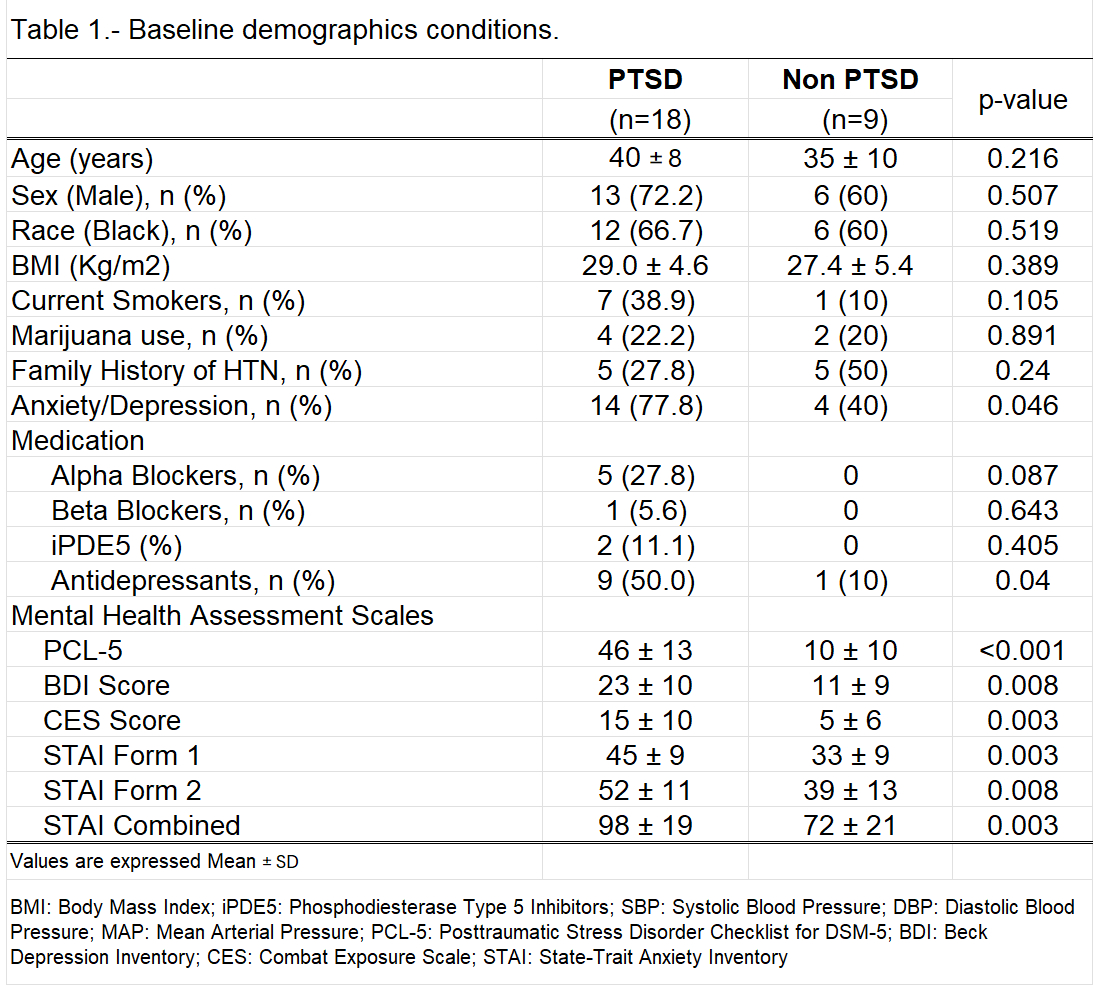
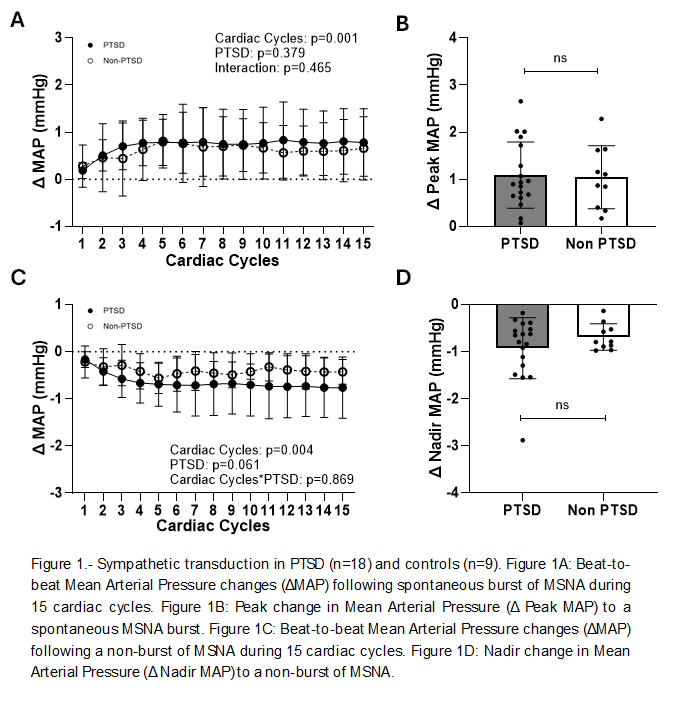
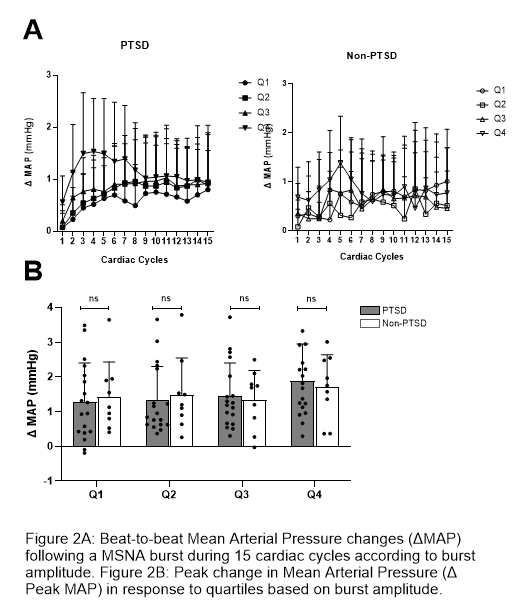
Abstract Body: Individuals with Post-Traumatic Stress Disorder (PTSD) have an overactive sympathetic nervous system (SNS) that is linked to a higher risk of developing hypertension and cardiovascular disease. Although prior work demonstrates higher SNS reactivity in PTSD, whether the vasoconstrictive response and the subsequent rise in blood pressure (BP) from sympathetic nerve activation (i.e., sympathetic transduction) is unclear. A higher BP response to SNS activation could contribute to cardiovascular risk in this population. Therefore, we tested the hypothesis that veterans with PTSD have higher sympathetic transduction than those without PTSD. Methods: Cross-sectional study involving 27 Veterans (n = 18 PTSD, 40 ± 8 yrs, n = 9 non-PTSD, 36 ± 9 yrs), matched by age and race, without medical comorbidities. Beat-to-beat BP (finger photoplethysmography), heart rate (electrocardiography) and muscle sympathetic nerve activity (MSNA; microneurography) were recorded at rest for 10 minutes. Sympathetic transduction was quantified using signal averaging, whereby the BP response to each MSNA burst was tracked over 15 cardiac cycles and averaged to derive the peak change in BP (ΔBP). To account for the potential influence of different amplitudes of MSNA bursts, the ΔBP to quartiles of normalized MSNA burst amplitudes were also analyzed. In a sub-set of participants (n = 14 PTSD, n = 4 non-PTSD) PTSD symptom severity was measured via the PTSD Checklist for DSM-5 (PCL-5). Independent t-tests were used to compare group means for resting hemodynamics, MSNA, and peak BP responses to bursts of MSNA. A general lineal regression model was used to determine group differences in beat-to-beat BP responses to MSNA bursts. Pearson correlations were performed to evaluate the relationship between resting MSNA, PCL-5 score, and sympathetic transduction. Results: Participants with PTSD had similar peak ΔBP following an MSNA burst compared with controls (1.16 ± 0.74 vs 0.98 ± 0.67; p= 0.53; Cohen’s d: -0.26). An increased MSNA burst amplitude caused a graded increase in BP, which was not different between groups (p > 0.05). Resting MSNA was negatively associated with sympathetic transduction only in PTSD (r= -0.49; p= 0.04). Sympathetic transduction was not associated with age, BMI or PCL-5. Conclusions: In otherwise healthy PTSD, sympathetic transduction at rest is not augmented. Thus, this mechanism alone is unlikely to explain the increased cardiovascular risk observed in this population.
  • Zanuzzi, Matias  ( Emory University School of Medicine , Atlanta , Georgia , United States )
  • Sabino-carvalho, Jeann  ( Emory University , Decatur , Georgia , United States )
  • Mcgranahan, Melissa J.  ( Emory University School of Medicine , Atlanta , Georgia , United States )
  • Park, Jeanie  ( Emory University School of Medicine , Atlanta , Georgia , United States )
  • Author Disclosures:
    Matias Zanuzzi: DO NOT have relevant financial relationships | Jeann Sabino-Carvalho: DO NOT have relevant financial relationships | Melissa J. McGranahan: No Answer | Jeanie Park: No Answer
Meeting Info:
Session Info:

Poster Session 2 with Breakfast Reception

Friday, 09/05/2025 , 09:00AM - 10:30AM

Poster Session

More abstracts on this topic:
Brain miR-410-3p Expression Sex-dependently Reduces Ang-II-induced Hypertension

Xia Huijing, Tarhriz Vahideh, Lazartigues Eric

Blunted Hemodynamic Reactivity to Acute Mental Stress in the Lab is Associated with Autonomic Inflexibility at Home

Shah Amit, Desai Shivang, Gold Matthew, Jain Vardhmaan, Yadalam Adithya, Razavi Alexander, Wiltshire Charis, Raggi Paolo, Pearce Brad, Quyyumi Arshed, Sameni Reza, She Hua, Bremner J Douglas, Clifford Gari, Vaccarino Viola, Elon Lisa, Roberts Tatum, Stefanos Lewam, Haddad George, Osei Jeffery, Suvada Kara, Okoh Alexis

More abstracts from these authors:
You have to be authorized to contact abstract author. Please, Login
Not Available