
Logo

American Heart Association

  30
  0


Final ID: Mo3065

Clinical Level of Endothelin-1 Causes ROCK2-Mediated Constriction of Porcine Coronary Arterioles Independent of Protein Kinase C Signaling

Abstract Body (Do not enter title and authors here): Background: Myocardial ischemia in the absence of obstructive coronary artery disease along with diminished coronary flow reserve is diagnostic for coronary microvascular dysfunction (CMD). Studies implicate vasoconstriction by endothelin-1 (ET-1) or through protein kinase C (PKC) activation in CMD development. However, the molecular signaling in coronary microvascular constriction to ET-1 and PKC is incompletely understood. Herein, coronary arteriolar constrictions to a clinical level of ET-1 and PKC activator phorbol 12,13-dibutyrate (PDBu) were directly characterized in vitro.

Aim: Determine roles of ET-1 receptors, extracellular Ca2+, Rho kinase isoforms, PKC, and myosin light chain phosphatase subunit MYPT1 in coronary arteriolar constrictions to ET-1 and PDBu.

Methods: The vasomotor response and signaling pathway of isolated and pressurized (60 cmH2O) pig coronary arterioles (<100 µm maximal diameter) to vasoconstrictors were studied using videomicroscopic, pharmacologic, and molecular tools.

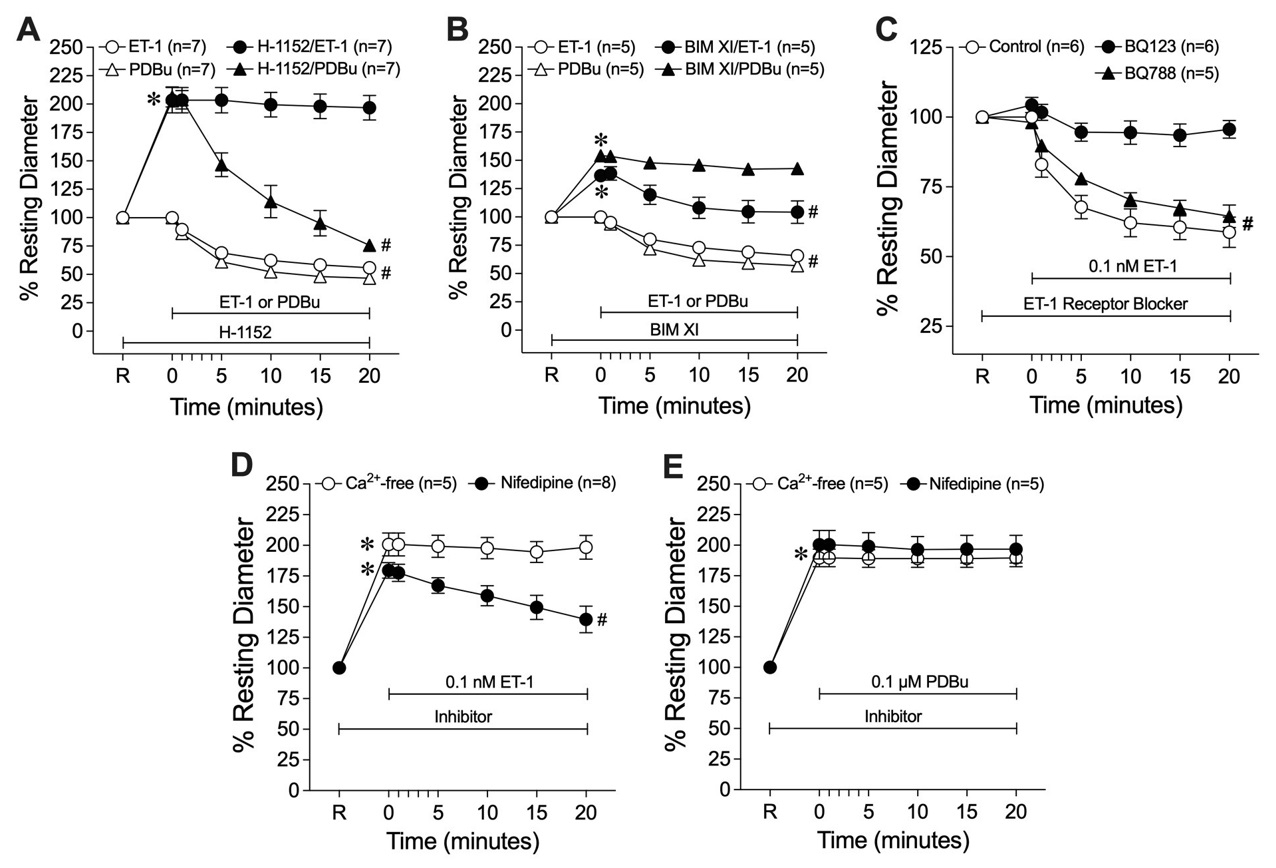
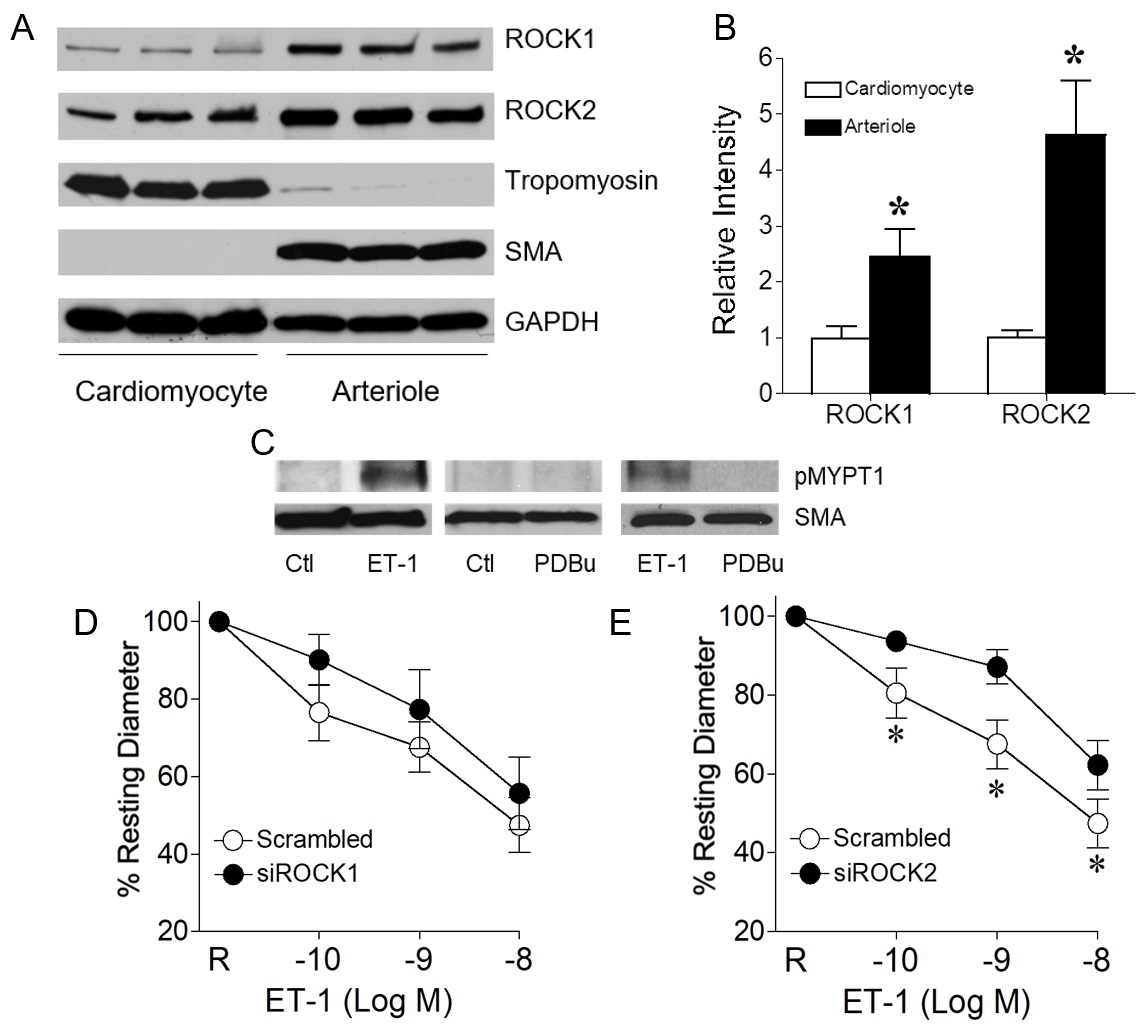
Results: Coronary arterioles developed basal tone with resting diameters (40-50 µm) about 50% of maximal diameters. ET-1 (0.1 nM) and PDBu (0.1 µM) evoked comparable degree of constriction. Without crossover effects, ROCK inhibitor H-1152 and broad-spectrum PKC inhibitor bisindolylmaleimide XI, abolished constriction to ET-1 and PDBu, respectively. Expression of ROCK2 was greater than ROCK1 in arterioles, and ROCK2 but not ROCK1 siRNA attenuated ET-1-induced constriction. Increased pMYPT1 (Thr850) was detected in ET-1-constricted but not PDBu-constricted arterioles. In the absence of extracellular Ca2+, arterioles lost basal tone and did not constrict to ET-1 and PDBu. In the presence of extracellular Ca2+, L-type voltage-operated Ca2+ channel (L-VOCC) blocker nifedipine abolished both basal tone and constriction to PDBu but did not alter constriction to ET-1. ETA receptor antagonist BQ123 but not ETB receptor antagonist BQ788 inhibited constriction to ET-1.

Conclusions: Our findings indicate divergent mechanisms for ET-1- and PKC-induced constriction of coronary arterioles. ET-1 binds to arteriolar ETA receptors and triggers extracellular Ca2+ entry. Subsequent activation of ROCK2 phosphorylates MYPT1 independent of PKC. By contrast, PKC activation linked to L-VOCCs independent of ROCK and MYPT1 elicits constriction. These insights suggest that ROCK2 and L-VOCCs may provide druggable targets in CMD associated with elevated ET-1 and PKC activation, respectively.
  • Lu, Guangrong  ( TAMU Health Science Center , Bryan , Texas , United States )
  • Xu, Xin  ( TAMU Health Science Center , Bryan , Texas , United States )
  • Kuo, Lih  ( TAMU Health Science Center , Bryan , Texas , United States )
  • Hein, Travis  ( TAMU Health Science Center , Bryan , Texas , United States )
  • Author Disclosures:
    Guangrong Lu: DO have relevant financial relationships ; Consultant:Fulgent Pharma:Active (exists now) ; Ownership Interest:Lucier Pharmaceuticals:Active (exists now) ; Individual Stocks/Stock Options:Chimerix:Past (completed) | Xin Xu: No Answer | Lih Kuo: No Answer | Travis Hein: No Answer
Meeting Info:

Scientific Sessions 2025

2025

New Orleans, Louisiana

Session Info:

Novel Biomarkers, Indices & Blood-Pressure Targets in Stable CAD

Monday, 11/10/2025 , 01:00PM - 02:00PM

Abstract Poster Board Session

More abstracts on this topic:
Carotid Body Paraganglioma Causing Arterial Splaying: A Case Report and Surgical Management of a Vascular Neck Mass

Kumar Nishal, Garlapati Sameer Krishna Prasad, Konakanchi Venkata Sai Bhargav Pradeep

Coronary Microvascular Disease Modulates Long-Term Outcomes in Myocardial Infarction with Non-Obstructive Coronary Arteries

Carrington Justin, Nogami Kai, Prasad Abhiram, Gulati Rajiv, Lerman Amir, Raphael Claire

You have to be authorized to contact abstract author. Please, Login
Not Available