
Logo

American Heart Association

  17
  0


Final ID: TAC118

Restructuring a Treat-To-Target Program In a Primary Care Setting To Improve Blood Pressure Control

Abstract Body: Introduction
NYC Health + Hospitals/Harlem implemented the Treat-to-Target (T2T) program in 2013 to improve hypertension (HTN) management. Persistent gaps in blood pressure (BP) control led to a 2023 restructuring focused on standardized workflows with staff retraining, validated BP measurements, accurate referrals, reminders, timely scheduling, and free home BP monitor distribution.

Hypothesis
We assessed the hypothesis that the restructuring of the T2T program improved overall patient capture and BP control rates.

Methods
This retrospective cohort study analyzed de-identified Electronic Health Record data from 1,901 adult primary care patients with uncontrolled HTN referred to T2T in two periods: pre-restructuring (July 2021–June 2022) and post-restructuring (July 2023–June 2024). Inclusion required a T2T specific referral with documented BP>140/90 mmHg and a primary diagnosis of HTN. Outcomes included number of T2T referrals, proportion seen within 3 and 6 months, and proportion achieving BP control (<140/90 mmHg) at follow-up. Simple logistic regression was used to assess outcomes.


Results
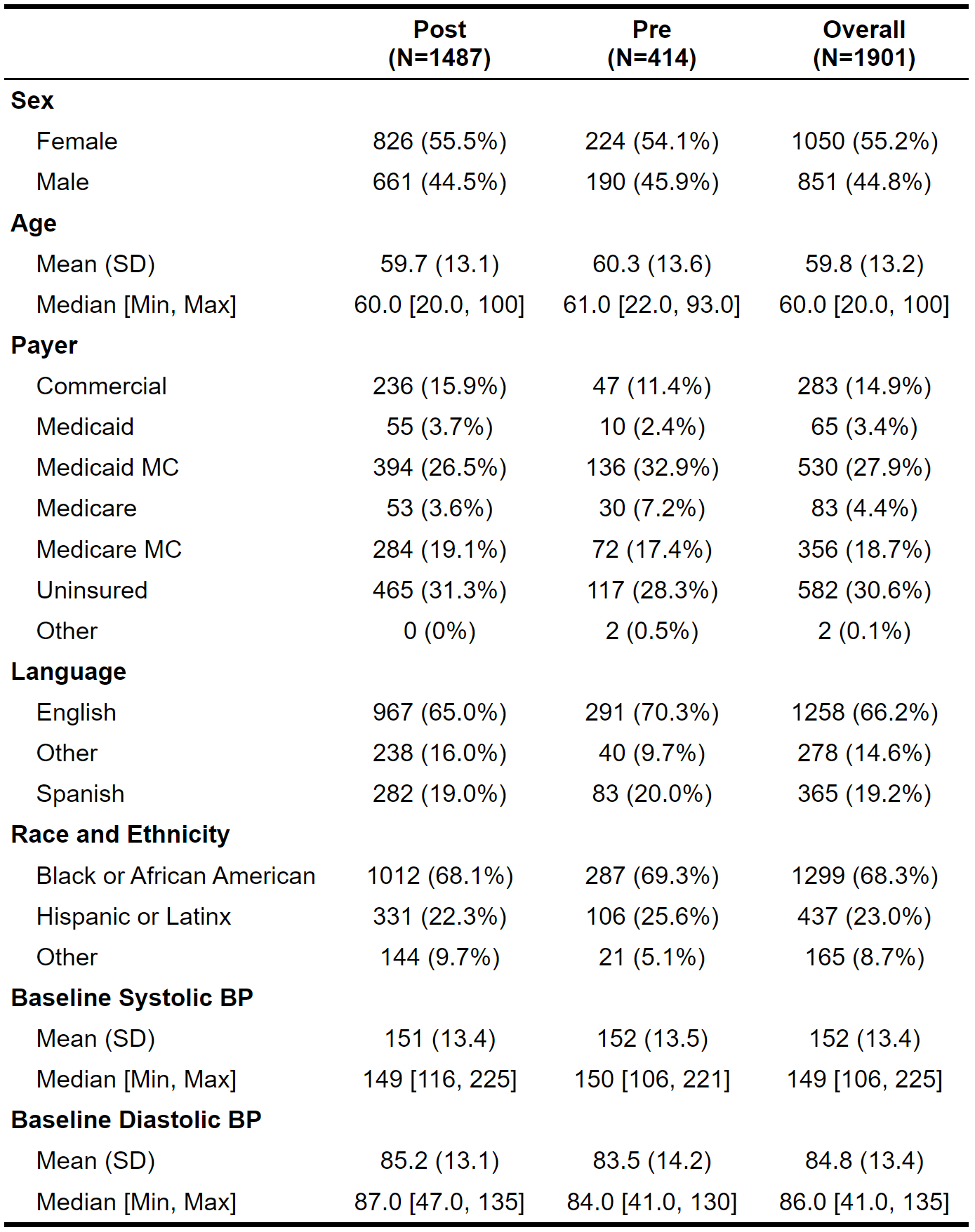
Demographics of the study cohort are shown in Table 1. Post-restructuring, there was a 3.6-fold increase in accurate referrals, reflecting improved capture and tracking fidelity. The proportion of patients seen at a T2T visit within 3 months of the referral decreased post-restructuring (pre: 55.3% vs post: 49.6%; OR 0.8 [0.64, 0.99]; p = 0.04), although the proportion with a documented BP during this time was unchanged (47.8% vs 46.7%) and more achieved BP control <140/90 (54.5% vs 62.9%; OR 1.41 [1.02, 1.94]; p = 0.03). By 6 months, follow-up rates were similar (59.2% vs 56.6%; OR 0.9 [0.72, 1.12]; p = 0.35) as was the proportion with a documented BP (35.5%) and BP control (58.5% vs 61.2%; OR 1.12 [0.77–1.63]; p = 0.56).


Conclusion
The 2023 restructuring led to a nearly fourfold increase in referral fidelity and improved BP control at 3 months. Despite a lower proportion of patients seen within 3 months, potentially due to limited workforce or patient attrition, the increase in patients with BP control demonstrates the program’s potential. Next steps will include efforts to support expanded follow-up, reduce attrition, and offer a scalable framework for other safety-net systems.

  • Phillips, Jerel  ( Harlem Hospital Center , Bronx , New York , United States )
  • Joson, Marquis Von Angelo Syquio Go  ( Harlem Hospital Center , Bronx , New York , United States )
  • Kogan, Stan  ( NYC DOHMH , Long Island City , New York , United States )
  • Thearle, Marie  ( Harlem Hospital Center , Bronx , New York , United States )
  • Ryan, Sarah  ( Columbia University , New York , New York , United States )
  • Author Disclosures:
    Jerel Phillips: DO NOT have relevant financial relationships | Marquis Von Angelo Syquio Go Joson: No Answer | Stan Kogan: No Answer | Marie Thearle: DO NOT have relevant financial relationships | Sarah Ryan: DO NOT have relevant financial relationships
Meeting Info:
Session Info:

Poster Session 1 and Reception (includes TAC Poster Competition)

Thursday, 09/04/2025 , 05:30PM - 07:00PM

Poster Session

More abstracts on this topic:
More abstracts from these authors:
You have to be authorized to contact abstract author. Please, Login
Not Available