
Logo

American Heart Association

  67
  0


Final ID: 029

Comprehensive Resistant Hypertension Clinic Improves Access to Care and Blood Pressure Control

Abstract Body: Resistant hypertension is a leading risk factor for adverse cardiovascular events including stroke, heart failure, and death. It is defined as blood pressure (BP) that remains above guideline-specified goals despite using maximum tolerated doses of at least three antihypertensives or controlled while on four or more. Given that this is a significant health crisis in regions that lack specialized programs, we established a Resistant Hypertension Clinic at an academic medical center to meet the needs of this high-risk patient population.

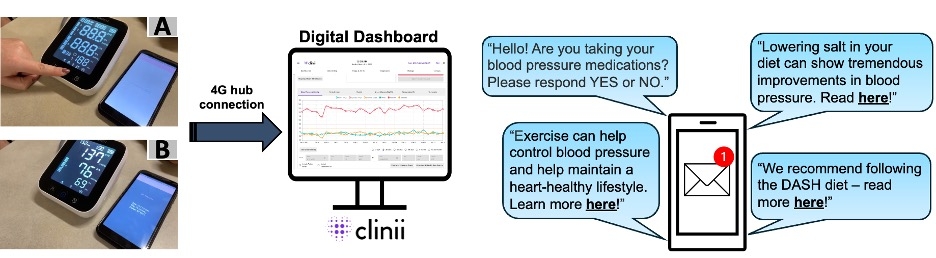
A population health-based registry was created to identify patients in large health systems who have uncontrolled BP while on three medications via EMR. A retrospective chart review was conducted to confirm that patients were appropriately identified. Their PCP then received a pended referral to Resistant Hypertension Clinic where patients are screened for secondary causes of hypertension, enrolled in remote BP monitoring and text-messaging for medication adherence, and evaluated for advanced therapies. The mean change in systolic BP and clinical outcomes were assessed longitudinally.

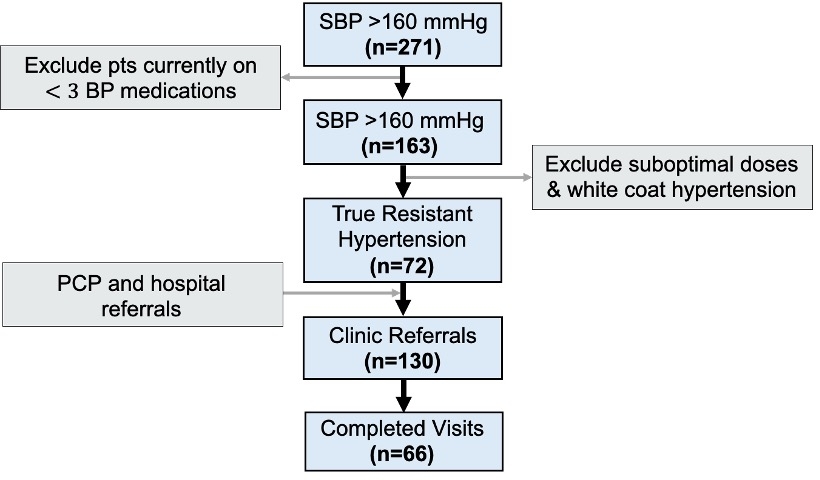
A cohort of 271 patients aged 29-86 years (66 ±15 years) with systolic BP above 160 mmHg while on three or more antihypertensives were screened. Those with suboptimal doses and white-coat hypertension were excluded and a total of 130 clinic referrals were received. Of those identified with resistant hypertension, only 24% had any workup for secondary causes, therefore, screening was initiated in 100% of referred patients. After completing 66 initial clinic visits, medication changes were implemented for 76% of patients, specialty referrals were made to nephrology or endocrinology for 30%, remote BP monitoring was offered to 26%, and advanced renal therapies including denervation, stenting and angioplasty were provided to 26%. Of those screened for secondary causes, elevated aldosterone/renin ratio (36%), documented obstructive sleep apnea (64%), and renal artery stenosis (20%) were detected. To date, 75% of patients have achieved BP control, with 65% experiencing 10 mmHg or more decrease in mean systolic BP.

These results reflect the positive impact of a health systems QI initiative. Here, we show the development and outcomes of a comprehensive program that increases screening for secondary causes, improves access to specialty care and helps patients take active control of their hypertension through remote BP monitoring and text-message reminders.
  • Vardanyan, Lilit  ( UC Davis School of Medicine , Sacramento , California , United States )
  • Atreja, Surabhi  ( UC Davis Medical Center , Sacramento , California , United States )
  • Yoon, Karis  ( UC Davis School of Medicine , Sacramento , California , United States )
  • Martinez-puente, Brenda  ( UC Davis School of Medicine , Sacramento , California , United States )
  • Zeb, Suhail  ( UC Davis School of Medicine , Sacramento , California , United States )
  • Acosta, Milan  ( UC Davis School of Medicine , Sacramento , California , United States )
  • Ta, Brian  ( UC Davis School of Medicine , Sacramento , California , United States )
  • Lwin, Yee May  ( UC Davis School of Medicine , Sacramento , California , United States )
  • Lee, Vivian  ( UC Davis School of Medicine , Sacramento , California , United States )
  • Sobol, Tim  ( UC Davis Medical Center , Sacramento , California , United States )
  • Author Disclosures:
    Lilit Vardanyan: DO NOT have relevant financial relationships | surabhi Atreja: No Answer | Karis Yoon: DO NOT have relevant financial relationships | Brenda Martinez-Puente: No Answer | Suhail Zeb: No Answer | Milan Acosta: DO NOT have relevant financial relationships | Brian Ta: No Answer | Yee May Lwin: No Answer | Vivian Lee: DO NOT have relevant financial relationships | Tim Sobol: No Answer
Meeting Info:
Session Info:

Concurrent A: TAC Oral Abstract Award Competition

Friday, 09/05/2025 , 10:30AM - 12:00PM

Oral Abstract TAC Award

More abstracts on this topic:
A Culturally Tailored mHealth Lifestyle Intervention Improves Diet and Physical Activity Self-Regulation Among African Americans

Lalika Mathias, Jenkins Sarah, Hayes Sharonne, Jones Clarence, Burke Lora, Cooper Lisa, Patten Christi, Brewer Laprincess

Ethnicity-Based Response in Systolic Blood Pressure Response in Post-Renal Denervation patients: A Meta-Analysis

Marlecha Pranay, Sahu Sweta, Nanjundappa Aravinda

You have to be authorized to contact abstract author. Please, Login
Not Available