
Logo

American Heart Association

  36
  0


Final ID: FR546

Microbiome Presence And Variability In Perivascular Adipose Tissue: A Whole-Genome Sequencing Study In SS-Dahl Rats.

Abstract Body: Introduction. Perivascular adipose tissue (PVAT) contains adipocytes and a stromal vascular fraction (SVF) with immune cells, such as macrophages and T lymphocytes, which influence adjacent vasculature through paracrine and immunomodulatory effects. The reason for immune cells in PVAT from certain vascular beds, such as the aorta and mesenteric, is not fully understood; are they resident or called to action? An unexplored factor is the microbiome—bacteria, viruses, or fungi—in PVAT. Building on the paradigm of gut microbiota-host immunity interactions, we propose that a resident microbial community may also exist in PVAT, particularly given the immune-rich SVF environment. We hypothesize that distinct bacterial and viral communities exist in healthy PVAT and would differ from non-PVAT adipose tissues. We aimed to identify PVAT microbiome communities from resistance and conductance vessels and compare them with non-PVAT tissues.
Methods. PVAT samples from thoracic aorta, abdominal aorta, and mesenteric resistance arteries, along with non-PVAT tissues (subscapular brown adipose tissue [BAT], retroperitoneal white adipose tissue [WAT]) and fecal samples, were collected aseptically from six male SS-Dahl Sprague Dawley rats. Two cohorts were sampled: rats 1–3 (euthanized in 2023) and 4–6 (euthanized in 2024). Samples were analyzed by CosmosID® via whole-genome shotgun sequencing. DNA extraction targeted the 16S rRNA gene for taxonomic classification. Analysis focused on relative microbial abundance (%).
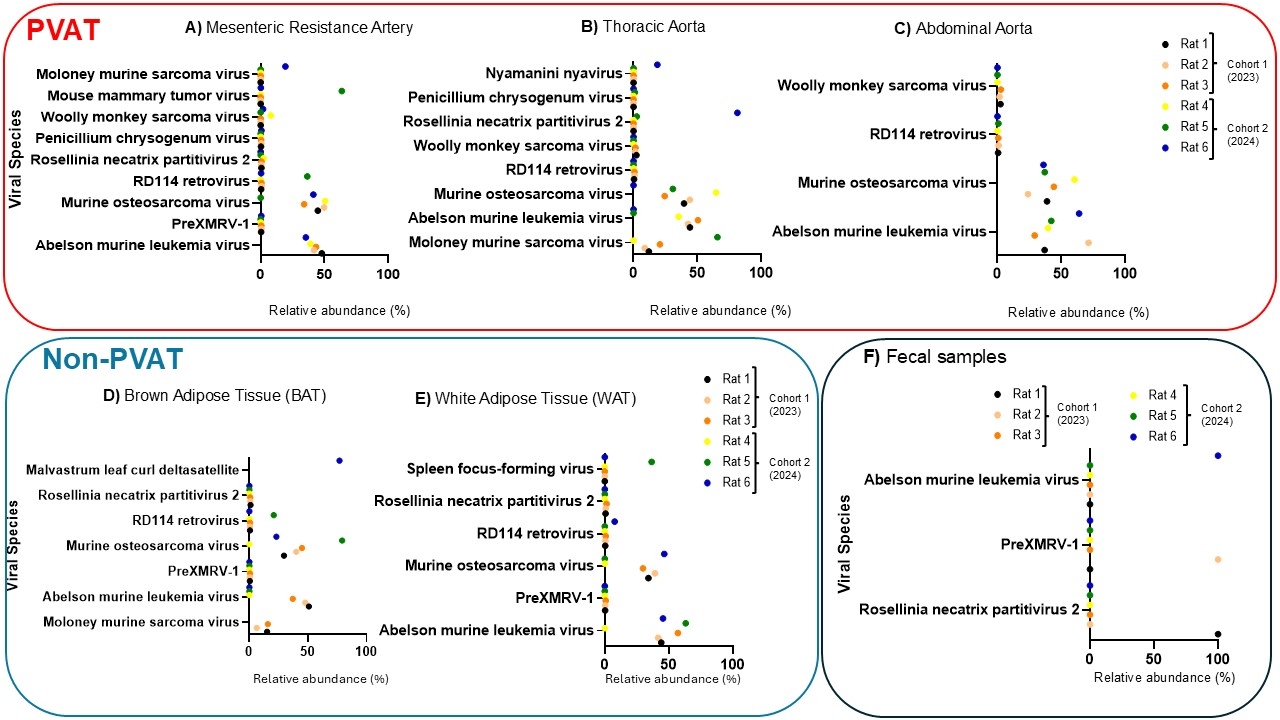
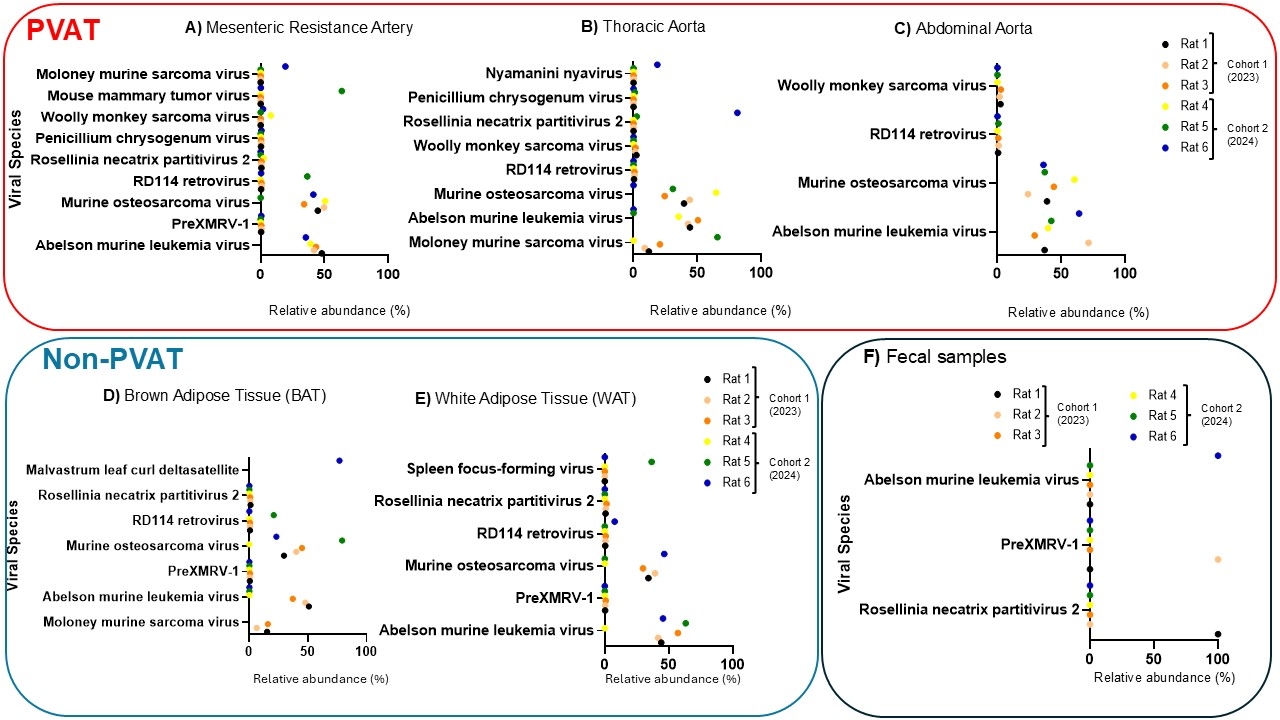
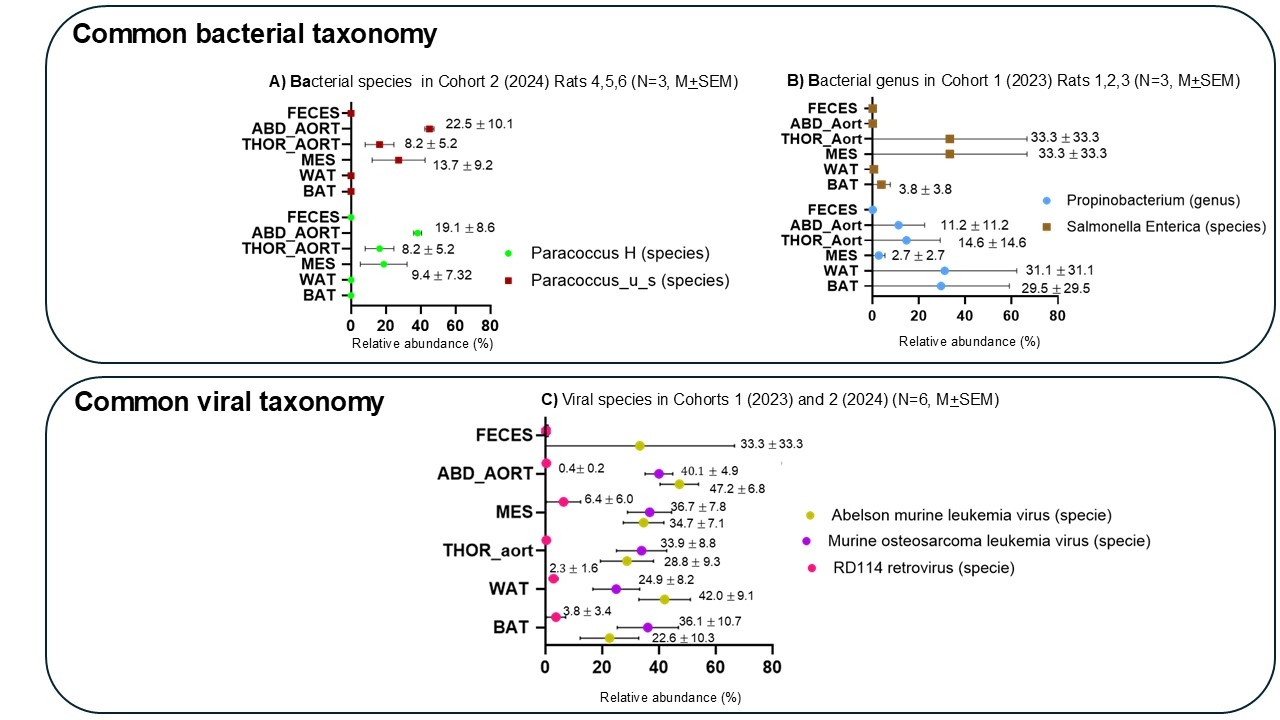
Results: Sequencing confirmed 16S rRNA virus and bacterial gene sequences in PVAT. Bacterial composition in PVAT showed cohort-specific variability, requiring stratification between the 2023 and 2024 cohorts, while viral composition was consistent. Non-PVAT tissues exhibited less variability than PVAT; fecal samples showed the least microbial variability (Figs.1-3).
Conclusions: PVAT harbors bacteria and viruses, with bacterial composition varying by collection timeframe, unlike stable viral profiles. Non-PVAT and fecal samples showed lower variability. These findings confirm a PVAT-specific microbiome and suggest one gap in the temporal influence of the presence and variety of viruses and bacteria. This is the first study to report microbiome presence in PVAT, laying the groundwork for future studies exploring PVAT-specific microbial influences on vascular biology and microbiome-immune interactions and their role in vascular homeostasis or dysfunction.
  • Mahimkar, Sameera  ( Michigan State University - MSU-COM , Clinton Twp , Michigan , United States )
  • Watts, Stephanie  ( MICHIGAN STATE UNIVERSITY , East Lansing , Michigan , United States )
  • Thompson, Janice  ( Michigan State University , East Lansing , Michigan , United States )
  • Bollampally, Murali  ( Idaho State University , Meridian , Idaho , United States )
  • Restini, Carolina  ( Michigan State University - MSU-COM , Clinton Twp , Michigan , United States )
  • Author Disclosures:
    Sameera Mahimkar: DO NOT have relevant financial relationships | Stephanie Watts: DO NOT have relevant financial relationships | Janice Thompson: DO NOT have relevant financial relationships | Murali Bollampally: No Answer | Carolina Restini: DO NOT have relevant financial relationships
Meeting Info:
Session Info:

Poster Session 2 with Breakfast Reception

Friday, 09/05/2025 , 09:00AM - 10:30AM

Poster Session

More abstracts on this topic:
Hepatic Autophagy Deficiency Increases ANGPTL4 Biosynthesis And Reduces Vascular Contractility Through Integrin Signaling in Spontaneously Hypertensive BPH/2J Mice

Bernardino De Paula Ricardo, Mccarthy Cam, Hyatt Miranda, Pernomian Laena, Waigi Emily, Willmore Carolyn, Townsend Jr Paul, Tomazini Goncalves Tiago, Webb R Clinton, Wenceslau Camilla

Markov Chain Modeling of Postoperative Hemodynamics and Vasoplegia After Cardiac Surgery Using a Novel Resistance Flow Ratio based State Definition

Patel Nikhil, Levin Matthew

More abstracts from these authors:
You have to be authorized to contact abstract author. Please, Login
Not Available