Determining the relationship between renal accessory and branching arteries with resistant hypertension: a case-control study
Abstract Body: Introduction: Renal accessory arteries originate at the aorta and deliver renal blood flow independent of the main renal artery, while renal artery branches originate from and their flow depends on the main renal artery. However, the clinical significance of accessory arteries remains unclear. We tested the hypothesis that characteristics of renal accessory and/or branching arteries morphology are linked to resistant hypertension (RH).
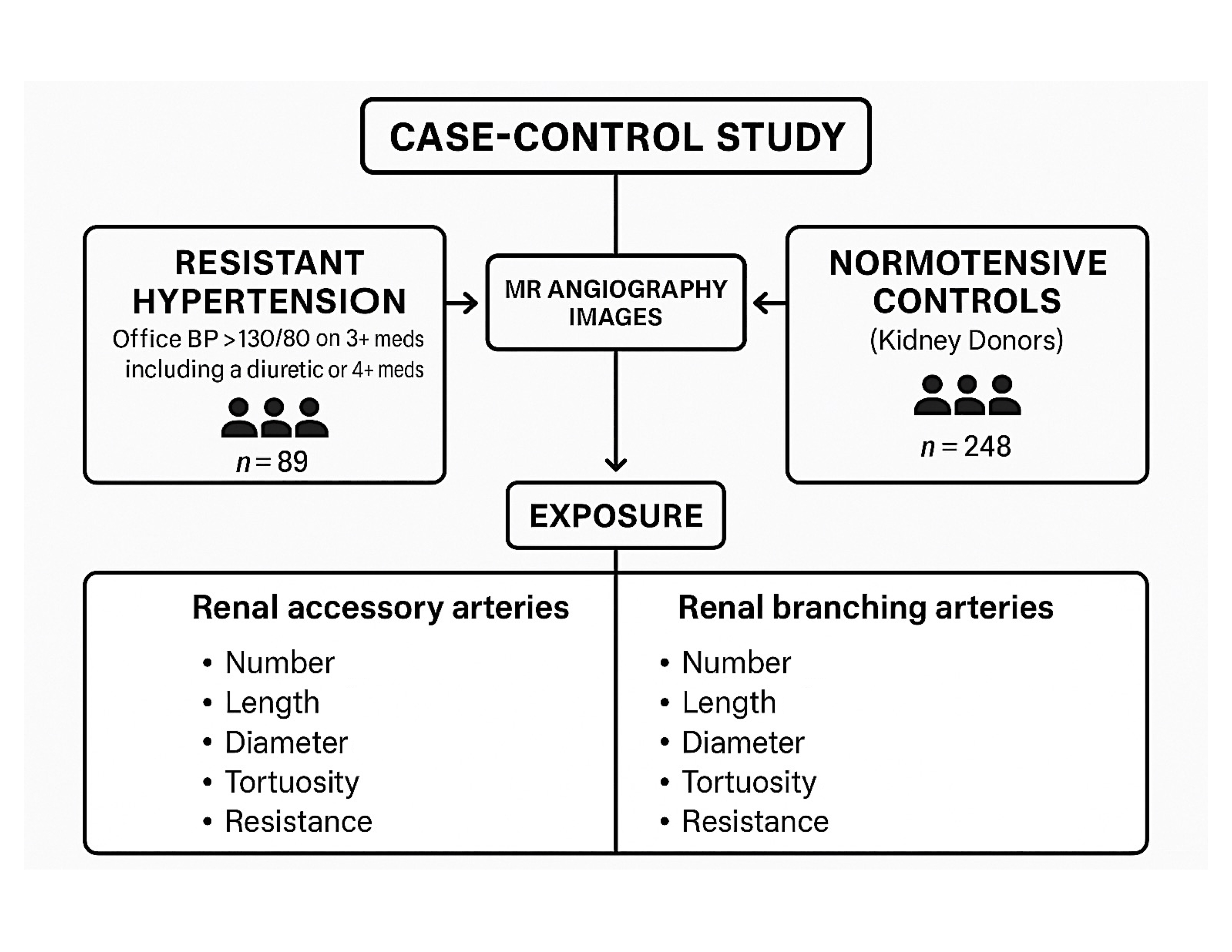
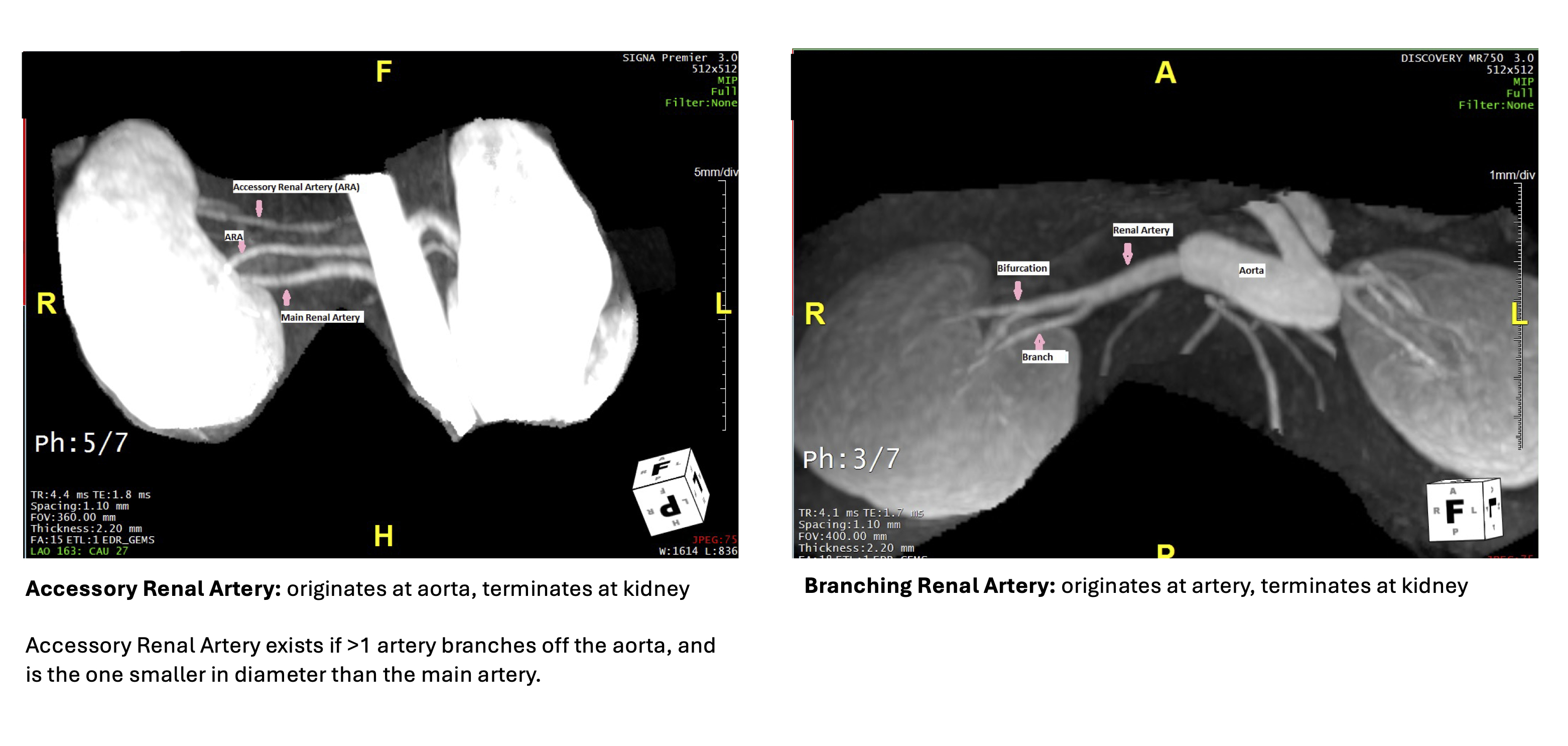
Methods: In a case-control study we compared the presence and characteristics of renal accessory and branching arteries (exposures) in individuals with RH (cases) vs. healthy kidney donors (normotensive controls) (Figure 1). Using MR angiography we calculated the length, diameter, tortuosity, and resistance (8*Length*blood viscosity)/(πr4)) of each artery (Figure 2). In separate logistic regression analyses we compared cases and controls for each of the following accessory or branching artery parameters: number of vessels, smallest diameter, length of longest vessel, greatest tortuosity, and greatest resistance.
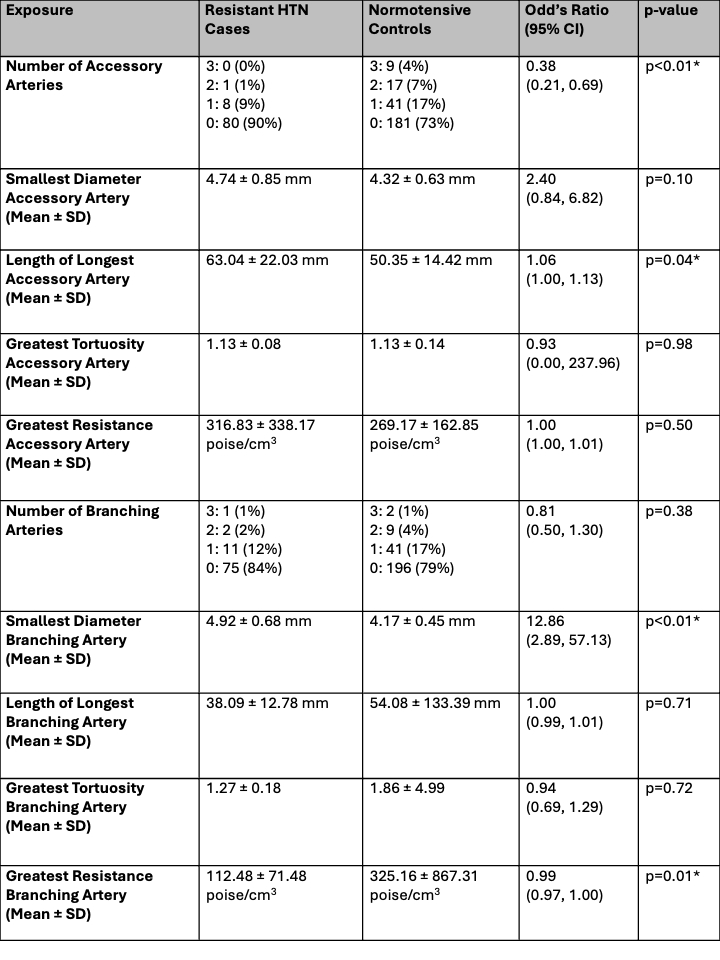
Results: We compared 89 unique RH cases to 248 unique normotensive controls (Table 1). For accessory arteries, their number was inversely related with RH (OR 0.38, 95% CI: 0.21 to 0.69, p<0.01), while length was mildly associated with RH (OR 1.06, 95% CI 1.00 to 1.13, p=0.04). Diameter and tortuosity were not associated in either direction. For branching arteries, RH was strongly associated with their diameter (OR 12.86, 95% CI 2.89 to 57.13, p<0.01), but more mildly and inversely with their resistance (OR 0.99, 95% CI: 0.97 to 1.00, p=0.01). The number and length of branching arteries were not associated in either direction.
Conclusion: RH is strongly associated with a reduced number of accessory renal arteries and wider branching arteries, both being novel findings. Future longitudinal studies should determine if these changes are causally related to development of hypertension. Elucidation of this relationship may open new avenues for management of RH.
Pasricha, Sachin Vidur
(
University of Toronto
, Toronto , Ontario , Canada )
Funes Hernandez, Mario
(
University of Minnesota
, Minneapolis , Minnesota , United States )
Gulati, Mayari
(
Mayo Clinic
, Rochester , Minnesota , United States )
Lerman, Lilach
(
Mayo Clinic
, Rochester , Minnesota , United States )
Bhalla, Vivek
(
STANFORD UNIVERSITY
, Palo Alto , California , United States )