Chronic Suppression of the Renin-Angiotensin System Induces Renal Vascular Remodeling, Hypoxia, and Metabolic Reprogramming
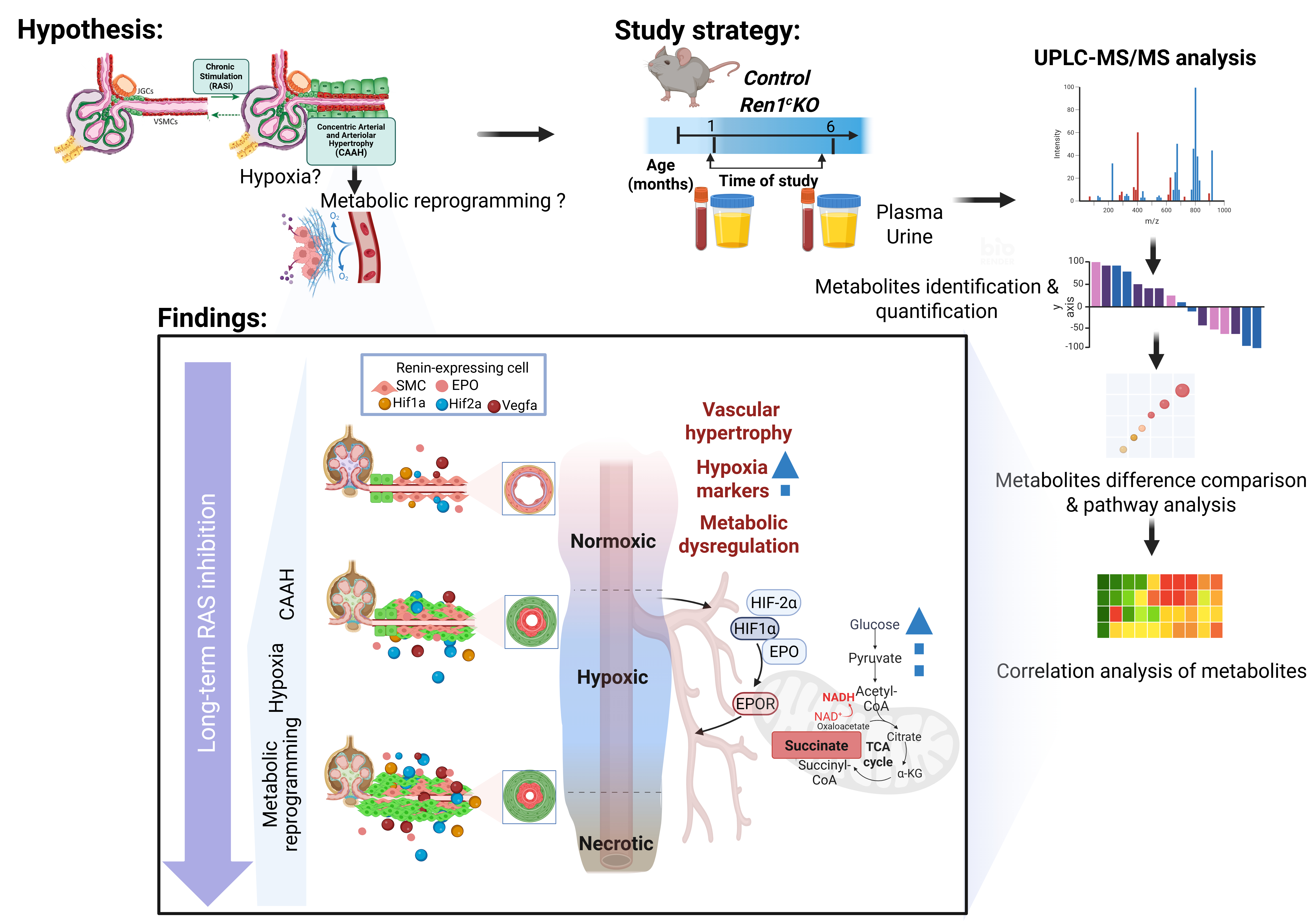
Abstract Body: Introduction: Hypertension is a global health burden and a major cause of cardiovascular, renal disease, and stroke. While renin-angiotensin system (RAS) inhibitors are effective antihypertensives, prolonged RAS suppression can induce renal vascular remodeling, characterized by concentric arteriolar and arterial hypertrophy. The metabolic consequences of this remodeling—particularly its role in promoting hypoxia and dysfunction—remain poorly defined. This study investigates whether chronic RAS inhibition drives hypoxia, metabolic reprogramming, and identifies potential biomarker of vascular injury. Methods: we used two murine models of chronic RAS inhibition. In a genetic model, renin gene deletion (Ren1cKO, n=6–8) was compared to wild-type (WT) controls (n=6–8). In a pharmacologic model, WT mice were treated long-term with captopril (n=6–7) or left untreated (n=6–7). Plasma, urine, and kidney samples were collected at 1 and 6 months. Untargeted metabolomic profiling was performed by LC-MS. Renal hypoxia was assessed using Hypoxyprobe staining and qPCR for HIF-1α, HIF-2α, erythropoietin (Epo), and its receptor (EpoR). Glycolytic reprogramming was evaluated by qPCR and immunohistochemistry. Results: Ren1cKO mice exhibited marked vascular thickening (4.54 ± 0.17 μm vs. 11.57 ± 0.91 μm, p<0.0001) and renin-lineage cell accumulation. Hypoxia was confirmed by increased Hypoxyprobe signal and upregulation of HIF-1α (p<0.0001), HIF-2α (p<0.002), Epo (p<0.0001), and EpoR (p<0.0001) (n=6-7). Metabolomic analysis revealed disruptions in the tricarboxylic acid (TCA) cycle (FDR=0.004, impact=0.3) and NAD metabolism (FDR=0.008, impact=0.3). Urinary succinate was elevated (log2 fold change= 2.5, p<0.0001), while nicotinate and nicotinamide metabolites were decreased (log2 fold change= –1.6, p<0.001). qPCR showed a 70-fold increase in hexokinase (HK) (p<0.0001) and a 4-fold increase in pyruvate kinase 2 (p<0.0001). Immunohistochemistry confirmed elevated HK and pyruvate kinase 2, supporting a hypoxia-driven glycolytic shift. Conclusion: Chronic RAS suppression induces vascular remodeling and hypoxia, driving a metabolic shift marked by enhanced glycolysis, NAD depletion, and succinate accumulation. This cascade amplifies HIF signaling and contributes to renal injury, uncovering mechanistic links and potential biomarkers of RAS-driven vascular disease.
Almeida, Lucas
(
UVA
, Charlottesville , Virginia , United States )
Medrano, Silvia
(
UNIVERSITY OF VIRGINIA
, Charlottesvle , Virginia , United States )
Smith, Jason
(
University of Virginia
, Charlottesville , Virginia , United States )
Yamaguchi, Hiroki
(
University of Virginia
, Charlottesville , Virginia , United States )
Yamaguchi, Manako
(
UNIVERSITY OF VIRGINIA
, Charlottesvle , Virginia , United States )
Sequeira, Maria Luisa
(
UNIVERSITY VIRGINIA
, Charlottesville , Virginia , United States )
Gomez, Ariel
(
UNIVERSITY OF VIRGINIA
, Charlottesvle , Virginia , United States )
Author Disclosures:
Lucas Almeida:DO NOT have relevant financial relationships
| Silvia Medrano:DO NOT have relevant financial relationships
| Jason Smith:DO NOT have relevant financial relationships
| Hiroki Yamaguchi:DO NOT have relevant financial relationships
| Manako Yamaguchi:DO NOT have relevant financial relationships
| Maria Luisa Sequeira:DO NOT have relevant financial relationships
| Ariel Gomez:No Answer