Arterial Stiffness and Endothelial Dysfunction can be reversed with Healthy Eating in Obese Children.
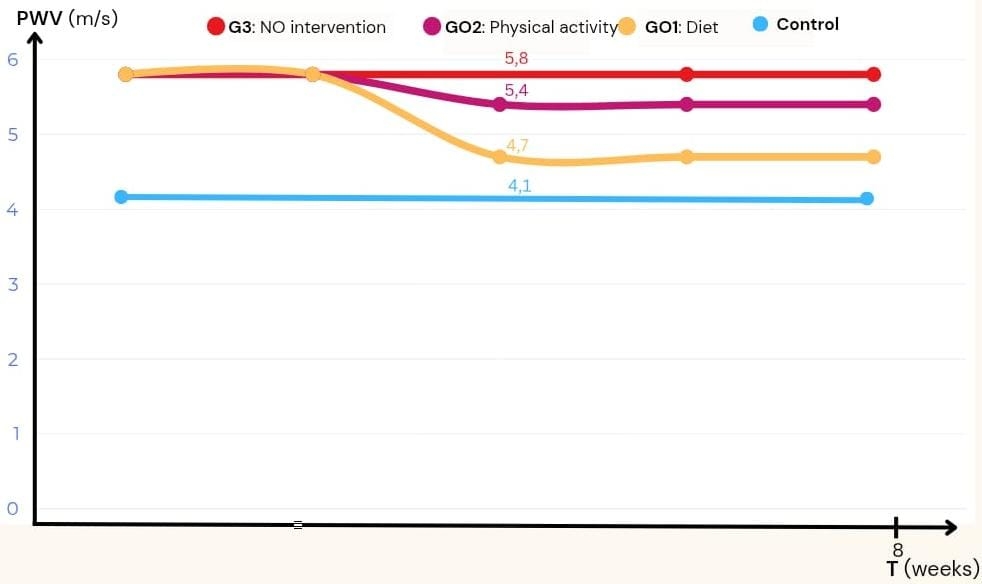
Abstract Body: Introduction: Obesity is an emerging pandemic in children, driven by a diet high in fat, highly refined carbohydrates, and a sedentary lifestyle. In obese children, we previously observed how arterial stiffness developed early, even before hypertension, and is one of the first biomarkers of cardiovascular risk. Study objective: To evaluate whether diet and exercise, both separately, could reduce arterial stiffness and improve endothelial function in obese children in the study group Methods: Obese normotensive children: BMI 29.40±2.72 Z:2.05±0.26 BP 107±9 / 69±4 mm Hg, between 9 and 13 years of age (n=30) with increased arterial stiffness (5.8 ± 1.1 m/s) and endothelial dysfunction were divided into three groups for 8 weeks. G1 (n=12): Diet without ultra-processed and frozen foods, with no changes in physical activity. G2: Physical activity, 30 minutes daily, appropriate for age, with no changes in diet. In both groups, work was carried out jointly with the family and school environment. G3 (n=6), control, no intervention. All 3 groups were assessed before and after 8 weeks. Carotid-femoral pulse wave velocity (PWV) was used to assess AR and carotid-brachial PWV variation before and after transient ischemia induced by Medical France). Central blood pressure and Augmentation Index were assessed with the Uscom device. Results: In obese children, arterial stiffness (CF-PWV) decreased more in the G1 vs G2 group Δ-1.6±0.3 m/s (p<0.01) vs 0.4±0.2 m/s respectively. The variation in CB-PWV was favorably modified in both groups, turning from an initial paradoxical response with endothelial dysfunction (△+9% with respect to the baseline value) and approaching the control group (△-15.2%), with G1 Δ-5% and G2Δ-6%. Conclusions: A diet free of ultra-processed foods was the best intervention for significantly reducing obesity and arterial stiffness, even more so than physical activity. Both interventions had a similarly favorable impact on improving endothelial dysfunction in these patients. Both family and school settings offer nutritional education and physical activity incentives, which are essential for preventing and treating childhood obesity and its consequences.
Duarte, Mariano
(
Facultad De Medicina Uba
, Martinez , Argentina )
Donth Leger, Gimena
(
Facultad De Medicina Uba
, Martinez , Argentina )
Aquieri, Analia
(
Hospital de Clinicas
, Buenos Aires , Argentina )
Coyle, Javier
(
Hospital de Clinicas
, Buenos Aires , Argentina )
Rivas, Silvia
(
Hospital de Clinicas
, Buenos Aires , Argentina )
Rodriguez, Cesar
(
Hospital de Clinicas
, Buenos Aires , Argentina )
Ponzo, Osvaldo
(
Facultad De Medicina Uba
, Martinez , Argentina )
Author Disclosures:
Mariano Duarte:DO NOT have relevant financial relationships
| Gimena Donth Leger:No Answer
| Analia Aquieri:No Answer
| Javier Coyle:DO NOT have relevant financial relationships
| Silvia Rivas:No Answer
| Cesar Rodriguez:No Answer
| Osvaldo Ponzo:No Answer