
Effects of Antihypertensive Medications on All-cause Dementia: Evidence from Target Trial Emulation of 3 Million US Veterans
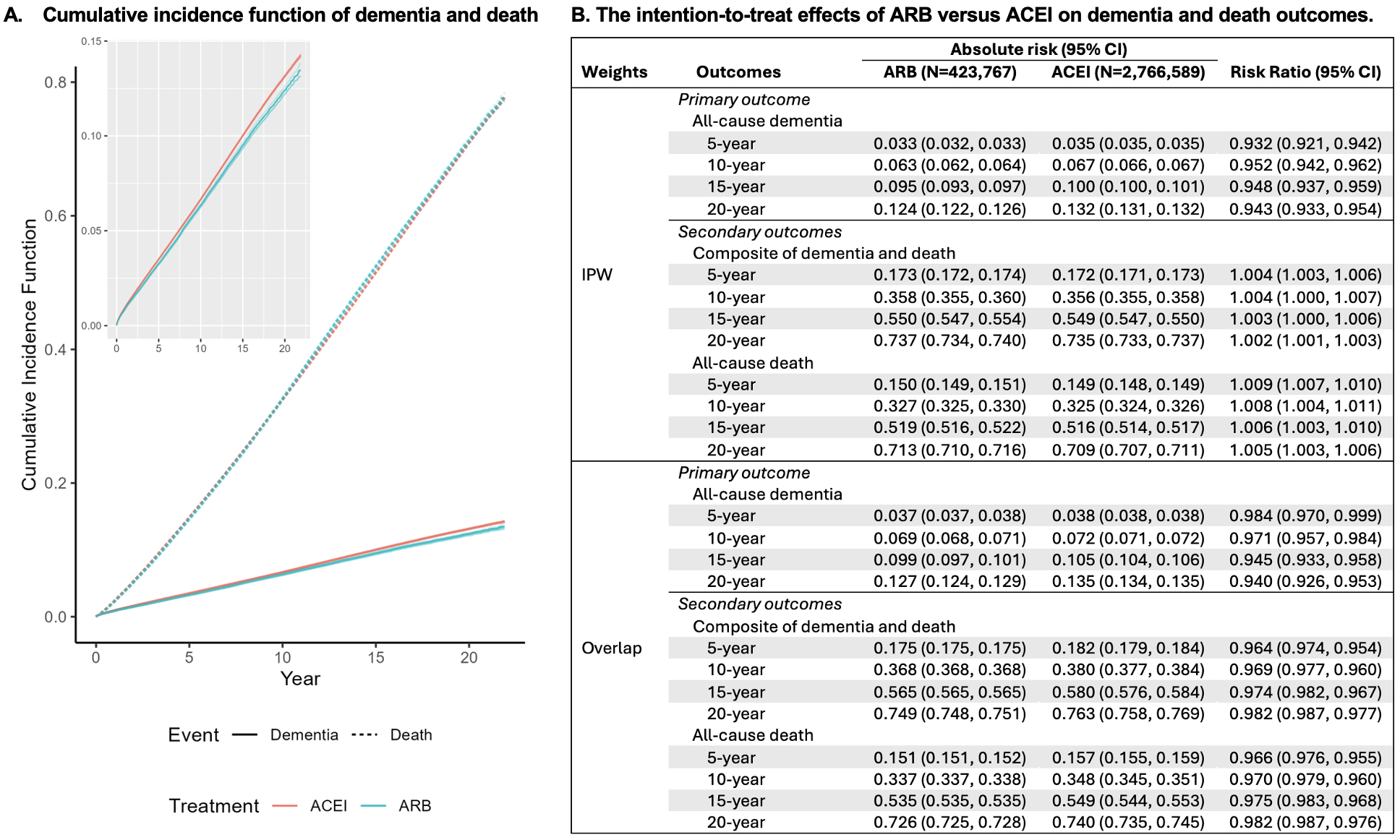
Abstract Body: Introduction: Hypertension is a modifiable risk factor for all-cause dementia. Mechanistic and observational evidence suggest angiotensin receptor blockers (ARBs) and angiotensin converting enzyme inhibitors (ACEIs) may differentially affect dementia risk. Objective and Methods: We used longitudinal electronic health records of over 3 million US Veterans to conduct a target trial emulation with a new-user, active comparator design. We compared the intention-to-treat effect of initiating ARBs vs ACEIs (1/1/2000-12/31/2022) on dementia risk. We controlled for >60 baseline covariates using inverse probability (IP) of treatment and overlap weighting. Dementia was ascertained using diagnosis codes and medications. We nonparametrically estimated the cause-specific cumulative incidence for each treatment group under the competing risk of death then computed treatment effects as weighted risk ratios with bootstrapped 95% confidence intervals. We also evaluated all-cause death and a composite outcome of dementia or death (dementia/Death) using Cox regression. Results: Among the 3,190,356 included Veterans (mean age 63, 5% female, 64% White, and 15% Black), 13% initiated ARBs and 87% initiated ACEIs. Overall, 8% developed dementia and 35% died over a median follow-up of 8 years. The risk of dementia was lower among ARB vs ACEI initiators (10-year risk ratio: 0.95 (0.94, 0.96)). The risk of all-cause death and dementia/Death were also lower among ARB vs ACEI initiators with overlap weighting. Conclusions: Among US Veterans with hypertension, ARB vs ACEI initiation was associated with a moderately lower risk of dementia. Future work assessing sustained treatment with ARB vs ACEI is needed to inform their use to reduce dementia risk.
Xu, Yizhe
(
University of Utah
, Salt Lake City , Utah , United States )
Derington, Catherine
(
University of Utah
, Salt Lake City , Utah , United States )
Greene, Tom
(
University of Utah
, Salt Lake City , Utah , United States )
Scharfstein, Daniel
(
University of Utah
, Salt Lake City , Utah , United States )
Andrews, Ryan
(
Boston University
, Boston , Massachusetts , United States )
Berchie, Ransmond
(
University of Utah
, Salt Lake City , Utah , United States )
Zhang, Chong
(
University of Utah
, Salt Lake City , Utah , United States )
Supiano, Mark
(
University of Utah
, Salt Lake City , Utah , United States )
Williamson, Jeff
(
Wake Forest School of Medicine
, Winston-Salem , North Carolina , United States )
Pajewski, Nicholas
(
Wake Forest School of Medicine
, Winston-Salem , North Carolina , United States )
Pruzin, Jeremy
(
Banner Alzheimer’s Institute
, Phoenix , Arizona , United States )
Shulman, Rachel
(
University of Pennsylvania
, New Hope , Pennsylvania , United States )
Cohen, Jordana
(
University of Pennsylvania
, New Hope , Pennsylvania , United States )
Bress, Adam
(
University of Utah
, Salt Lake City , Utah , United States )
Author Disclosures:
Yizhe Xu:DO NOT have relevant financial relationships
| Nicholas Pajewski:No Answer
| Jeremy Pruzin:No Answer
| Rachel Shulman:DO NOT have relevant financial relationships
| Jordana Cohen:DO NOT have relevant financial relationships
| Adam Bress:DO NOT have relevant financial relationships
| Catherine Derington:DO have relevant financial relationships
;
Employee:University of Colorado:Active (exists now)
; Independent Contractor:AHA Journals - Technical Editor for Circulation Cardiovascular Quality and Outcomes:Active (exists now)
; Independent Contractor:Springer/Nature - Associate Editor for Journal of Human Hypertension:Active (exists now)
; Employee:University of Utah:Past (completed)
| Tom Greene:No Answer
| Daniel Scharfstein:No Answer
| Ryan Andrews:No Answer
| Ransmond Berchie:No Answer
| Chong Zhang:No Answer
| Mark Supiano:DO NOT have relevant financial relationships
| Jeff Williamson:No Answer