
Logo

American Heart Association

  11
  0


Final ID: TU208

Household Education Is Associated with Barriers for Children Walking and Biking

Abstract Body: Introduction
Walking and biking promote cardiovascular health. Children may have limited opportunity to walk/bike depending on the neighborhood environment, which plausibly differs by household education level. This study estimates the national prevalence of adult-reported neighborhood characteristics that impact walking/biking for children by household education.

Methods
Data from the sample child 2024 National Health Interview Survey was analyzed. An adult caregiver from a household with at least one child between the ages of 6-17 years was asked: Where the child lives, 1) are there walkable/bikeable routes? 2) Are there parks/playgrounds close enough for the child to walk/bike to? 3) Does traffic and 4) crime make it unsafe for the child to walk/bike, even with an adult? Adults who answered these questions and had complete data for highest household education level and child age, race/ethnicity, and sex were included for analysis (n=5,747).

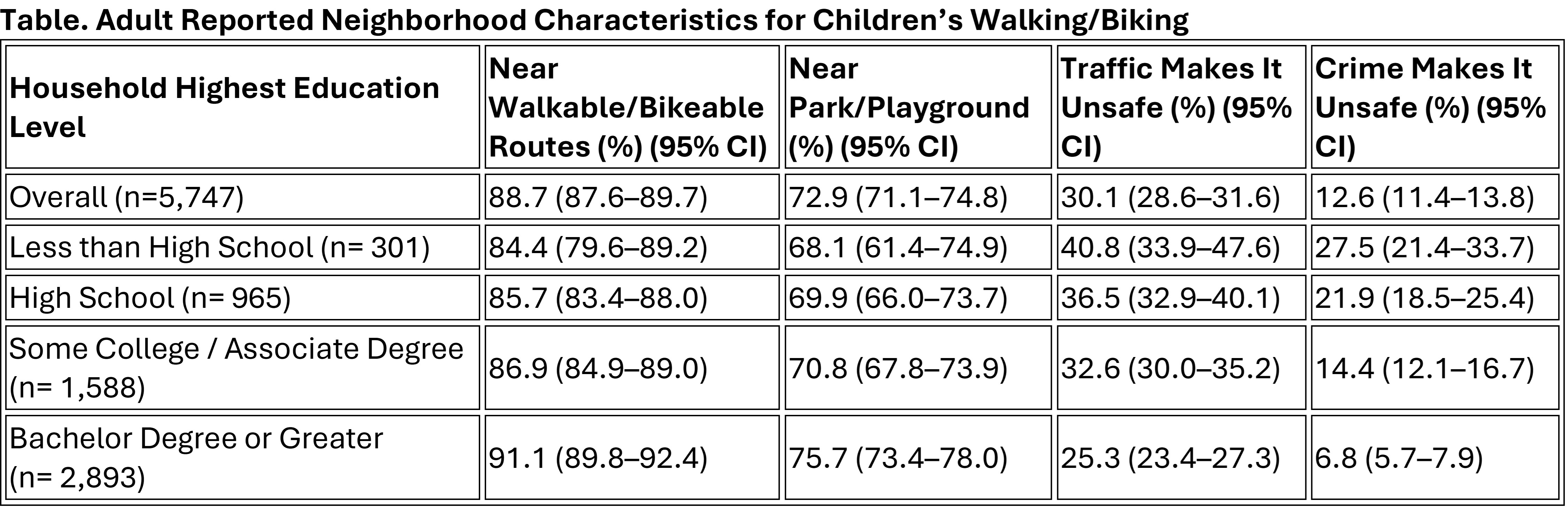
Highest household education level was categorized: less than high school (P<0.05) and pairwise testing (Bonferroni corrected P<0.0083) were used to determine differences in the prevalence of neighborhood characteristics by household education.

Results
Overall, adults report 88.7% (95% CI: 87.6%–89.7%) of children lived near walkable/bikeable routes and 72.9% (71.1%–74.8%) lived close enough to walk/bike to a park/playground (Table). Children in P< 0.001) or crime (27.5% [21.4–33.7%] vs. 6.8% [5.7–7.9%], P< 0.001).

Conclusions
Most US children have a walkable/bikeable route or a park/playground near home; however, traffic and crime may limit safe walking/biking, with significant differences between households with lowest and highest education levels. In conclusion, these national estimates show proximity to routes/parks alone may not provide children opportunities for safe walking/biking. Strategies such as Safe Routes to School that can simultaneously address traffic (e.g. separating pedestrians from vehicles) and crime (e.g. street lighting) may increase opportunities for all children to walk/bike, supporting cardiovascular health and healthier lifestyle choices.
  • Macleish, Heather  ( Centers for Disease Control , Atlanta , Georgia , United States )
  • Nakayama, Jasmine  ( Centers for Disease Control , Atlanta , Georgia , United States )
  • Stowe, Ellen  ( Centers for Disease Control , Atlanta , Georgia , United States )
  • Whitfield, Geoffrey  ( Centers for Disease Control , Atlanta , Georgia , United States )
  • Author Disclosures:
Meeting Info:

EPI-Lifestyle Scientific Sessions 2026

2026

Boston, Massachusetts

Session Info:

Poster Session 1

Tuesday, 03/17/2026 , 05:00PM - 07:00PM

Poster Session

More abstracts on this topic:
Health Behaviors of Middle School Children by Community Type: Metropolitan, Micropolitan, and Rural

Smith Emma, Krallman Rachel, Pai Chih Wen, Newman Brad, Eagle Kim, Jackson Elizabeth

Assessing low-density lipoprotein cholesterol (LDL-C) equations in childhood for long-term risk of cardiovascular disease events: Superior performance of the Sampson equation

Meng Yaxing, Steinberger Julia, Urbina Elaine, Venn Alison, Viikari Jorma, Whitaker Kara, Woo Jessica, Raitakari Olli, Magnussen Costan, Wu Feitong, Juonala Markus, Jacobs David, Bazzano Lydia, Daniels Stephen, Dwyer Terence, Kahonen Mika, Sinaiko Alan

You have to be authorized to contact abstract author. Please, Login
Not Available