In a Large Minnesota Healthcare System Most Patients with Hypertension Do Not Use Their Nearest Pharmacy
Abstract Body: Background: Recent pharmacy closures have fueled research into “pharmacy deserts” raising concerns about limited pharmacy access and disparities in convenience of pharmacy use. However, it is unclear if proximity to pharmacy is a primary factor driving pharmacy choice.
Methods: We created a cohort of patients with hypertension using electronic health record data from M Health Fairview, a health system with hospitals and clinics that serve patients across MN with >1 million outpatient visits annually. We geocoded all MN pharmacies open to the public in 2022, categorized them by type (chain, grocery store, community, and health system), and determined drive times from census blocks to the nearest pharmacies. Patient characteristics included age, sex, census block of residence, and pharmacies used in 2022. A preferred pharmacy was designated as the one where most prescriptions were sent. Census blocks were characterized by geographic region and poverty quartiles. We evaluated differences between those who preferred the nearest pharmacy and those who preferred a more distant pharmacy (DP).
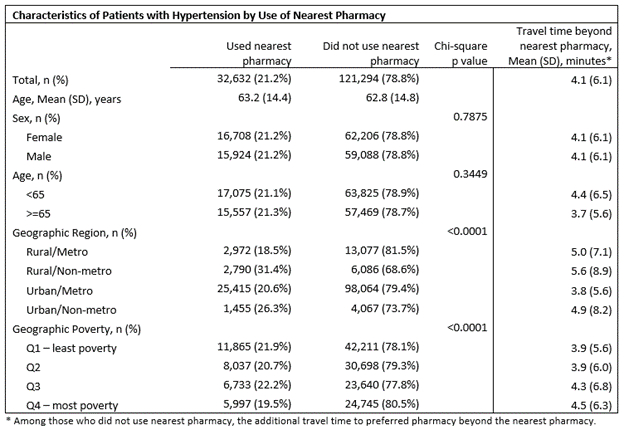
Results: In 2022, 153,926 patients were seen in an outpatient clinic and received at least one medication prescription. A large majority (121,294, 79%) did NOT prefer to use the nearest pharmacy. There was little difference by age and sex, but choice of nearest pharmacy varied significantly by geographic region and poverty level with higher use of nearest pharmacy in the non-metro regions and the lowest use in the highest poverty group (Table). Average drive time to the nearest pharmacy was 4.5 minutes overall. In the total DP group, average drive time beyond the nearest pharmacy was 4.1 minutes. Those in rural/non-metro regions added the most extra travel time, 5.6 minutes. When assessed by poverty quartiles, the highest poverty group traveled the furthest beyond the nearest pharmacy, 4.5 minutes (Table). Patients in the DP group tended to choose chain pharmacies more often and community pharmacies less often.
Conclusion: A majority of patients with hypertension in a large healthcare system preferred to use a pharmacy that was not nearest to their residence, suggesting proximity to residence may not be the most important factor for determining adequate pharmacy access. Other factors (e.g. insurance coverage, costs) need to be considered in future research.
Van't Hof, Jeremy
(
University of Minnesota
, Minneapolis , Minnesota , United States )
Van Riper, David
(
University of Minnesota
, Minneapolis , Minnesota , United States )
Chiu, Tobyn
(
Lillehei Heart Institute
, Minneapolis , Minnesota , United States )
Lutsey, Pamela
(
University of Minnesota
, Minneapolis , Minnesota , United States )
St Peter, Wendy
(
University of Minnesota
, Minneapolis , Minnesota , United States )
Drawz, Paul
(
Paul Drawz
, Golden Valley , Minnesota , United States )