Demographic and Cardiovascular Risk Factors Influence Midlife Cognitive Function: Evidence from the i3C DECADE Study
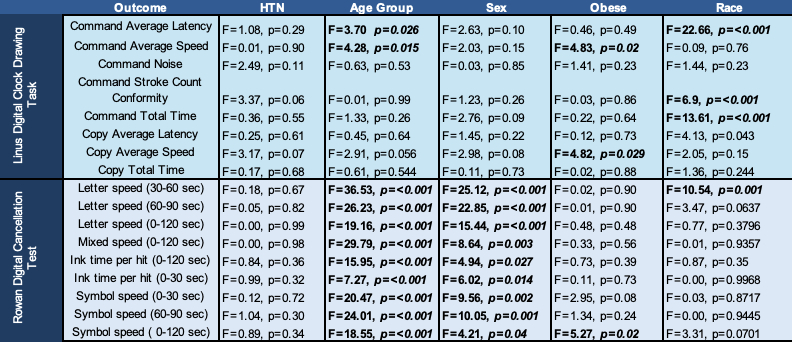
Abstract Body: Introduction: Age, sex, race, and education are known determinants of cognitive performance in traditional neuropsychological testing; however, their impact on novel digital measures remains less defined. Digital assessments offer scalable, precise evaluations of cognition, potentially revealing subtle demographic differences relevant to early risk detection. Leveraging three distinct cohorts from the Disparities and Equity in Childhood Cardiovascular Exposures and Alzheimer’s Dementia (DECADE) project, we examined demographic influences on two digital cognitive tools. Methods: Participants included 236 adults (age 38-69 years; 79.5% female; 68.3% White) from three midlife DECADE cohorts, each with distinct racial/ethnic and socioeconomic profiles. Demographic predictors included age, sex, and race; obesity and hypertension were included, given their cognitive relevance. Cognitive performance was measured using two tablet-based instruments: the Rowan Digital Cancellation Test (RDCT), including letter, symbol, and mixed cancellation with outcomes of accuracy and processing speed, and the Digital Clock Drawing Task (dCDT), including command and copy conditions with metrics of latency, stroke conformity, speed, and total completion time. Standardized protocols were used across sites. One-way ANOVA models tested differences between demographic variables and digital outcomes, with post hoc comparisons to delineate group differences. Results: Older participants showed slower processing across RDCT (letter speed F=36.5, p<0.001; mixed speed F=29.8, p<0.001) and clock tasks. Women outperformed men on RDCT speed (letter F=22.9, p<0.001; symbol F=9.6, p=0.002) and clock copy time (F=4.9, p=0.027). Black participants exhibited longer clock command latencies (F=22.7, p<0.001), more stroke errors (F=6.9, p<0.001), and slower cancellation performance (letter speed F=10.5, p=0.001). Obese participants showed slower digital processing on clock average speed (F = 4.83, p = 0.02) and symbol speed F = 4.82, p = 0.029), whereas those with hypertension did not show any significant differences. Conclusion: Significant group differences were observed across digital cognitive outcomes by age, sex, race, and obesity status, consistent with patterns previously reported in traditional neuropsychological testing. Both the RDCT and dCDT were sensitive to these differences, supporting their utility as scalable tools for characterizing demographic variation in midlife cognitive performance
Fonseca Lomeli, Vanessa
(
San Ysidro Health
, San Diego , California , United States )
Moukaled, Shirine
(
Tulane University
, New Orleans , Louisiana , United States )
Woo, Jessica
(
CCHMC
, Cincinnati , Ohio , United States )
Urbina, Elaine
(
CCHMC
, Cincinnati , Ohio , United States )
Baliga, Ganesh
(
Rowan University
, Stratford , New Jersey , United States )
Libon, David
(
Rowan University
, Glassboro , New Jersey , United States )
De Anda-duran, Ileana
(
Tulane University
, NEW ORLEANS , Louisiana , United States )
Bazzano, Lydia
(
TULANE UNIVERSITY
, New Orleans , Louisiana , United States )