Higher Carotid IMT Is Associated With Worse Cognitive Function Independently Of Age In Healthy Adults in Midlife
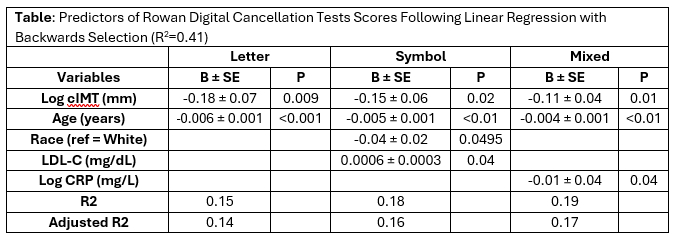
Abstract Body: Introduction: Cognitive decline is a growing public health concern as the prevalence of Alzheimer’s Disease and Related Dementias (ADRD) is expected to rise. Moreover, vascular health has been shown to be linked to the eventual emergence of ADRD. Carotid intima-media thickness (cIMT) is a noninvasive measure that could potentially reveal subclinical vascular disease that could identify individuals at risk of ADRD earlier in life. Hypothesis: Increased cIMT is independently associated with worse cognitive function in healthy adults in midlife. Methods: We analyzed 174 adults (mean age 54±8 years; 83% female; 61% Caucasian) from two International Childhood Cardiovascular Cohort (i3C) studies - National Growth and Health Study and Princeton Lipid Research Study. Anthropometrics and laboratory evaluation were performed. Participants underwent carotid ultrasound to measure cIMT (mean of internal, bulb, and common carotid segments measured bilaterally) and completed the three Rowan Digital Cancellation Tests (RDCT; Letter, Symbol, Mixed Letter/Symbol) to measure executive and graphomotor information processing speed. Cancelation performance was expressed using composite scores that combine accuracy and processing speed. Variables were log transformed if indicated. General linear models with backward selection were used to identify predictors of RDCT performance, with logcIMT, age, sex, race, BMI, blood pressure, LDL, TG:HDL ratio, and logCRP. Results: After backward selection, logcIMT and age remained significant predictors across all RDCT forms. Higher logcIMT was associated with worse cognitive function independently of age (Letter: β=-0.18, p<0.01; Symbol: β=-0.15, p=0.02; Mixed: β=-0.11, p=0.01). Age was also inversely associated with cognitive performance (Letter: β=-0.006, Symbol: β=-0.005, Mixed: β=-0.004; p<0.01 for all). Additional covariates retained in some models included race (Symbol: β=-0.04, p=0.0495), LDL (Symbol: β=0.0006, p=0.04), and logCRP (Mixed: β=-0.01, p=0.04). Model R2 were 0.15 (Letter), 0.18 (Symbol), and 0.19 (Mixed). Conclusions: In healthy middle-aged adults, greater cIMT is associated with greater executive and graphomotor processing speed deficits, independent of age and select cardiovascular risk factors. These findings suggest that subclinical vascular disease may be associated with cognitive decline earlier in the life course. Future studies should examine whether interventions targeting vascular health can preserve cognition.
Sill, Jordan
(
Cincinnati Children's Hospital
, Cincinnati , Ohio , United States )
De Anda-duran, Ileana
(
Tulane University
, NEW ORLEANS , Louisiana , United States )
Urbina, Elaine
(
Cincinnati Children's Hospital
, Cincinnati , Ohio , United States )
Baliga, Ganesh
(
Rowan University
, Stratford , New Jersey , United States )
Libon, David
(
Rowan University
, Stratford , New Jersey , United States )
Woo, Jessica
(
Cincinnati Children's Hospital
, Cincinnati , Ohio , United States )