
Community-engaged Intervention Improves Cardiovascular Health Literacy
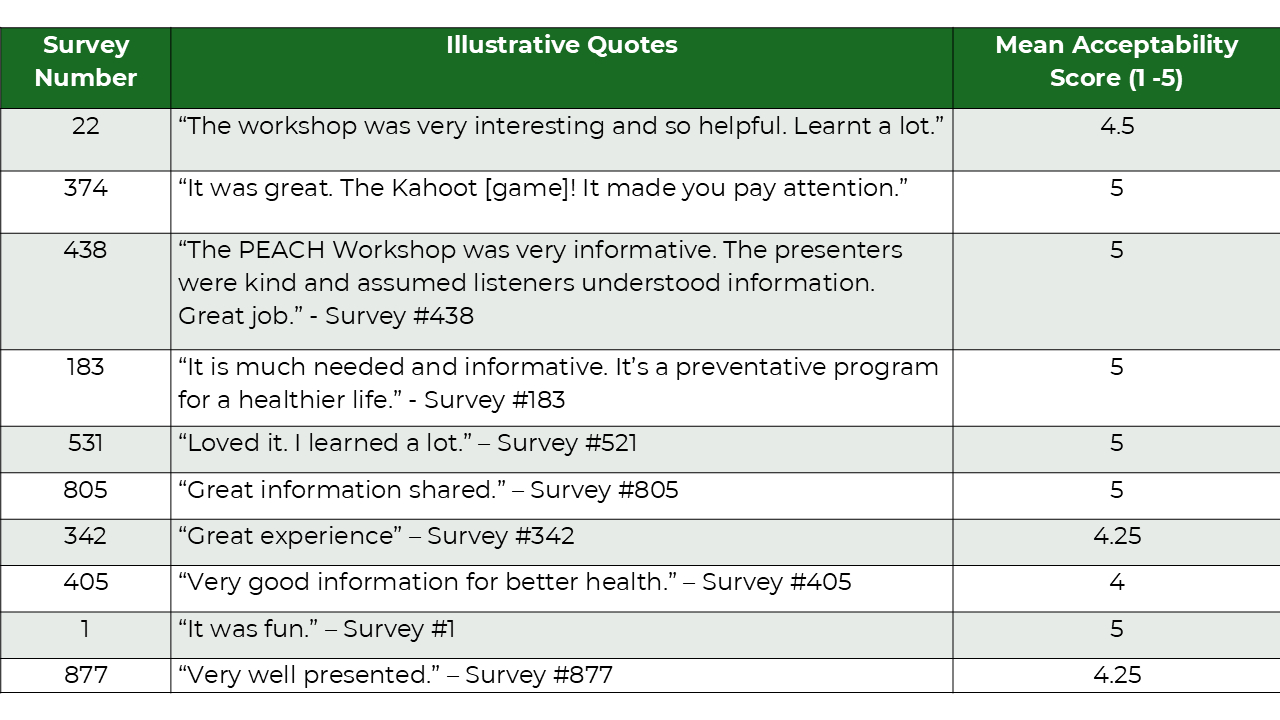
Abstract Body: Background Cardiovascular complication accounts for 26.7% of maternal deaths in the United States. Women residing in maternity care deserts (MCDs) face higher risks from cardiac complications. People with limited health literacy have fewer health-promoting behaviors, report poorer health status, and underuse preventive services. Hypotheses Reproductive aged women residing in maternity desserts who access Pre-pregnancy and Interpregnancy Engagement for Alabama’s Cardiovascular Health (PEACH) intervention will show higher comprehensive knowledge about the American Heart Association’s (AHA) Life’s Essential 8 on a pre and post assessment. Methods We adopted the Intervention Mapping (IM) Framework to develop the Pre-pregnancy and Interpregnancy Engagement for Alabama’s Cardiovascular Health (PEACH) intervention to improve cardiovascular health (CVH) literacy among reproductive-aged women residing in two MCDs in Alabama. The six steps of the IM framework include: 1) A needs assessment to determine CVH literacy needs in the target population. 2) Using the AHA’s Life’s Essential 8, we 3) identified the change objectives for the intervention. 4) We established an Expert Panel comprising lived experiences experts, community leaders/members, community health workers (CHWs), and health professionals to validate the design and development of the intervention materials including CHW training curriculum and facilitation guide, videos, interactive games and workbook. 5) We engaged key community stakeholders in the two MCDs to determine the best delivery strategies. 6) We delivered the intervention through in-person and virtual workshops. Enrolled participants were paired with CHWs for three months of community-based support. We used the Acceptability of Intervention Measure (AIM) scale to assess acceptability and the CVH literacy scale to assess knowledge gain between pre- and post-workshop. Results Thirty-four (34) women participated in the in-person and virtual workshops; 24 completed the pre- and post-workshop surveys. Participants reported the workshops as engaging and informative. The mean acceptability (AIM) score was 4.6 (SD = 0.68) on a 1-5 scale and the mean CVH literacy improvement score was 1.1 points. Conclusion The PEACH intervention was acceptable to participants and improved their CVH literacy.
Toluhi, Angelina
( University of Alabama at Birmingham
, Birmingham
, Alabama
, United States
)
Ugwu, Lynda
( University of Alabama at Birmingham
, Birmingham
, Alabama
, United States
)
Carlo, Waldemar
( UAB
, Birmingham
, Alabama
, United States
)
Tita, Alan
( University of Alabama at Birmingham
, Birmingham
, Alabama
, United States
)
Sinkey, Rachel
( UAB
, Birmingham
, Alabama
, United States
)
Turan, Janet
( University of Alabama at Birmingham
, Birmingham
, Alabama
, United States
)
Lukhele, Bhekumusa
( University of Alabama at Birmingham
, Birmingham
, Alabama
, United States
)
Quinney, Rosylen
( University of Alabama at Birmingham
, Birmingham
, Alabama
, United States
)
Torres-benson, Kayla
( University of Alabama at Birmingham
, Birmingham
, Alabama
, United States
)
Rattan, Jesse
( University of Alabama at Birmingham
, Birmingham
, Alabama
, United States
)
Ajijola, Lekan
( University of Alabama at Birmingham
, Birmingham
, Alabama
, United States
)
Jimoh, Itopa
( University of Alabama at Birmingham
, Birmingham
, Alabama
, United States
)
Ashford, Trinita
( University of Alabama at Birmingham
, Birmingham
, Alabama
, United States
)
Richardson, Molly
( University of Alabama at Birmingham
, Birmingham
, Alabama
, United States
)