EPI-Lifestyle Scientific Sessions 2026
/
Poster Session 1
/
Human Milk Consumption During the Neonatal Hospitalization is Not Associated with Length- or Weight-for-Age at Discharge for Infants with Critical Congenital Heart Disease.
American Heart Association
62
0
Final ID: TU213
Human Milk Consumption During the Neonatal Hospitalization is Not Associated with Length- or Weight-for-Age at Discharge for Infants with Critical Congenital Heart Disease.
Abstract Body: Introduction: Human milk is the optimal nutritional source for infants. In critically ill infants, human milk offers benefits related to disease reduction (eg, lower necrotizing enterocolitis) and neurodevelopment. Infants with critical congenital heart disease (CCHD), a particularly vulnerable population, may be at risk for below-average perioperative growth. This project aimed to determine whether the percentage of enteral volume received as human milk was associated with length-for-age (LAZ) and weight-for-age (WAZ) z-scores at hospital discharge. We hypothesized a positive association for LAZ and no association for WAZ.
Methods: For this retrospective cohort study, daily nutrition information was extracted from the electronic health record (EHR) for infants who underwent neonatal cardiac surgery on cardiopulmonary bypass between 2014–2023. Infants were excluded if their hospital length of stay was <7 days or >180 days, if they received <7 days of enteral feeding, or if they died before discharge. Linear regression was used to estimate the association between the average daily human milk percentage and LAZ or WAZ at hospital discharge. Models were adjusted for sociodemographic and physiological covariates, including infant sex, insurance type, single ventricle physiology, genetic syndrome, and hospital length of stay. Sensitivity analysis was conducted examining human milk consumption as a categorical variable with cutoffs for quartiles 1, 2, 3, and 4 set at 0-25%, 26-50%, 51-75%, and 76%-100%, respectively.
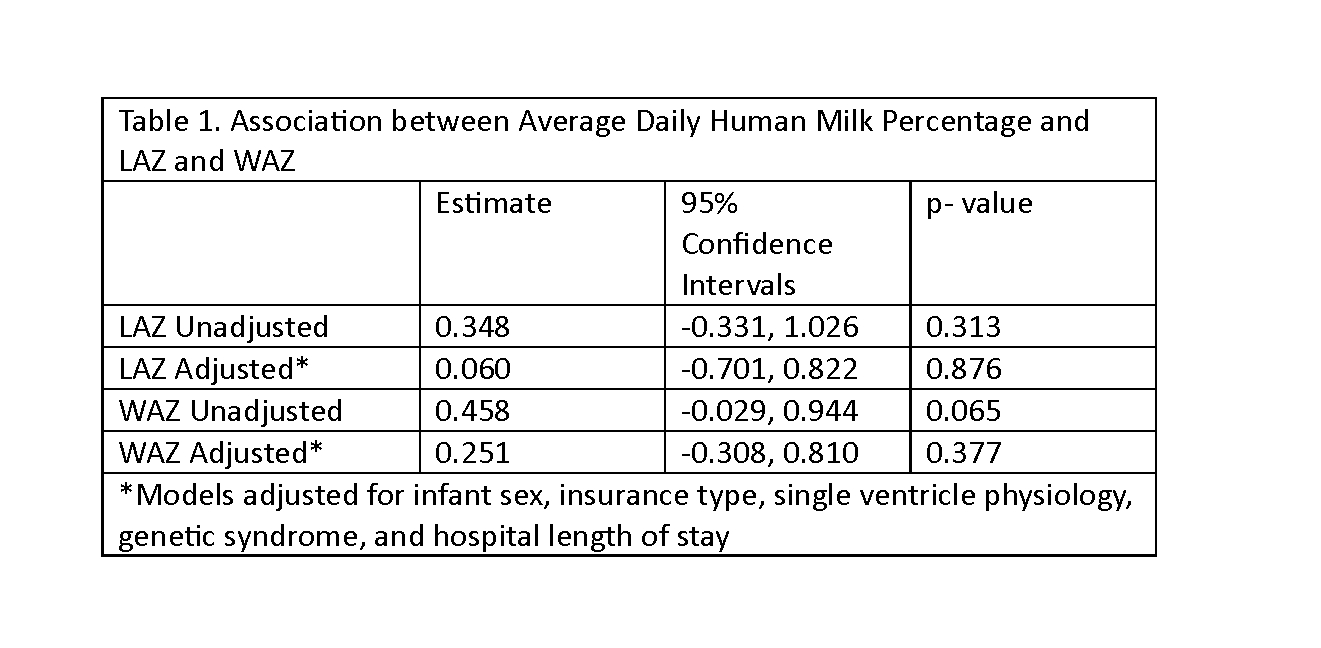
Results: Infants (n=211) were 33% female, 71% White, 36% with public insurance, and 42% with single ventricle physiology. Human milk comprised on average 75% of the daily enteral nutrition. Infants’ median (25%,75%) hospital length of stay was 39 (28,56) days, with average -1.53 (±1.49) LAZ and -1.62 (±1.08) WAZ at discharge. There were no significant associations between human milk percentage and LAZ or WAZ at discharge in unadjusted or adjusted models, or in sensitivity analyses (Table 1).
Conclusions: Human milk consumption was not associated with differences in discharge LAZ or WAZ among infants with CCHD, suggesting non-inferior growth for infants fed human milk during the neonatal hospitalization for cardiac surgery. Given the well-established benefits of human milk feeding for all infants, these findings support continued human milk promotion for critically ill infants with CCHD.
Crimmins, Meghan
(
University of Minnesota
, Minneapolis , Minnesota , United States )
Slater, Nancy
(
Children's Heart Clinic
, Minneapolis , Minnesota , United States )
Watkins, Kimberly
(
Children's Heart Clinic
, Minneapolis , Minnesota , United States )
Demerath, Ellen
(
University of Minnesota
, Minneapolis , Minnesota , United States )
Elgersma, Kristin
(
University of Minnesota
, Minneapolis , Minnesota , United States )