
Logo

American Heart Association

  3
  0


Final ID: WE547

Patient Perspectives of Life’s Essential 8 Cardiovascular Health Questionnaire and Cardiovascular Health Score

Abstract Body: Introduction/Background
The American Heart Association’s Life’s Essential 8 (LE8) is a cardiovascular health (CVH) framework assigning scores to eight CVH metrics, inversely associated with cardiovascular disease (CVD) risk. We aimed to assess patient perspectives on completing LE8 questionnaires and receiving LE8 scores as a means to promote behavior change. This evaluation used an inductive, data-driven qualitative approach.
Objectives
To identify: (1) patient perspectives on completing LE8 questionnaires, and (2) how best to provide LE8 CVH scores to motivate improvements in CVH.
Methods
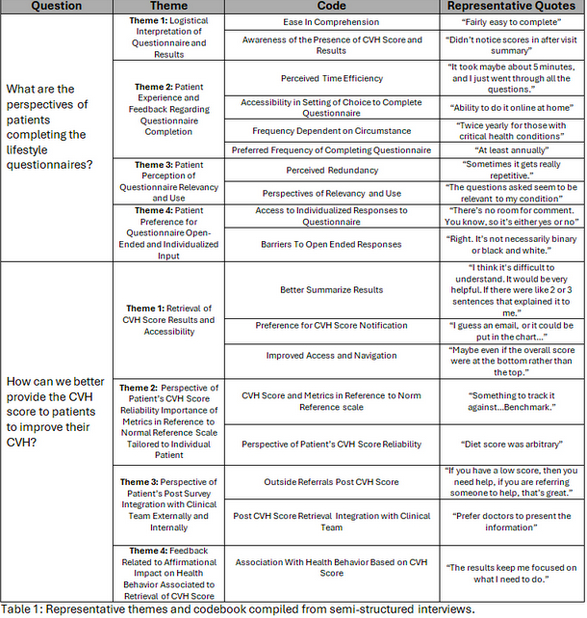
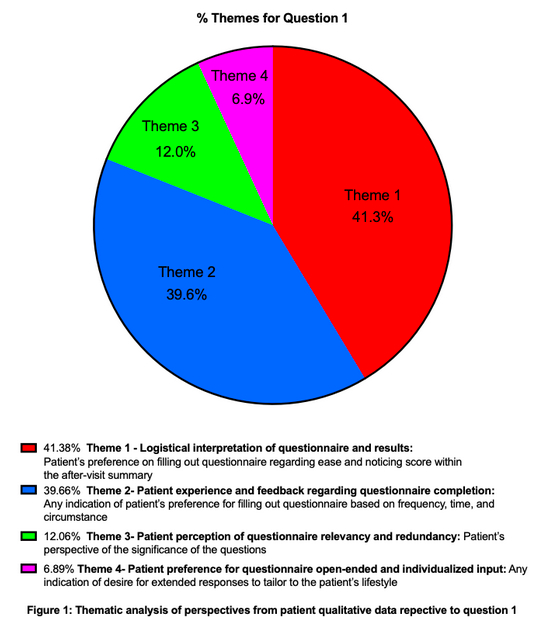
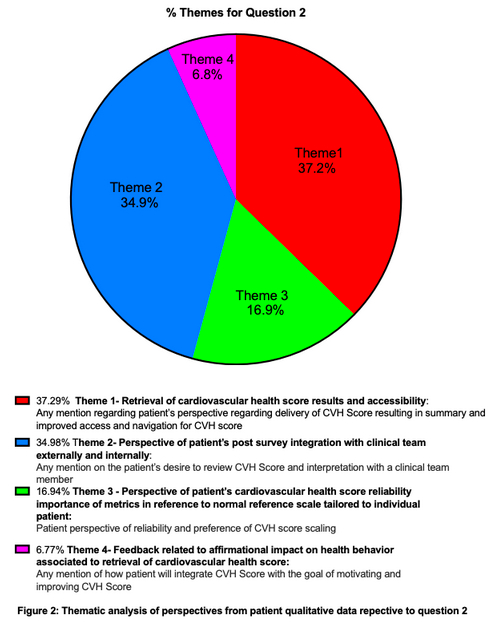
This qualitative observational study recruited adult patients who completed the LE8 questionnaire, had video conferencing access, and were fluent in English. Participants were invited to semi-structured interviews about their experience with the LE8 questionnaire and perceptions of the resulting score. Transcripts were coded independently by three researchers to develop preliminary codebooks. A finalized codebook was created with input from the entire study team and was applied to all transcripts in Dedoose. Codes were grouped into themes, and thematic frequency was calculated based on the number of quotes per theme. Results were ranked by prevalence. The process was applied to each research question.
Results
Four overarching themes were identified per question (Table 1). For question one, the most common theme was “logistical interpretation of the questionnaire and results.” Many participants reported not noticing their LE8 CVH score in the after-visit summary. However, most found the questionnaire easy to complete and the score understandable when seen.
For question two, the most common theme was “retrieval of CVH score results and accessibility.” Participants preferred receiving their LE8 score by text, email, or phone—separate from the after-visit summary. They recommended including a short summary explaining the score’s meaning and suggested actions.
Conclusion
This initiative highlights the need to optimize LE8 delivery. While patients found the questionnaire easy to complete, they suggested reducing redundancy and allowing updates to prior responses. Most did not recall seeing their score in the after-visit summary and preferred separate, direct communication. Patients also expressed a desire to review their score with clinicians. Incorporating LE8 discussions into clinic visits may enhance engagement and improve CVH outcomes.
  • Quadir, Rafid  ( NYU Langone , New York , New York , United States )
  • Quintero Chacon, Stephanie  ( NYU Langone , New York , New York , United States )
  • Lesser, Annabelle  ( NYU Langone , New York , New York , United States )
  • Berger, Jeffrey  ( NYU Langone , New York , New York , United States )
  • Heffron, Sean  ( NYU Langone , New York , New York , United States )
  • Ortiz, Robin  ( NYU Langone , New York , New York , United States )
  • Author Disclosures:
Meeting Info:

EPI-Lifestyle Scientific Sessions 2026

2026

Boston, Massachusetts

Session Info:

Poster Session 2

Wednesday, 03/18/2026 , 05:00PM - 07:00PM

Poster Session

More abstracts on this topic:
Associations between Chronic Stress, Resilience Factors and Cardiovascular Health among Young Adults in Puerto Rico

Rosal Milagros, Perez Cynthia, Person Sharina, Kiefe Catarina, Tucker Katherine, Rodriguez Jose, Sanchez Miredys, Torres Polaris, Boneu Claudia, Frisard Christine

Artificial Intelligence-Derived Social Determinants of Health Profiles and Cardiovascular Risk in Asian American Adults

Le Austin, Dodani Sunita, Elfassy Tali, Yang Eugene

You have to be authorized to contact abstract author. Please, Login
Not Available