Social Determinants of Health and Circulating Biomarkers of Neurodegeneration: the REasons for Geographic and Racial Differences in Stroke (REGARDS) Cohort
Abstract Body: Introduction Neuropathologic changes precede dementia symptoms by decades, complicating prevention. Technological advances now allow detection of low abundance circulating neurodegeneration biomarkers enabling early risk assessment; higher plasma glial fibrillary acidic protein (GFAP), neurofilament light chain (NfL), and ubiquitin carboxy-terminal hydrolase L1 (UCH-L1) relate to incident cognitive impairment (ICI) risk. The burden of cognitive disorders is uneven among demographic groups, prompting our investigation of associations of adverse social determinants of health (SDOH) and these biomarkers, and whether any biomarkers attenuated associations of SDOH with ICI.
Hypotheses 1. Adverse SDOH are associated with higher circulating biomarkers of neurodegeneration. 2. Biomarkers may attenuate relationships between SDOH and ICI.
Methods REGARDS is an ongoing, national cohort study of 30,239 Black and White participants enrolled in 2003-2007. Baseline risk factor data, cognitive function testing, and blood samples were collected. SDOH exposures included income, education, race, and neighborhood socioeconomic status (nSES). In an 1104-person random sample, linear regression was used to assess associations of SDOH and biomarkers, with interaction testing by sex, race, and age. For significant associations, attenuation analysis was performed using Cox regression models for the association of SDOH’s with ICI without then with inclusion of the biomarker.
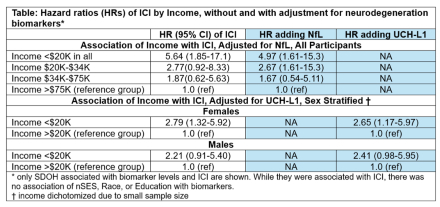
Results Three SDOH were significantly associated with ICI: lowest income HR 5.64, 95%CI 1.85-17.1; Black race HR 1.60, 95%CI 1.01-2.52; and lowest nSES tertile HR 2.69, 95%CI 1.42-5.11. After multivariable adjustment, only lower income was associated with higher biomarker concentrations, specifically NfL in all participants (Beta exp 1.19, 95%CI 1.03-1.37), and UCH-L1 in females only (Beta exp 1.52, 95%CI 1.13-2.04). Thus, attenuation analysis for UCHL-1 was sex-stratified. Biomarkers associated with income did not attenuate the income relationship (Table).
Conclusions SDOH had limited associations with studied biomarkers; lower income with higher NfL, and lower income in females with higher UCH-L1. Black race, low income and low nSES were associated with ICI risk, but biomarkers did not weaken these relationships. Consequently, targeting interventions to Black people, and those with low-income, or living in low-advantage neighborhoods may reduce ICI burden in the US population regardless of biomarker status.
Bourdeau, Jenna
(
Larner College of Medicine
, Burlington , Vermont , United States )
Cushman, Mary
(
Larner College of Medicine
, Burlington , Vermont , United States )
Kamin Mukaz, Debora
(
University of Vermont
, Colchester , Vermont , United States )
Olson, Nels
(
University of Vermont
, Colchester , Vermont , United States )
Sawyer, Russell P.
(
University of Cincinnati
, Cincinnati , Ohio , United States )
Judd, Suzanne
(
UAB
, Birmingham , Alabama , United States )
Wilkinson, Katherine
(
University of Vermont
, Colchester , Vermont , United States )
Sparks, Andrew
(
University of Vermont
, Colchester , Vermont , United States )