Grim Age Acceleration Does Not Improve Risk Prediction of the PREVENT (Predicting Risk of Cardiovascular Disease Events) Base Equation
Abstract Body: Introduction: The PREVENT (Predicting Risk of Cardiovascular Disease Events) equations estimate 10-year absolute risks for atherosclerotic CVD (ASCVD), heart failure (HF), and CVD (ASCVD + HF). Of PREVENT inputs, chronological age explains most of the variance in risk estimates. Grim Age acceleration (Grim2AA) is an epigenetic age measure that predicts morbidity and mortality; however, whether it contributes to risk prediction is not known.
Hypothesis: Incorporating Grim2AA-adjusted age into PREVENT base equations improves 10-year risk discrimination, calibration, and reclassification.
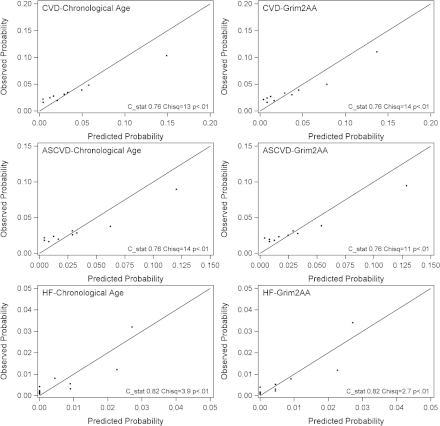
Methods: We analyzed data from the Coronary Artery Risk Development in Young Adults (CARDIA) study, a prospective, multicenter U.S. cohort. We included participants free of CVD with available clinical and Grim2AA measures in midlife (year 20 visit). Grim2AA-adjusted age (Grim2AA + chronological age) replaced chronological age in PREVENT-CVD, PREVENT-ASCVD, and PREVENT-HF base models. Model performance was assessed using C-statistics and calibration, comparing Grim2AA-adjusted age–based vs. original models. We assessed reclassification using the Partial Likelihood Ratio Test.
Results: Among the 2,432 participants included, 42.3% were men and 43.4% were Black, with a mean chronological age of 45.2 ± 3.6 years and a mean Grim2AA of 0.13 ± 5.14 years. During a median follow-up of 17.8 (interquartile range 16.9–18.0) years, 147 ASCVD, 173 CVD, and 42 HF events occurred. In univariate models, predicted risk with original and Grim2AA-adjusted PREVENT measures were each significantly associated with CVD outcomes. Each 1-SD Grim2AA-adjusted PREVENT was associated with ASCVD (1.53 [1.43–1.64]), CVD (1.50 [1.42–1.58]), and HF (1.34 [1.26–1.43]) events. There was no difference in overall predictive utility when Grim2AA-adjusted age was integrated in place of chronological age (C-statistic 0.76 [0.72–0.83] vs 0.76 [0.71–0.82]; Δ<0.01; Figure 1) for PREVENT-CVD. Findings were similar for PREVENT-ASCVD and PREVENT-HF models, with no improvement in calibration or reclassification. Results were similar among the subset of participants with Grim2AA ≥ 2 years.
Conclusions: Grim2AA does not improve CVD risk estimation of the PREVENT equations. Further research is needed to determine whether other biological age measures can enhance CVD risk assessment.
Boztepe, Bedirhan
(
Northwestern University
, Chicago , Illinois , United States )
Ning, Hongyan
(
Northwestern University
, Chicago , Illinois , United States )
Zheutlin, Alexander
(
Northwestern University
, Chicago , Illinois , United States )
Bhatt, Ankeet
(
Kaiser Permanente San Francisco Medical Center
, San Francisco , California , United States )
Bae, Sejong
(
Augusta University School of Public Health
, Augusta , Georgia , United States )
Khan, Sadiya
(
Northwestern University
, Chicago , Illinois , United States )
Wilkins, John
(
Northwestern University
, Chicago , Illinois , United States )