Non-Hispanic Black Adolescents Show Highest Prediabetes Prevalence Among Normal Weight Adolescents: Evidence from NHANES 2011–2020
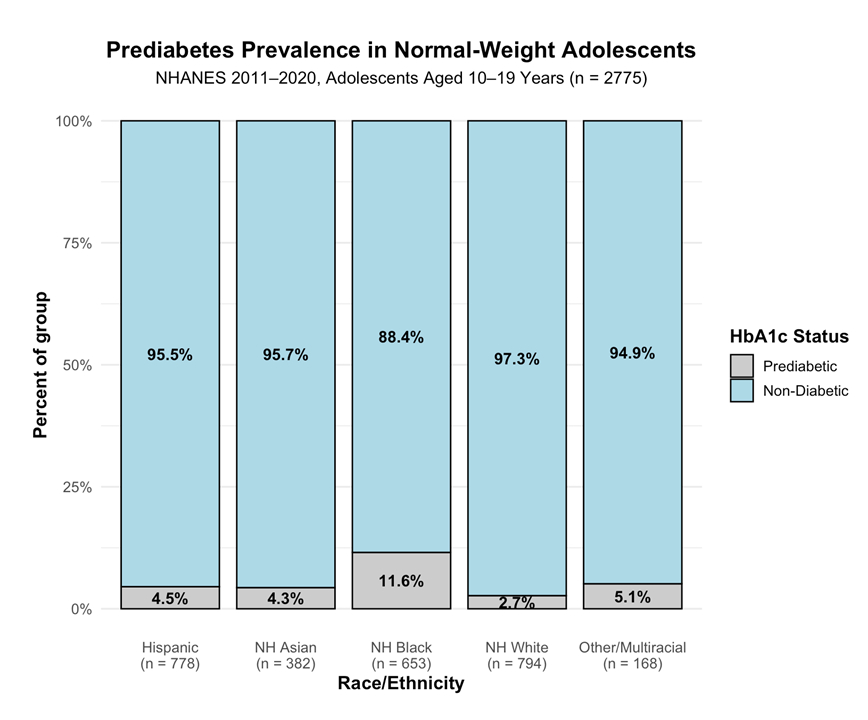
Abstract Body: Background: Prediabetes is often associated with obesity, yet prevalence among normal-weight adolescents remains underexplored. We hypothesized that racial disparities in prediabetes persist independent of obesity status Methods: We analyzed pooled 2011–2020 NHANES data for U.S. adolescents aged 10–19 years (n = 4,927). Underweight adolescents, those who had diabetes, or used insulin/metformin were excluded. Prediabetes was defined as HbA1c 5.7–6.4%, and BMI was categorized per CDC growth charts (normal 5th–<85th percentile, overweight ≥85th–<95th, obese ≥95th). The primary exposure was self-reported race/ethnicity. Weighted logistic regression models, adjusted for age, sex, and BMI, estimated the odds of prediabetes.. Results: Prediabetes prevalence differed significantly across race/ethnicity (Chi-Square = 39.0, p < 0.001). Compared with Non-Hispanic White adolescents, odds of prediabetes were higher among Non-Hispanic Black (OR = 6.22, 95% CI 4.21–9.19), Other/Multiracial (OR = 2.82), Non-Hispanic Asian (OR = 2.29), and Hispanic (OR = 2.14) youth. Among normal-weight adolescents (Figure 1), disparities persisted (Chi-Square = 12.48, p < 0.001), with Non-Hispanic Black youth showing the highest prevalence (11.6%) and nearly fivefold greater odds versus Non-Hispanic Whites. Among overweight/obese adolescents, differences remained (Chi-Square = 23.91, p < 0.001), with Non-Hispanic Black youth again showing the greatest odds (OR = 7.41, 95% CI 4.40–12.49). Conclusion: Racial disparities in prediabetes are evident even among normal-weight adolescents, with Non-Hispanic Black youth at greatest risk. Screening strategies relying solely on obesity may overlook at-risk adolescents and should incorporate early, weight-independent prevention efforts.
Gutierrez, Angel
(
University of California Berkeley
, Berkeley , California , United States )
Truong, Raymond
(
University of Houston College of Medicine
, Houston , Texas , United States )
Bacong, Adrian
(
Stanford University
, Palo Alto , California , United States )
Palaniappan, Latha
(
STANFORD UNIVERSITY
, Stanford , California , United States )