Trends in Cardiovascular Disease (CVD) Risk Factors in American Indian Populations: A Phase 7 update from the Strong Heart Family Study (SHFS)
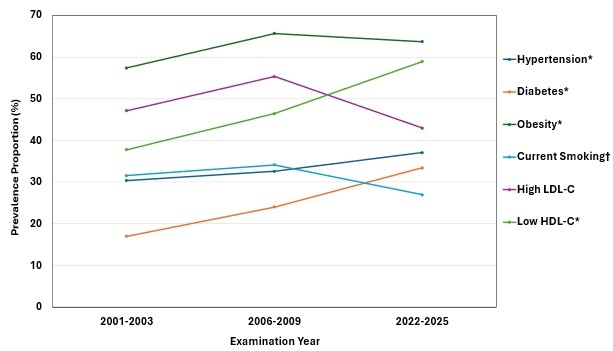
Abstract Body: Introduction: CVD is the leading cause of death among American Indians but major CVD risk factors, like hypertension, diabetes, obesity, smoking, and abnormal cholesterol, have not been updated recently. Therefore, we report changes in the prevalence of major CVD risk factors after a median 21.7 (range= 21.0-22.4) years of follow-up. Methods: The SHFS is the longest running, prospective cohort study of CVD in American Indians from Arizona, Oklahoma, and the Dakotas. We included participants from the SHFS, that completed the baseline (2001-2003), first follow-up (2006-2009), and the most recent, Phase 7, examination (2022-2025, n=1,383). We defined hypertension as high blood pressure (systolic ≥140 or diastolic ≥90 mmHg) or taking antihypertensive medication. Diabetes was defined as a measured fasting plasma glucose level ≥126 mg/dL or taking hypoglycemic medication and obesity as a measured body mass index ≥30 kg/m2. Current smoking was self-reported through standardized questionnaires. To measure lipids, we drew blood after a 12-hour fast and defined high LDL-C≥100mg/dL and low HDL-C < 40 mg/dL for men, HDL-C < 50 mg/dL for women. We used logistic generalized estimating equations to determine if the prevalence proportion of the CVD risk factors changed overtime, adjusting for age, sex, and center of collection. Results: During Phase 7, the adjusted prevalence proportion of CVD risk factors were hypertension=37%, diabetes=33%, obesity=64%, current smoking=27%, high LDL-C=43%, and low HDL-C=59% (Figure 1). Over a follow-up of 22 years, the prevalence of hypertension increased 6.7%, diabetes increased 16.4%, obesity increased 6.3%, and low HDL-C increased 21.1% (all p<0.01). Current smoking decreased 4.6% (p=0.03) and the prevalence of high LDL did not change. Conclusion: Although these results may only apply to participants who were relatively healthy at baseline, several risk factors appear to be increasing in American Indian populations, at the same time smoking behavior has decreased, and LDL-C has not changed.
Reese, Jessica
(
University of Oklahoma- HSC
, Oklahoma City , Oklahoma , United States )
Ali, Tauqeer
(
University of Oklahoma- HSC
, Oklahoma City , Oklahoma , United States )
Best, Lyle
(
Missouri Breaks Industries Research
, Watford City , North Dakota , United States )
Cole, Shelley
(
Texas Biomedical Research Institute
, San Antonio , Texas , United States )
Daffron, Kateri
(
University of Oklahoma- HSC
, Oklahoma City , Oklahoma , United States )
Devereux, Richard
(
Weill Cornell Medicine
, New York , New York , United States )
Fabsitz, Richard
(
Missouri Breaks Industries Research
, Watford City , North Dakota , United States )
Fretts, Amanda
(
University of Washington School of Public Health
, Seattle , Washington , United States )
Kota, Pravina
(
University of Oklahoma- HSC
, Oklahoma City , Oklahoma , United States )
Li, Weiyi
(
University of Oklahoma- HSC
, Oklahoma City , Oklahoma , United States )
Soliman, Elsayed
(
WAKE FOREST SCHOOL OF MEDICINE
, Winston Salem , North Carolina , United States )
Umans, Jason
(
MedStar Health Research Institute
, Bethesda , Maryland , United States )
Willmott, Heather
(
University of Oklahoma- HSC
, Oklahoma City , Oklahoma , United States )
Zhang, Ying
(
University of Oklahoma- HSC
, Oklahoma City , Oklahoma , United States )
Keshvani Neil, Wang Thomas, Pandey Ambarish, Coellar Juan David, Rizvi Syed Kazim, Jain Anand, Bustillo-rubio M. Karina, Segar Matthew, Lokesh Nidhish, Miller James, Yates Sean