

Logo

American Heart Association

  1
  0


Final ID: TH918

Post-prandial glucose and triglyceride response to a standardized mixed meal tolerance test among community-dwelling adults

Abstract Body: Background The glycemic response to an oral glucose tolerance test (OGTT, comprised of 75 g of glucose) can be used to characterize diabetes risk in individuals with normal fasting glucose. While the post-meal triglyceride response has been associated with higher cardiovascular disease (CVD) risk, there is limited data on post-meal triglyceride responses and specific thresholds are uncertain. We characterized glucose and triglyceride responses to a standardized meal among a large prospective cohort of community-dwelling adults to characterize metabolic responses and their underlying relations.
Methods Framingham Heart Study Generation 3, Omni 2, and New Offspring Spouses participants free of diabetes underwent a standardized mixed meal tolerance test (MMTT, comprised of 48% carbohydrate [with 75 g glucose], 31% fat, and 21% protein) during a routine examination cycle (N = 2,081). Blood samples were collected after a 10-hour fast and 2 hours post-MMTT. We characterized an abnormal glucose response as 2-hour glucose ≥140 mg/dL (consistent with impaired glucose tolerance) and abnormal triglyceride response as 2-hour triglycerides ≥175 mg/dL, based on published criteria. Clinical predictors of post-MMTT glucose and triglyceride responses were assessed using linear models with adjustment for fasting values.
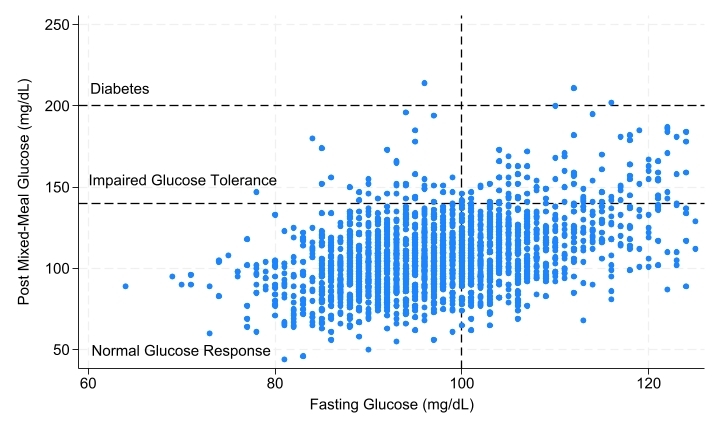
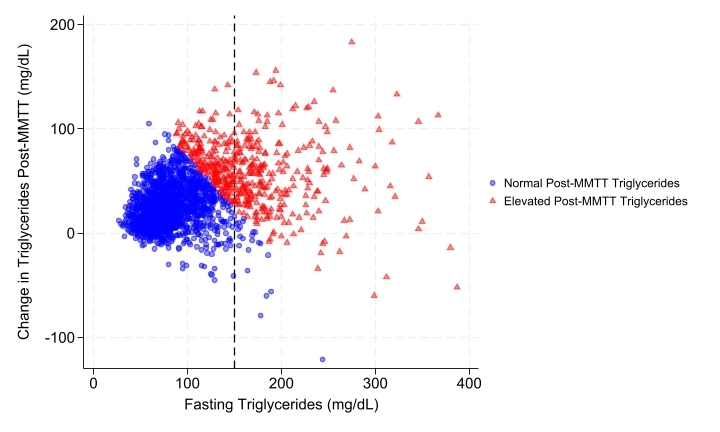
Results In the study sample, 54.3% were female, mean age was 59.5 ± 8.7 years, and BMI was 28.4 ± 5.4 kg/m2. Post-MMTT glucose was moderately correlated with fasting glucose (r = 0.43) whereas post-MMTT triglycerides were strongly correlated with fasting triglycerides (r = 0.90). In total, 159 participants (7.6%) had an abnormal glucose response (impaired glucose tolerance); among these, 4 individuals (0.2%) had a response consistent with diabetes (Figure 1). For triglycerides, 468 participants (22.5%) had an abnormal response. Notably, 186 participants (8.9%) with normal fasting triglycerides had elevated post-MMTT triglycerides (Figure 2). In linear models, we observed distinct clinical correlates of the post-MMTT glucose and triglyceride response (Figure 3).
Conclusion A standardized mixed meal tolerance test may allow for the identification of individuals with underlying metabolic dysfunction that is not readily apparent in the fasting state. Further research is needed to understand the clinical implications of post-prandial triglyceride and glucose responses among community-dwelling individuals.
  • Qian, Frank  ( Boston Medical Center , Boston , Massachusetts , United States )
  • Aghi, Anushka  ( Boston University School of Medicine , Boston , Massachusetts , United States )
  • Mi, Michael  ( Beth Israel Deaconess Medical Ctr , Boston , Massachusetts , United States )
  • Nayor, Matthew  ( Boston Medical Center , Boston , Massachusetts , United States )
  • Author Disclosures:
Meeting Info:

EPI-Lifestyle Scientific Sessions 2026

2026

Boston, Massachusetts

Session Info:

Poster Session 3

Thursday, 03/19/2026 , 05:00PM - 07:00PM

Poster Session

More abstracts on this topic:
A human cardiomyocyte model of CD36 haploinsufficiency uncovers fatty acid oxidation deficits driving dilated cardiomyopathy

Al Sayed Zeina, Klattenhoff Carla, Aragam Krishna, Ellinor Patrick, Willcox Jon, Zheng Alice, Koledova Vera, Srivastava Salil, Yin Xiaofei, Chaffin Mark, Rigaud Vagner, Kovacs-bogdan Erika

84 Immune checkpoint profiling in major aortic diseases leads to identification of potential roles of CD155-CD206 pathway in suppressing inflammation and immune responses

Shao Ying, Saaoud Fatma, Xu Keman, Lu Yifan, Jiang Xiaohua, Wang Hong, Yang Xiaofeng

You have to be authorized to contact abstract author. Please, Login
Not Available