
Logo

American Heart Association

  11
  0


Final ID: TU218

Are U.S. Women Meeting Nutritional Guidelines Across Pregnancy? Data from a Multicenter National Cohort

Abstract Body: Introduction:
Optimal nutrition during pregnancy is essential to support maternal health and fetal development. Although the 2020-2025 US Dietary Guidelines include specific nutritional goals for pregnancy, it is unclear if pregnant women are meeting those goals.

Purpose:
To assess nutritional intake and dietary quality in early and late pregnancy and compare with US Dietary Guidelines.

Methods:
Pregnant women enrolled in the prospective multicenter GO MOMs study completed three non-consecutive 24-hr dietary recalls using the Automated Self- Administered Dietary Assessment tool (ASA24) in early (10 - 21wks) and again in late pregnancy (24 - 37wks). Daily macronutrient and micronutrient intakes from food sources, adjusted for kcal, were compared with nutritional guidelines for pregnant women ages 19 - 50yrs. Percent of recommended intake and Healthy Eating Index (HEI) scores (0 - 100) were calculated.

Results:
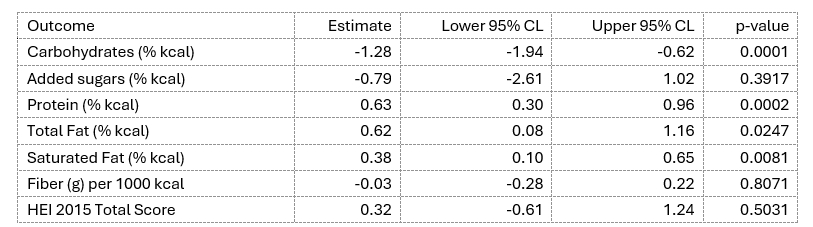
Among 542 pregnant women (mean 32yrs, mean BMI, 26.6kg/m2), 99% in early pregnancy and 92% in late pregnancy completed at least one dietary recall. Mean energy intake increased from early to late pregnancy (2004 to 2172kcals). Mean differences from early to late pregnancy in percentage of energy from protein, fat, and saturated fat increased while carbohydrate intake decreased (Table 1). Despite increases in energy intake, fiber density and percent of energy from added sugars remained unchanged. Dietary quality remained low throughout pregnancy (average HEI scores of 53). Key micronutrient intake including folate, iron, choline, potassium, calcium, sodium and vitamin D increased significantly over time.

Both in early and late pregnancy, 98% met the Acceptable Macronutrient Distribution Range (AMDR) for protein, and 61% vs. 53% (early vs. late) met the recommended AMDR for carbohydrate intakes. Dietary fiber intake was low overall with 9% vs. 8% meeting recommended levels and added sugar intake exceeded guidelines in 44% vs. 48% of women. More than 50% consumed below recommended levels for key micronutrients and 3% met the recommended 27 mg of iron/day throughout pregnancy. Sodium intake exceeded the recommended intake in 86% vs. 92% of women in early vs. late pregnancy.

Conclusion:
Pregnant women did not meet recommended intake for several key nutrients and exceeded limits for sodium, saturated fat, and added sugars throughout pregnancy. Dietary quality remained low across gestation, highlighting the need for nutrition interventions during pregnancy.
  • Oshiro, Caryn  ( Kaiser Permanente Hawaii , Honolulu , Hawaii , United States )
  • Leblanc, Erin  ( Kaiser Permanente Northwest, Center for Health Research , Portland , Oregon , United States )
  • Catalano, Patrick  ( Massachusetts General Hospital , Boston , Massachusetts , United States )
  • Powe, Camille  ( Massachusetts General Hospital , Boston , Massachusetts , United States )
  • Andrei, Adi  ( Northwestern University, Feinberg School of Medicine , Chicago , Illinois , United States )
  • Gray, Elizabeth  ( Northwestern University Feinberg School of Medicine , Chicago , Illinois , United States )
  • Considine, Elizabeth  ( Yale School of Medicine , New Haven , Connecticut , United States )
  • Feghali, Maisa  ( University of Pittsburgh , Pittsburgh , Pennsylvania , United States )
  • Vesco, Kimberly  ( Kaiser Permanente Northwest, Center for Health Research , Portland , Oregon , United States )
  • Zork, Noelia  ( Columbia University Irving Medical Center , New York , New York , United States )
  • Author Disclosures:
Meeting Info:

EPI-Lifestyle Scientific Sessions 2026

2026

Boston, Massachusetts

Session Info:

Poster Session 1

Tuesday, 03/17/2026 , 05:00PM - 07:00PM

Poster Session

More abstracts on this topic:
Aberrant MicroRNA Expression May Underlie Cardiac Dysfunction in a rat model of Preeclampsia

Vaka Ramana, Campbell Nathan, Edwards Kristin, Hoang Ngoc, Zheng Baoying, Lamarca Babbette

Advanced maternal age and association with major adverse cardiovascular events from NHANES from 1999 to 2018

Mehta Adhya, Honigberg Michael, Kennedy Jamie, Spitz Jared, Sharma Garima, Agboola Olayinka, Satti Danish Iltaf, Harrington Colleen, Scott Nandita, Sarma Amy, Saad Antonio, Sullivan Scott, Epps Kelly

More abstracts from these authors:
The Impact of Glucose Intolerance in Pregnancy

Powe Camille, Venkatesh Karthik, Michos Erin

Higher Gestational Weight Gain Is Associated With A Lower Risk Of Incident Diabetes

Chambers Brianna, Soria-contreras Diana, Pant Deepti, Hsu Sarah, Maya Jacqueline, Thaweethai Tanayott, Powe Camille

You have to be authorized to contact abstract author. Please, Login
Not Available