Genome-wide Characterization of Fourteen Circulating Metals and Possible Contribution to Cardiovascular-Kidney-Metabolic Syndrome
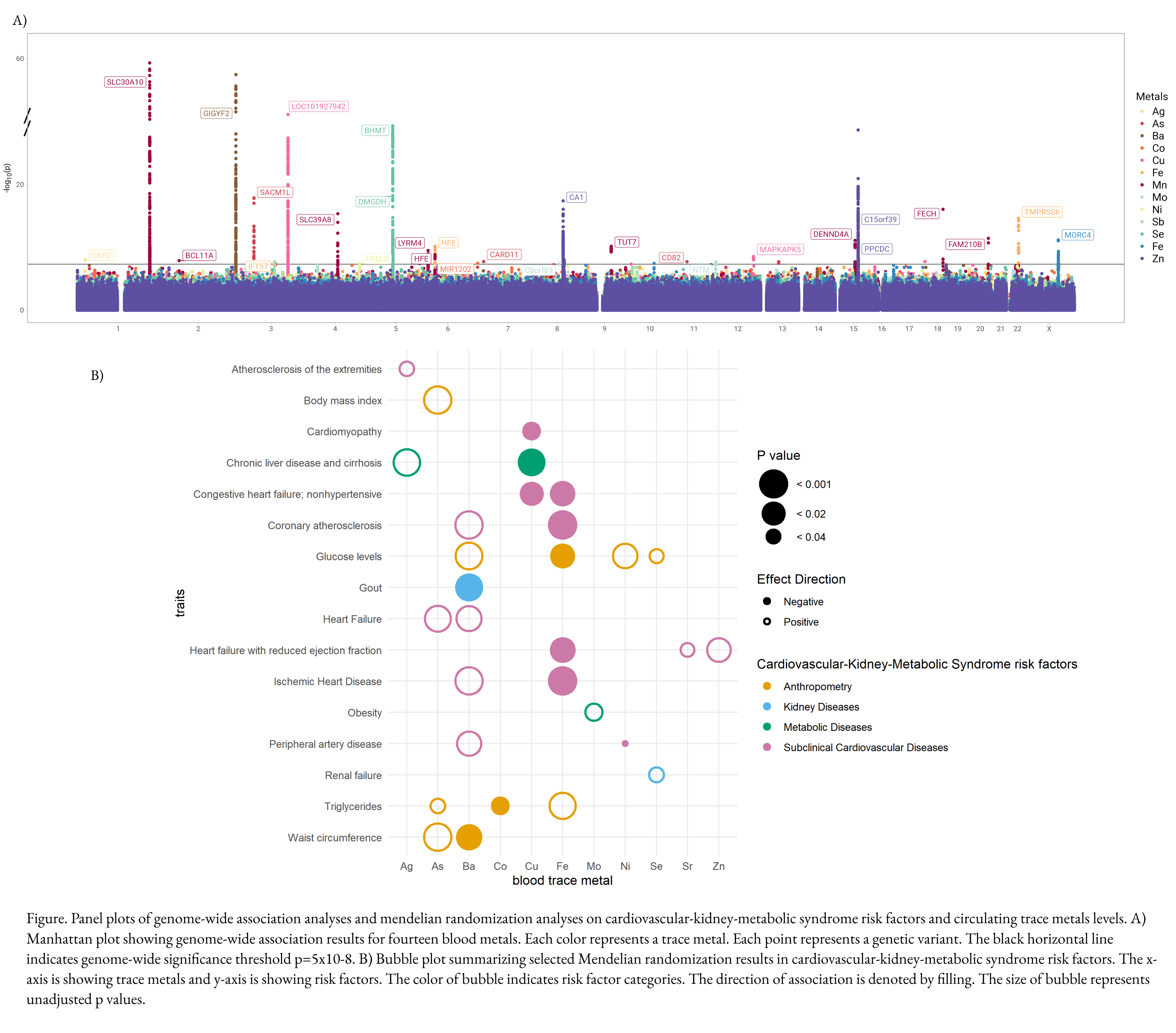
Abstract Body: Introduction Trace metals, both essential and non-essential, can be toxic at abnormally high or low concentrations and may contribute to cardiovascular-kidney-metabolic (CKM) syndrome. Limited genomic studies have examined trace metals in multi-ethnic populations. Hypothesis We hypothesize that common genetic variants are associated with circulating trace metal levels in a multi-ethnic population, and metal-related genetic variants may contribute to CKM. Methods Metal data were rank-based inverse-norm transformed and missingness imputed as LOD by √2. We conducted genome-wide association analysis of fourteen trace metals in the Atherosclerosis Risk in Communities Study (ARIC) separately for Black and White participants. The results summaries were then meta-analyzed with results from prior genetic studies of European and Asian cohorts for each metal. To elucidate potential biological mechanisms and phenotypic consequences, we performed downstream analyses including phenome-wide association analyses (PheWAS) by leveraging UK Biobank and FinnGen genetic summaries, colocalization with GTEx v8 expression data, and two-sample Mendelian Randomization (MR) with CKM traits. Results Among 15,054 multi-ethnic participants, 38 genetic loci (18 novel) were associated with 14 circulating metal levels (p<5×10⁻⁸, Figure A). For example, rs130107325, a missense variant on SLC39A8, previously linked to systolic and diastolic blood pressure, was associated with manganese. A novel locus, rs11939299 (PALLD), was associated with nickel, a gene previously linked to coronary artery disease. A novel intronic variant, rs41353851 (CARD11), previously associated with congenital cardiovascular anomalies, was associated with arsenic. In the PheWAS,111 significant associations were identified (p<2.7x10⁻¹⁰), including cardiovascular traits such as mean arterial, systolic, and diastolic blood pressure. Fourteen out of 38 identified loci showed evidence of colocalization (PP.H4>0.8) with gene expression in tissues, such as strontium with heart atrial appendages. In the MR, 31 significant associations showed modest to moderate effects on CKM traits (p<0.05, Figure B), including iron and barium with coronary atherosclerosis and barium with ischemic heart disease. Conclusion We identified novel loci associated with circulating trace metal concentrations in multi-ethnic populations. The observed associations in the downstream analysis provided biological plausibility of metal on CKM health effects.
Liu, Guning
(
The University of Texas Health Science Center at Houston
, Houston , Texas , United States )
Nguyen, Ngoc Quynh
(
UTHealth School of Public Health
, Houston , Texas , United States )
Alkis, Taryn
(
The University of Texas Health Science Center at Houston
, Houston , Texas , United States )
Zhou, Peidi
(
UTHealth School of Public Health
, Houston , Texas , United States )
Lutsey, Pamela
(
University of Minnesota
, Minneapolis , Minnesota , United States )
Navas-acien, Ana
(
Columbia University
, New York , New York , United States )
Boerwinkle, Eric
(
UTHealth
, Houston , Texas , United States )
Yu, Bing
(
UNIV OF TX HEALTH SCI CTR HOUSTON
, Houston , Texas , United States )