Plasma proteomics of fatigue and risk of incident heart failure in the Atherosclerosis Risk in Communities (ARIC) Study
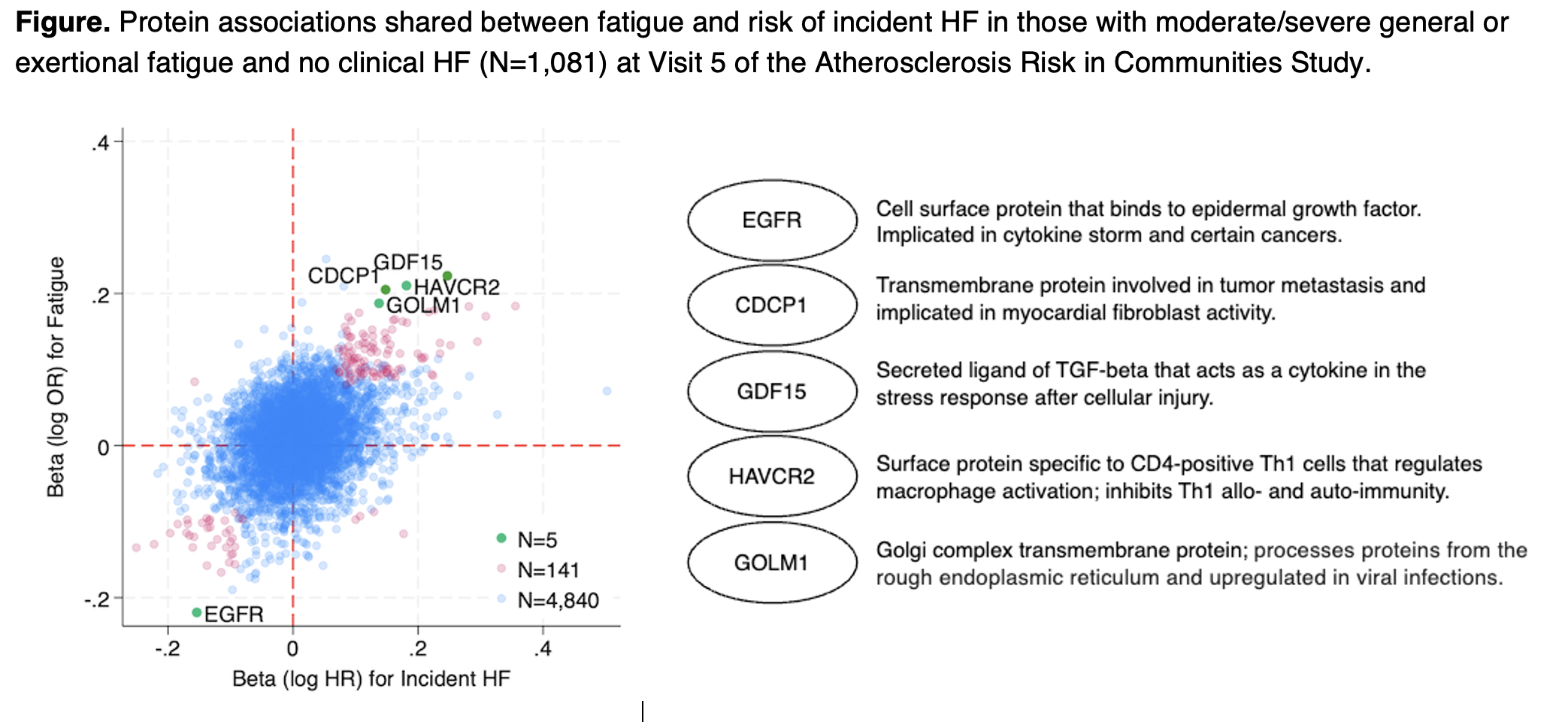
Abstract Body: Background: Among individuals at risk for heart failure (HF), general and exertional fatigue are common symptoms and are associated with HF development. The biological mechanisms underlying the associations of fatigue measures with incident HF are poorly understood and may be further clarified using proteomic profiling. Methods: We evaluated 4,558 individuals without clinical HF at ARIC Visit 5 (2011-2013), who had ~ 5000 plasma proteins quantified from stored Visit 5 samples using an aptamer-based platform (SomaScan). Moderate/severe fatigue was defined as a score of ≥ 52.5 on the Patient Reported Outcomes Information System (PROMIS) fatigue scale (general fatigue) and/or a score of >2 on the MRC Breathlessness Scale (exertional fatigue). In cross-sectional analysis, we used multivariate logistic regression to identify proteins associated with any fatigue and with individual fatigue types, using the false discovery rate (FDR) to account for multiple comparisons. Among individuals with fatigue, we used Cox regression to identify proteins associated (at FDR significance) with incident HF after Visit 5 through 12/31/23. We assessed for overlap between proteins associated with fatigue and those with future HF in the setting of fatigue. Results: Within the study population (mean age 75, 59% female, 19% black), 24% had moderate/severe fatigue. In cross-sectional analysis, 7 proteins were associated with any fatigue (vs no fatigue) after multivariable adjustment. Among these, 4 proteins were associated with exertional fatigue only, and none with general fatigue only. In those with moderate/severe fatigue, 301 proteins were associated with incident HF. Among these, 5 proteins were associated with both moderate/severe fatigue cross-sectionally and risk of incident HF prospectively (Figure). These included epidermal growth factor receptor (EGFR), CUB domain containing protein 1 (CDCP1), growth differentiation factor-15 (GDF15), Hepatitis A virus cellular receptor 2 (HAVCR2), and golgi membrane protein 1 (GOLM1) (Figure). These proteins are implicated in inflammation, cytokine production, and myocardial fibroblast activity. Conclusions: In older adults without prevalent HF, we identified several proteins associated both with moderate/severe fatigue and with the risk of HF in the setting of fatigue. These results provide new insights into potential mechanisms underlying the associations of fatigue with HF development.
Pavlovic, Noelle
(
Boston College School of Nursing
, Chestnut Hill , Massachusetts , United States )
Zhang, Sui
(
Johns Hopkins University
, Baltimore , Maryland , United States )
Lee, Christopher
(
Boston College
, Chestnut Hill , Massachusetts , United States )
Ozkan, Bige
(
Johns Hopkins University
, Baltimore , Maryland , United States )
Matsushita, Kunihiro
(
JOHNS HOPKINS UNIVERSITY
, Baltimore , Maryland , United States )
Ballantyne, Christie
(
BAYLOR COLLEGE MEDICINE
, Houston , Texas , United States )
Yu, Bing
(
UNIV OF TX HEALTH SCI CTR HOUSTON
, Houston , Texas , United States )
Shah, Amil
(
UT Southwestern Medical Center
, Dallas , Texas , United States )
Coresh, Josef
(
NYU Grossman School of Medicine
, New York , New York , United States )
Ndumele, Chiadi
(
JOHNS HOPKINS HOSPITAL
, Silver Spring , Maryland , United States )