Proteomic-Based Biological Aging Clocks Are Associated with Cognitive Aging: The Atherosclerosis Risk in Community Study
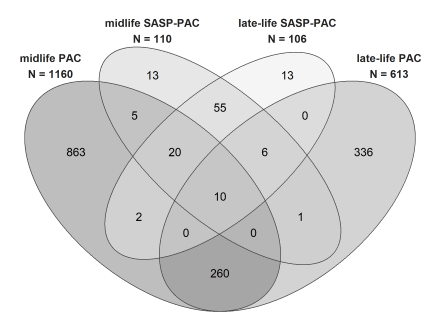
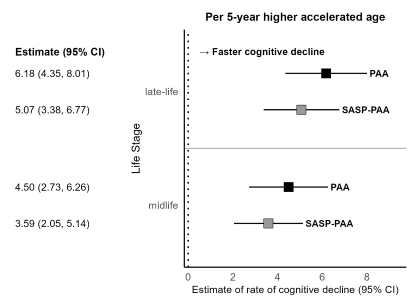
Abstract Body: Background: Proteomic aging clocks (PACs) reflect multifactorial biological aging and have shown strong associations with dementia risk. However, it remains unclear whether PACs can track cognitive aging trajectories among non-demented people. We examined associations between previously developed PACs and cognitive aging and also tested senescence-specific PACs (SASP-PACs), based on senescence-associated secretory phenotype (SASP) proteins, to assess their relevance compared with non-pathway-specific PACs. Methods: Participants from the Atherosclerosis Risk in Communities (ARIC) cohort, a U.S. population-based study, who remained dementia-free by 2022 were included in this analysis at two time points: midlife (Visit 2, 1990-92; N=3,510; mean age 54 y; 58% female, 17% Black) and late-life (Visit 5, 2011-13; N=3,745; mean age 75 y; 58% female, 17% Black). Non-pathway-specific PACs based on ~5,000 proteins measured by SomaScan were previously developed by training proteins against chronological age using elastic net regression and calculated as weighted sums (midlife: 1,160 and late-life: 613 proteins). SASP-PACs were created using the same method but included only SASP proteins (midlife:110 and late-life:106 proteins). The numbers of overlapping proteins are shown in Figure 1. Age acceleration (PAA for PACs and SASP-PAA for SASP-PACs) at each life stage was defined as the residual from regressing each PAC on chronological age. Cognitive aging from Visit 5 to 9 (2011–22) was defined as the percentage difference in an individual’s cognitive decline slope from the sample median, estimated using linear mixed models. To account for loss to follow-up, missing cognitive scores were imputed using multilevel joint modeling with predictors and auxiliary variables (e.g., mid-visit cognitive screening test scores). Associations between midlife and late-life PAA/SASP-PAA and cognitive aging were assessed using linear regression, adjusting for demographic and cardiovascular risk factors. Results: Each five-year increase in PAA was associated with a faster rate of cognitive decline relative to the sample median (β [95% CI]; midlife=4.50% [2.73%, 6.26%]; late-life=6.18% [4.35%, 8.01%]). SASP-PAA, despite using fewer proteins, showed comparable results (midlife=3.59% [2.05%, 5.14%]; late-life=5.07% [3.38%, 6.77%]) (Figure 2). Conclusions: PACs show potential to support monitoring of cognitive aging trajectories and early risk stratification for clinical cognitive impairment.
Park, Saeun
(
University of Minnesota
, Minneapolis , Minnesota , United States )
Giorgio, Katherine
(
University of Minnesota
, Minneapolis , Minnesota , United States )
Pike, James
(
Johns Hopkins University
, Chapel Hill , North Carolina , United States )
Hughes, Timothy
(
Wake Forest University School of Medicine
, Winston-Salem , North Carolina , United States )
Coresh, Joe
(
New York University Grossman School of Medicine
, New York , New York , United States )
Walker, Keenan
(
National Institute on Aging
, Mount Airy , Maryland , United States )
Guan, Weihua
(
University of Minnesota
, Minneapolis , Minnesota , United States )
Lutsey, Pamela
(
University of Minnesota
, Minneapolis , Minnesota , United States )
Prizment, Anna
(
University of Minnesota
, Minneapolis , Minnesota , United States )
Sedaghat, Sanaz
(
University of Minnesota
, Minneapolis , Minnesota , United States )