
Logo

American Heart Association

  22
  0


Final ID: TU261

Objectively Measured Sleep Duration and Incident Kidney Stone Disease: The Multi-Ethnic Study of Atherosclerosis

Abstract Body: Background: Kidney stone disease (KSD) is linked to chronic conditions such as hypertension, diabetes, and cardiovascular disease. Both short and long sleep duration have been associated with these conditions, but their relationship with KSD is unclear. We examined the association between sleep duration, an indicator of sleep health, and the risk of KSD.

Hypothesis: Both short and long sleep duration are associated with higher risk of KSD.

Methods: We analyzed data from the Multi-Ethnic Study of Atherosclerosis (MESA) Sleep ancillary study, conducted at Exam 5 (2010-2012), with kidney stone data collected by self-report at Exams 5 and 6 (2016-2018). Sleep duration, measured by wrist actigraphy, was categorized as short (<6 hours/night), medium-short (≥6 to <7 hours/night), medium-long (≥7 to <8 hours/night), and long (≥8 hours/night). The medium-long group served as the reference category. Incident KSD was defined as a first kidney stone between Exams 5 and 6; recurrent KSD was defined as a stone in this interval plus a prior stone before Exam 5. Multivariable Poisson regression with robust variance estimates was used to estimate risk ratios (RR).

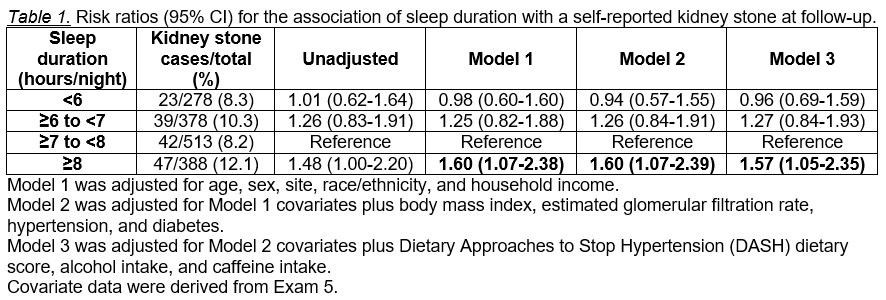
Results: Of 1,557 participants with complete actigraphy and KSD data, 151 reported KSD at Exam 6. In a fully adjusted multivariable model, long sleep duration was associated with higher risk of a kidney stone at follow-up (RR 1.57, 95% CI: 1.05-2.35; Table 1). This association was also statistically significant for incident KSD (RR 2.07, 95% CI: 1.04-4.10), but not statistically significant for recurrent KSD (RR 1.52, 95% CI: 0.92-2.51).

Conclusion: Long sleep duration was associated with incident kidney stones in this study. This finding aligns with evidence linking long sleep duration to adverse health outcomes. Future studies are needed to confirm this finding and explore underlying mechanisms.
  • Crivelli, Joseph  ( University of Alabama at Birmingham , Birmingham , Alabama , United States )
  • Turgut, Alp  ( University of Alabama at Birmingham , Birmingham , Alabama , United States )
  • Amini, Armon  ( University of Alabama at Birmingham , Birmingham , Alabama , United States )
  • Redline, Susan  ( Brigham and Women's Hospital , Boston , Massachusetts , United States )
  • Author Disclosures:
Meeting Info:

EPI-Lifestyle Scientific Sessions 2026

2026

Boston, Massachusetts

Session Info:

Poster Session 1

Tuesday, 03/17/2026 , 05:00PM - 07:00PM

Poster Session

More abstracts on this topic:
A human cardiomyocyte model of CD36 haploinsufficiency uncovers fatty acid oxidation deficits driving dilated cardiomyopathy

Al Sayed Zeina, Klattenhoff Carla, Aragam Krishna, Ellinor Patrick, Willcox Jon, Zheng Alice, Koledova Vera, Srivastava Salil, Yin Xiaofei, Chaffin Mark, Rigaud Vagner, Kovacs-bogdan Erika

A Quarter Century of Cardiovascular Strain: Mortality Trends in Hypertension and Hypertensive Heart Disease Among U.S. Adults Aged 55+

Ali Muhammad Faizan, Khan Muhammad, Sharif Aleena, Hossain Mohammad, Ahmad Husnain, Eltawansy Sherif, Faizan Muhammad, Ahmed Ashraf, Abdul Malik Mohammad Hamza Bin, Pahwani Ritesh, Patel Rahul, Mehdi Hassan

More abstracts from these authors:
Structural and Load-Dependent Arterial Stiffness Mechanisms and Sleep-Disordered Breathing: The Multi-Ethnic Study of Atherosclerosis.

Iyeku Akinwale, Korcarz Claudia, Pewowaruk Ryan, Hughes Timothy, Azarbarzin Ali, Redline Susan, Gepner Adam

Associations of Occupational and Social Factors with Incident Kidney Stones in the Pro-Saude Study

Crivelli Joseph, Goldfarb David, Mazzucchi Eduardo, Griffin Russell, Maluf Feres, Elorrieta Vicente, Faerstein Eduardo

You have to be authorized to contact abstract author. Please, Login
Not Available