EPI-Lifestyle Scientific Sessions 2026
/
Poster Session 1
/
Childhood and Adolescent Internalizing and Externalizing Symptom Trajectories and Cardiovascular Health in Young Adulthood: The Future of Families–Cardiovascular Health Among Young Adults study
American Heart Association
85
0
Final ID: TU133
Childhood and Adolescent Internalizing and Externalizing Symptom Trajectories and Cardiovascular Health in Young Adulthood: The Future of Families–Cardiovascular Health Among Young Adults study
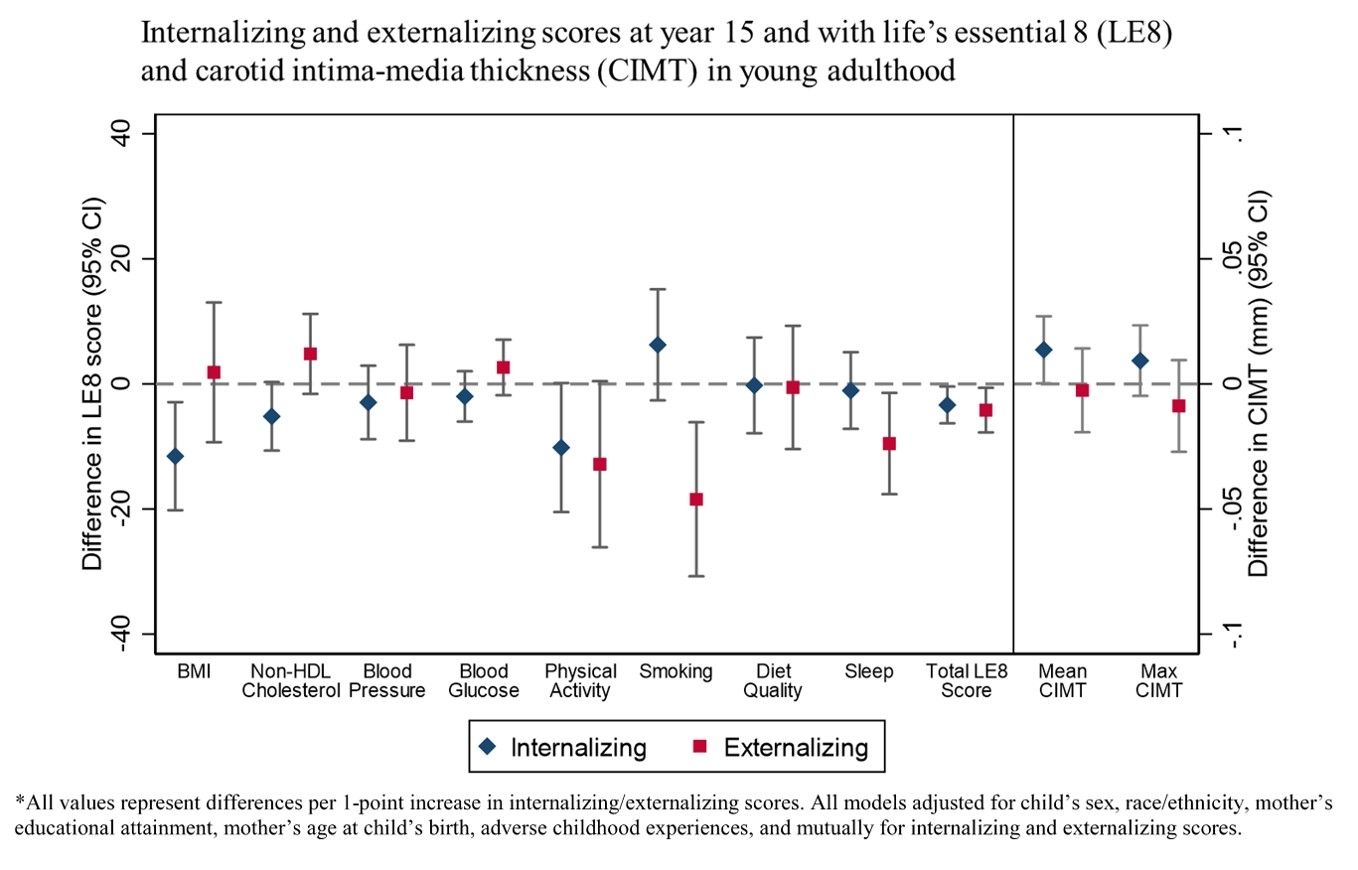
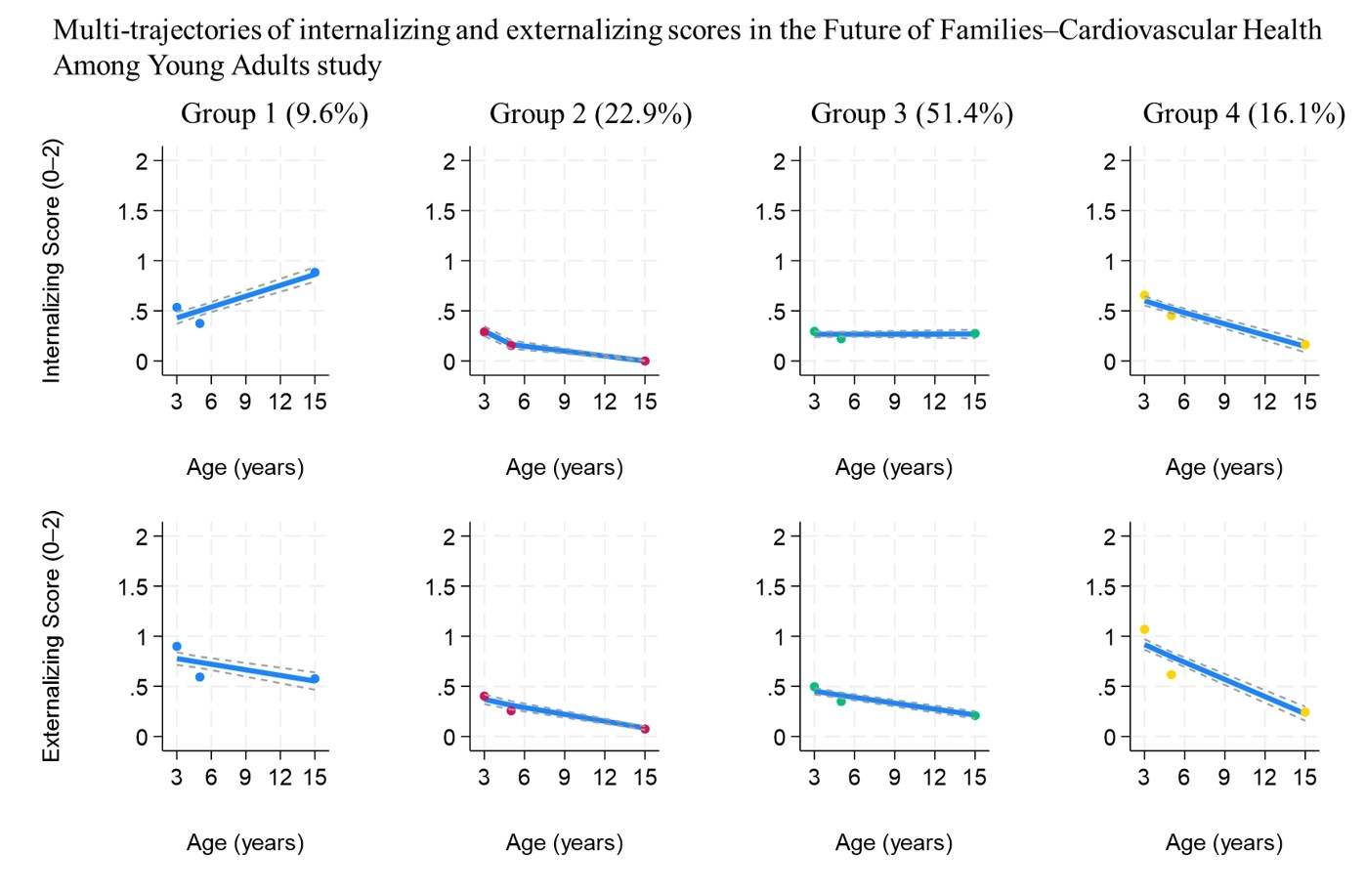
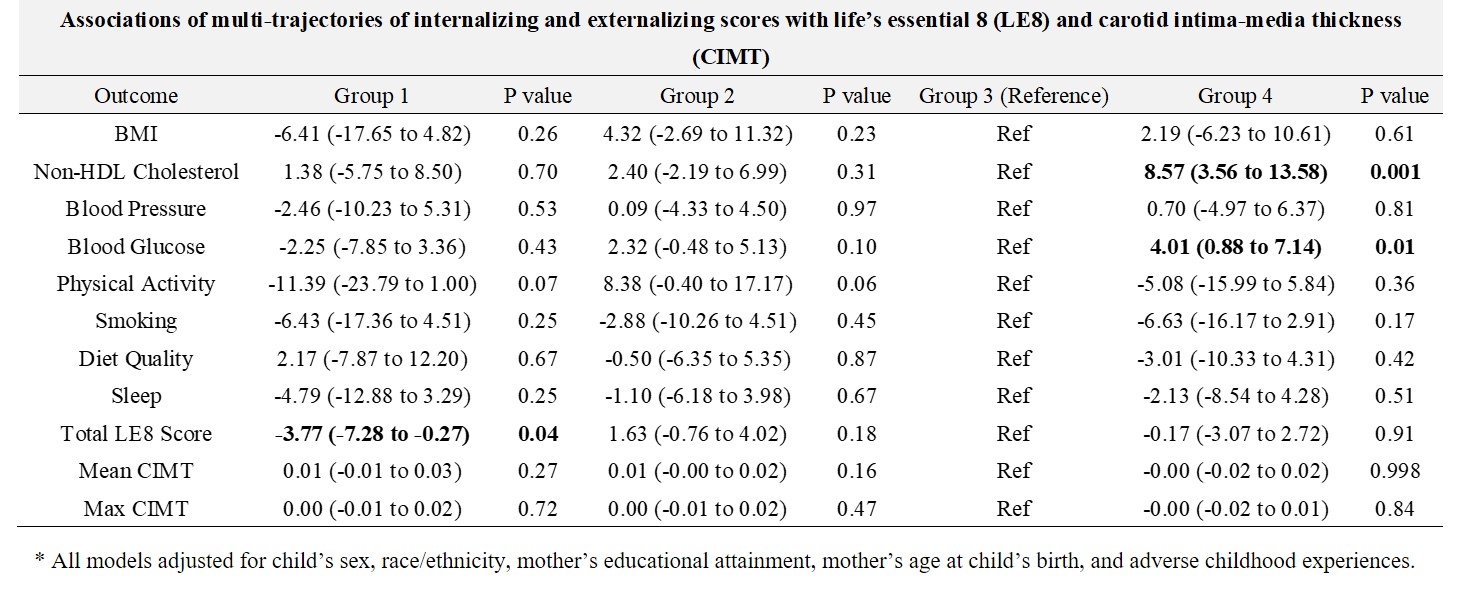
Abstract Body: Background: Internalizing and externalizing problems are the most prevalent childhood onset mental health syndromes. These reflect early behavioral patterns underlying lifestyles that presage a cardiovascular risk pathway. However, these areas of inquiry have rarely been integrated. Here, we examine their associations with cardiovascular health and subclinical atherosclerosis in young adulthood. Methods: We included 1,125 participants from the Future of Families and Child Wellbeing Study who completed the Year 15 examination and the Year 22 cardiovascular health assessment. At Year 15, primary caregivers completed the Child Behavior Checklist (CBCL) to assess internalizing problems (anxiety, depression, and social withdrawal; 8 items) and externalizing problems (aggression and rule-breaking behaviors; 20 items). Scores were averaged (range: 0–2.0), with higher values indicating more problems. Among those with CBCL data at Years 3, 5, and 15 (n = 626), group-based multi-trajectory modeling was used to identify developmental patterns of internalizing and externalizing problems. Life’s Essential 8 (LE8; range: 0–100) and carotid intima-media thickness (CIMT) were assessed at Year 22. Multivariable linear regression models with multiple imputation examined the associations of (1) Year 15 internalizing and externalizing scores and (2) trajectory groups with LE8 and CIMT, adjusting for child’s sex, race, maternal education, maternal age at birth, poverty level, and adverse childhood experiences. Results: Higher internalizing and externalizing scores at age 15 were associated with lower LE8 scores in young adulthood (β = –3.36, 95% CI: –6.30 to –0.42; β = –4.19, 95% CI: –7.75 to –0.62, per 1-point increase). Internalizing problems were primarily associated with lower BMI scores, whereas externalizing problems were associated with lower smoking and sleep scores. Higher internalizing scores were associated with increased mean CIMT (β = 0.01 mm, 95% CI: 0.00 to 0.03). Among the four developmental trajectories identified, the increasing-internalizing/high-externalizing group (group 1) had lower LE8 scores (β = –3.77, 95% CI: –7.28 to –0.27) compared with the low-internalizing/low-externalizing group (group 3). Conclusions: Higher internalizing and externalizing symptoms were associated with worse cardiovascular health in young adulthood. Addressing childhood emotional and behavioral problems may be important for maintaining cardiovascular health from youth to adulthood.
Teramoto, Masayuki
(
Northwestern Universtiy
, Evanston , Illinois , United States )
Ning, Hongyan
(
Northwestern Universtiy
, Evanston , Illinois , United States )
Lloyd-jones, Donald
(
Boston University Medical Center
, Boston , Massachusetts , United States )
Notterman, Daniel
(
Princeton University
, Princeton , New Jersey , United States )
Wakschlag, Lauren
(
Northwestern Universtiy
, Evanston , Illinois , United States )
Allen, Norrina
(
Northwestern Universtiy
, Evanston , Illinois , United States )