Social Determinants and Accumulation of Cardiometabolic Risk Factors in a Community Cohort: An Inverse Probability of Treatment Weighting Analysis
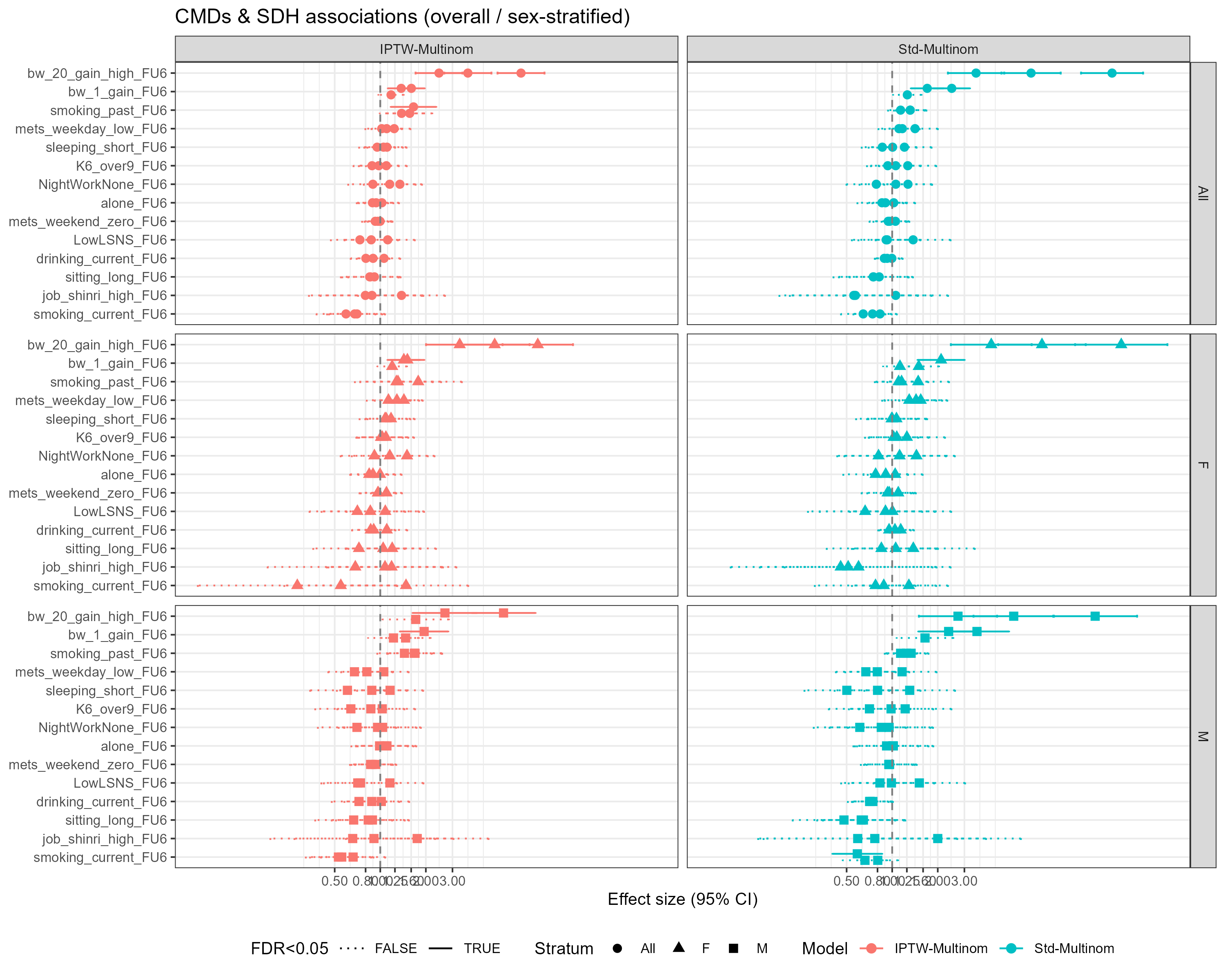
Abstract Body: Introduction: The co-occurrence of cardiometabolic risk factors (CMRFs) is strongly associated with all-cause mortality and incident disability. Although social determinants of health (SDoH), including lifestyle and psychosocial factors, have been recognized as important contributors to chronic diseases, their causal relationships with CMRF accumulation have not been sufficiently investigated. Hypothesis: SDoH are causally associated with CMRF accumulation. Methods: A total of 5,332 participants (2,362 men and 2,970 women, ≥40 years at T0) without cardiovascular disease completed initial (T0; 2012–2015) and six-year (T1) surveys in a Japanese population-based cohort. SDoH variables assessed at both timepoints included physical activity, sedentary time, sleep, alcohol, smoking, weight change, Kessler 6, Lubben Social Network Scale, living arrangement, occupational stress, and education. We analyzed cross-sectional associations between CMRFs scores (sum of hypertension, dyslipidemia, impaired glucose metabolism, and overweight, defined according to clinical guidelines) and SDoH at T1, using inverse probability of treatment weighting (IPTW) based on T0 data to estimate causal effects, applying multinomial logistic regression to estimate odds ratios comparing 1, 2, or ≥3 CMRFs versus 0 CMRFs adjusted for sex, age, and smoking. Results: Weight gain since age 20 showed the strongest association with CMRF accumulation, and recent weight gain within the past year was also positively associated with higher CMRF scores. Past smoking was associated with increased odds of CMRF accumulation, while current smoking showed a paradoxical inverse association, likely reflecting reverse causation whereby individuals with higher disease burden had already quit smoking. The cross-sectional association between current alcohol consumption and CMRFs observed in standard multinomial analysis disappeared after inverse probability of treatment weighting adjustment for T0 confounders. Additional modest associations included low weekday physical activity, high psychological distress, and short sleep duration. Conclusions: Both early adulthood weight gain and recent weight gain are the most robust modifiable risk factors for CMRF accumulation. These findings highlight weight management throughout life, warranting targeted interventions in health screening programs. Further investigation of other social determinants is needed to fully understand their contributions to CMRF development.
Iba, Chisato
(
Keio University School of Medicine
, Tokyo , Japan )
Toki, Ryota
(
Keio University
, Tokyo , Japan )
Omoto, Yuki
(
Keio University School of Medicine
, Tokyo , Japan )
Iida, Miho
(
Keio University
, Tokyo , Japan )
Edagawa, Shun
(
Keio University
, Tokyo , Japan )
Shibuki, Takuma
(
Keio University
, Tokyo , Japan )
Harada, Sei
(
Keio University
, Tokyo , Japan )
Hirata, Aya
(
Keio University
, Tokyo , Japan )
Matsumoto, Minako
(
Keio University
, Tokyo , Japan )
Miyagawa, Naoko
(
Keio University
, Tokyo , Japan )
Miyake, Atsuko
(
Keio University
, Tokyo , Japan )
Takebayashi, Toru
(
Keio University
, Tokyo , Japan )