Logo

American Heart Association

  18
  0


Final ID: 65

Food Insecurity Modifies Effect of GoFresh DASH-Patterned Grocery Intervention on Blood Pressure in Black Adults with High Blood Pressure

Abstract Body: Introduction: While the DASH diet improves blood pressure (BP) in tightly controlled research studies, health-related social needs such as food insecurity may limit its implementation in real-world settings. How food insecurity status affects BP impacts from DASH-type diets is unknown.

Hypothesis: A DASH-patterned grocery delivery intervention will more effectively lower BP for adults experiencing food insecurity.

Methods: The GoFresh study randomized 180 Black adults with high BP to receive either weekly dietitian-supported DASH-patterned grocery deliveries or $500 stipends every 4 weeks for 12 weeks. Food security status was assessed at baseline using the 2-item Hunger Vital Sign tool. Systolic BP (SBP) and diastolic BP (DBP) were measured at baseline and 3-months. We used generalized estimating equations to assess differences in BP changes by baseline food security status and study arm.

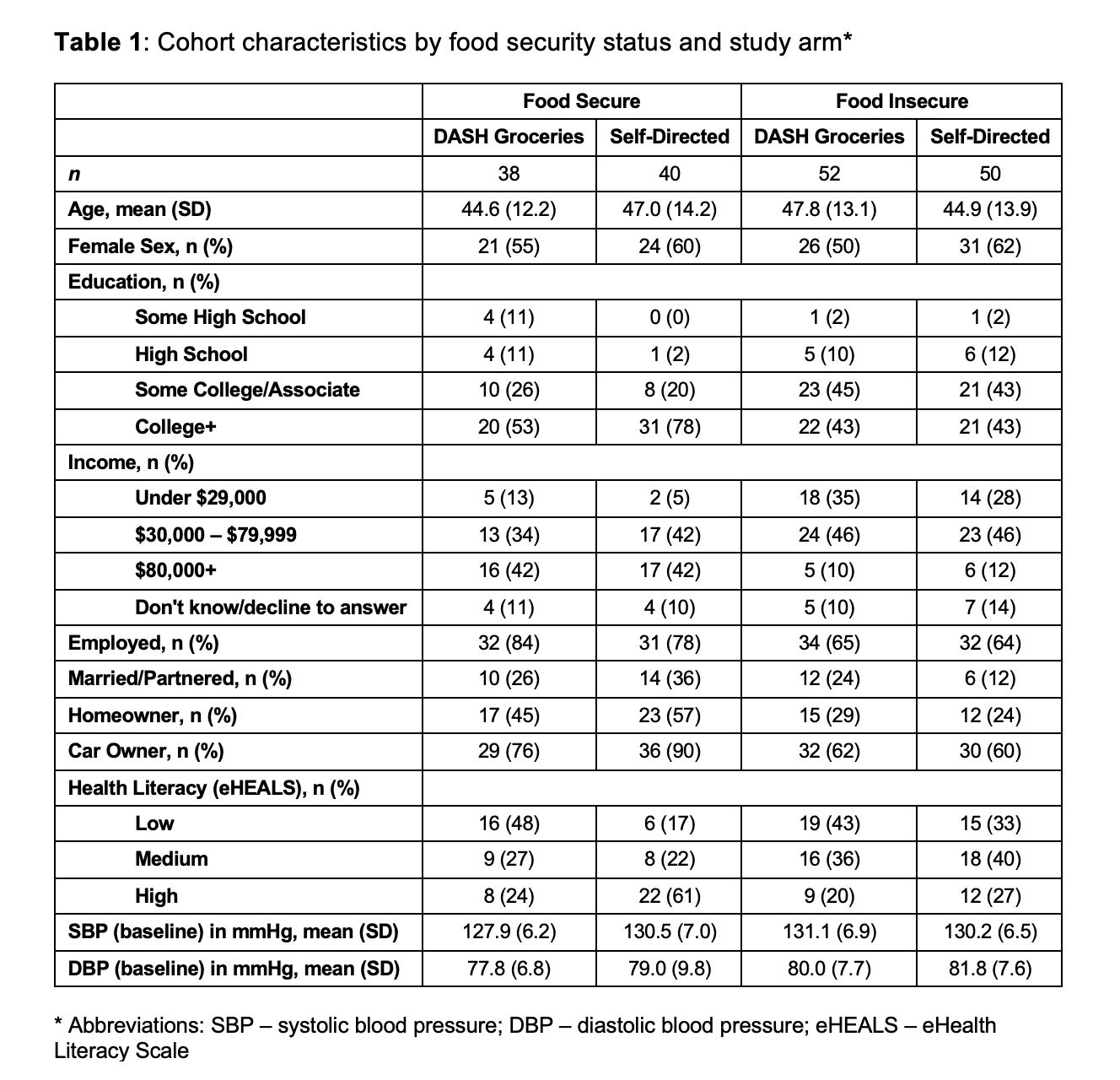
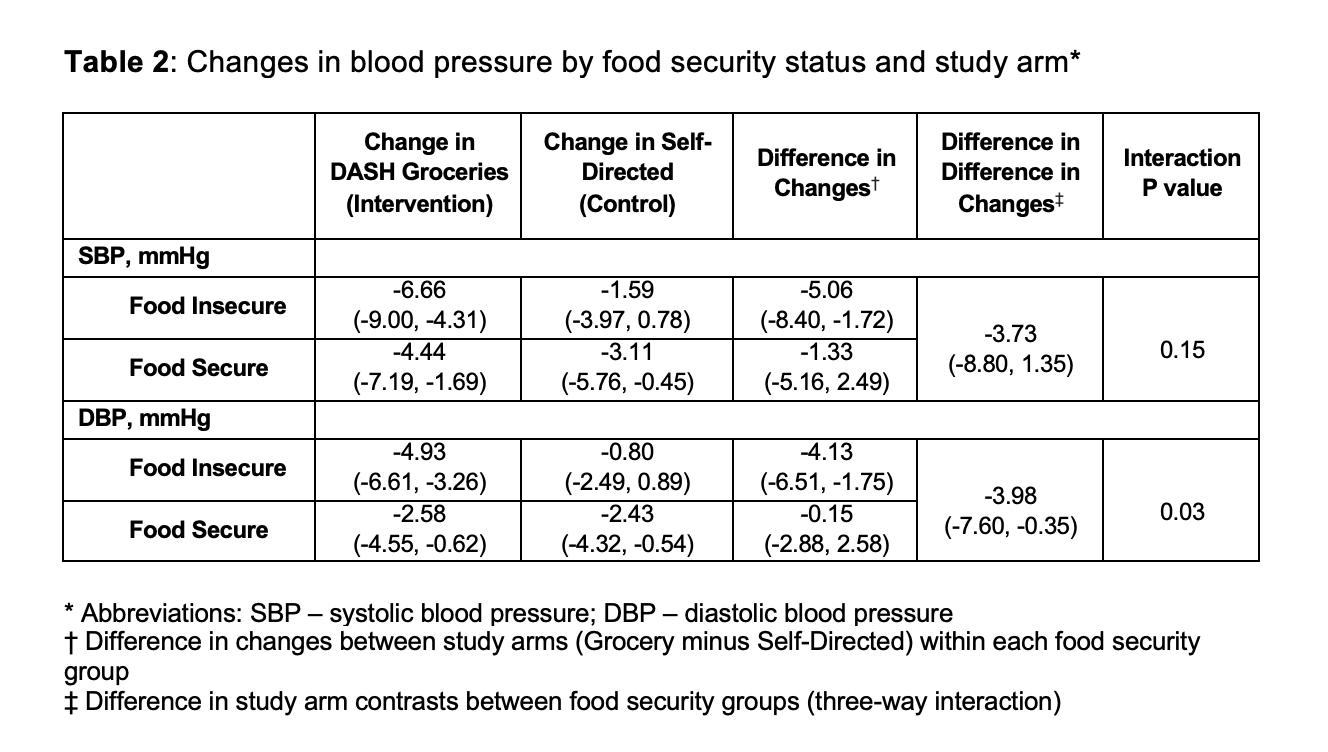
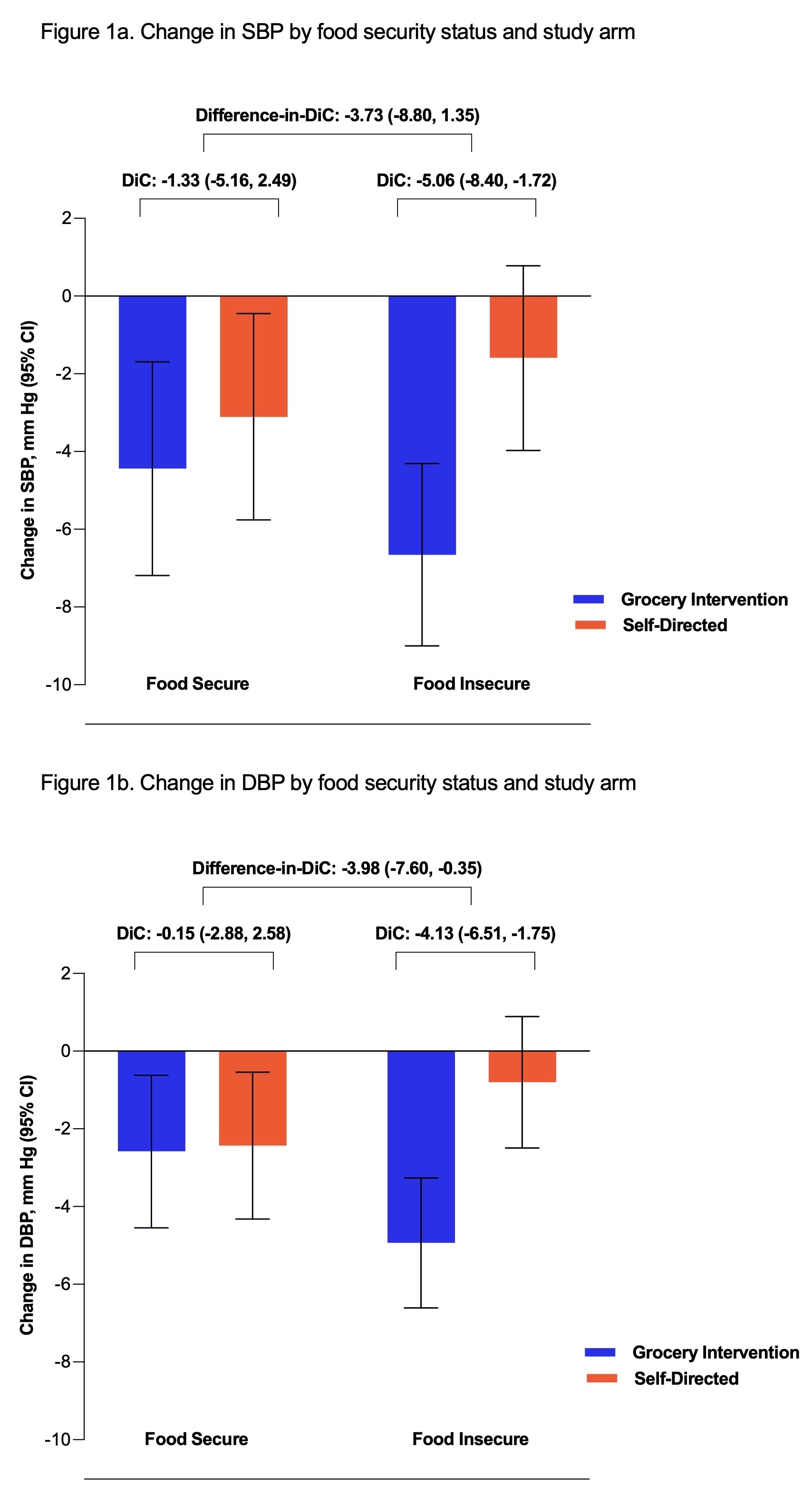
Results: Of 180 participants, 102 were experiencing food insecurity and 78 were not (Table 1). Overall, participants with food insecurity showed greater BP reductions with the intervention compared to participants without (p-interaction=0.15 for SBP; p-interaction=0.03 for DBP) (Figure 1). Among participants with food insecurity, SBP changed by -6.66 mmHg (95%CI -9.00, -4.31) in the intervention group vs -1.59 mmHg (95%CI -3.97, 0.78) in the self-directed group. Similarly, DBP changed by -4.93 mmHg (95%CI -6.61, -3.26) in the intervention group vs -0.80 mmHg (95%CI -2.49, 0.89) in the self-directed group. Among participants who were food secure, SBP changed by -4.44 mmHg (95%CI -7.19, -1.69) in the intervention group and -3.11 mmHg (95%CI -5.76, -0.45) in the self-directed group. DBP changed by -2.58 mmHg (95%CI -4.55, -0.62) in the intervention group and -2.43 mmHg (95%CI -4.32, -0.54) in the self-directed group. Participants with food insecurity saw greater SBP reduction with the intervention than those who were food secure (-3.73 mmHg; 95%CI: -8.80, 1.35), although not statistically significant. Similarly, participants with food insecurity showed significantly greater DBP reduction with the intervention (-3.98 mmHg; 95%CI -7.60, -0.35) compared to those who were food secure (Table 2).

Conclusions: DASH-patterned grocery delivery reduced DBP more among participants experiencing food insecurity than those who were not. These findings highlight the importance of addressing food insecurity to enhance cardioprotective effects of dietary interventions.
  • Gao, Katie  ( Harvard Medical School , Boston , Massachusetts , United States )
  • Wu, Yingfei  ( BIDMC-Harvard Medical School , Boston , Massachusetts , United States )
  • Col, Hannah  ( BIDMC-Harvard Medical School , Boston , Massachusetts , United States )
  • Lee, Grace  ( Harvard Medical School , Boston , Massachusetts , United States )
  • Grobman, Benjamin  ( Harvard Medical School , Boston , Massachusetts , United States )
  • Davis, Roger  ( BIDMC-Harvard Medical School , Boston , Massachusetts , United States )
  • Mukamal, Kenneth  ( BIDMC-Harvard Medical School , Boston , Massachusetts , United States )
  • Cluett, Jennifer  ( BIDMC-Harvard Medical School , Boston , Massachusetts , United States )
  • Aidoo, Emily  ( BIDMC-Harvard Medical School , Boston , Massachusetts , United States )
  • Budu, Marian  ( BIDMC-Harvard Medical School , Boston , Massachusetts , United States )
  • Larbi, Fredrick  ( BIDMC-Harvard Medical School , Boston , Massachusetts , United States )
  • Ferro, Kayla  ( BIDMC-Harvard Medical School , Boston , Massachusetts , United States )
  • Patil, Dhrumil  ( BIDMC-Harvard Medical School , Boston , Massachusetts , United States )
  • Kraemer, Kristen  ( BIDMC-Harvard Medical School , Boston , Massachusetts , United States )
  • Turkson-ocran, Ruth-alma  ( Ohio State University , Columbus , Ohio , United States )
  • Fitzpatrick, Stephanie  ( Northwell Health , New York , New York , United States )
  • Juraschek, Stephen  ( BIDMC-Harvard Medical School , Boston , Massachusetts , United States )
  • Author Disclosures:
Meeting Info:

EPI-Lifestyle Scientific Sessions 2026

2026

Boston, Massachusetts

Session Info:

Behavioral Medicine

Friday, 03/20/2026 , 11:15AM - 12:00PM

Oral Abstract Session

More abstracts from these authors:
Prediabetes Status Modifies the Effect of a DASH-Patterned Grocery Intervention on Cardiometabolic Risk Including Glycemic Control in Black Adults with High Blood Pressure

Wu Yingfei, Larbi Fredrick, Ferro Kayla, Patil Dhrumil, Turkson-ocran Ruth-alma, Juraschek Stephen, Col Hannah, Davis Roger, Mukamal Kenneth, Cluett Jennifer, Fitzpatrick Stephanie, Kraemer Kristen, Aidoo Emily, Budu Marian

Electronic Patient Portal Recruits for Cardiovascular Trials are Demographically Distinct with Improved Rates of Eligibility and Screening Attendance

Lee Grace, Budu Marian, Larbi Fredrick, Ferro Kayla, Patil Dhrumil, Plante Timothy, Juraschek Stephen, Wu Yingfei, Cao Jingyi, Grobman Benjamin, Col Hannah, Gao Katie, Carranza Celis Jose, Zhang Mingyu, Aidoo Emily

You have to be authorized to contact abstract author. Please, Login
Not Available