Prevalence, Temporal Trends, and Risk Factors of Hyperkalemia in U.S. Adults: NHANES 2001–2023
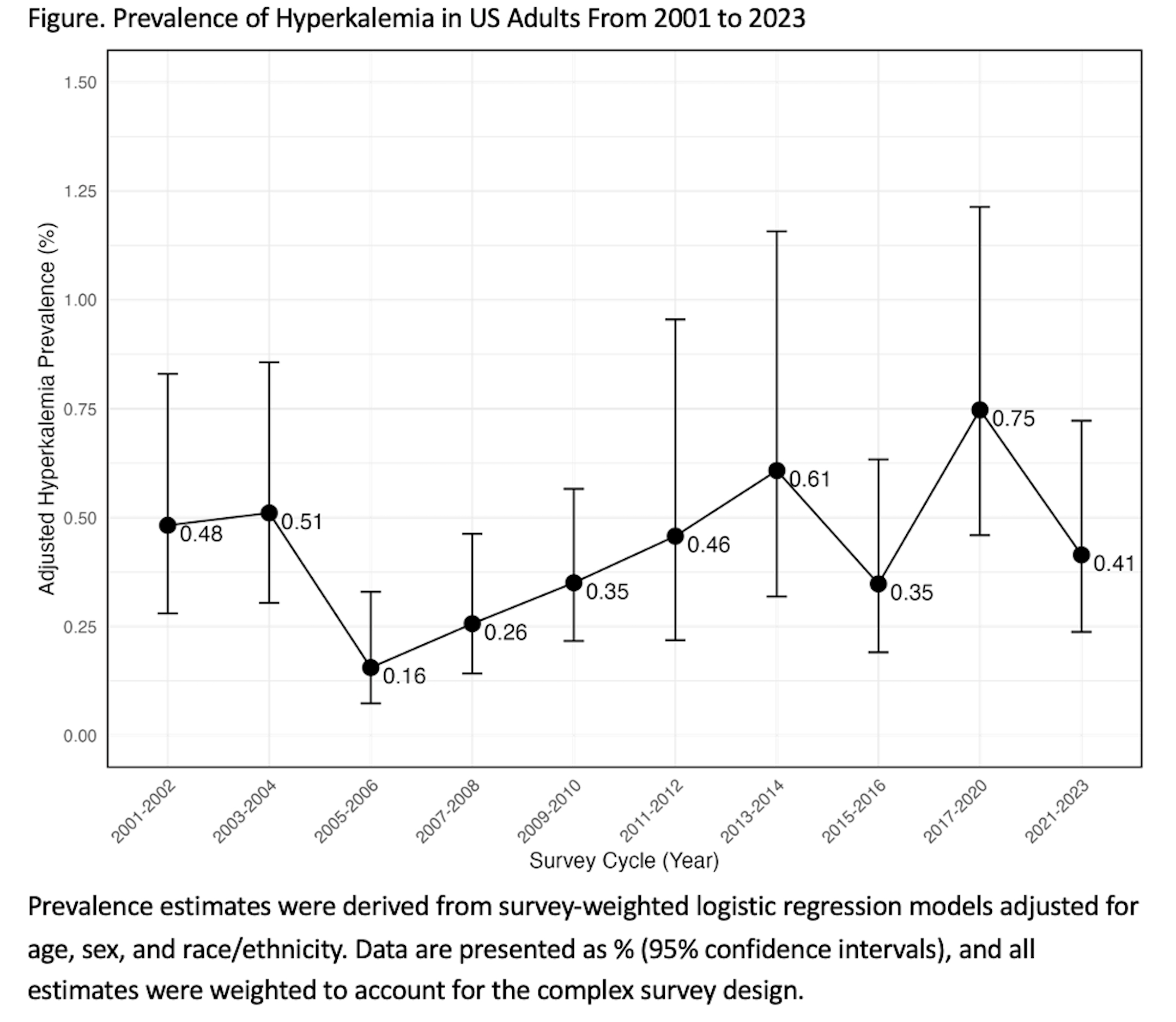
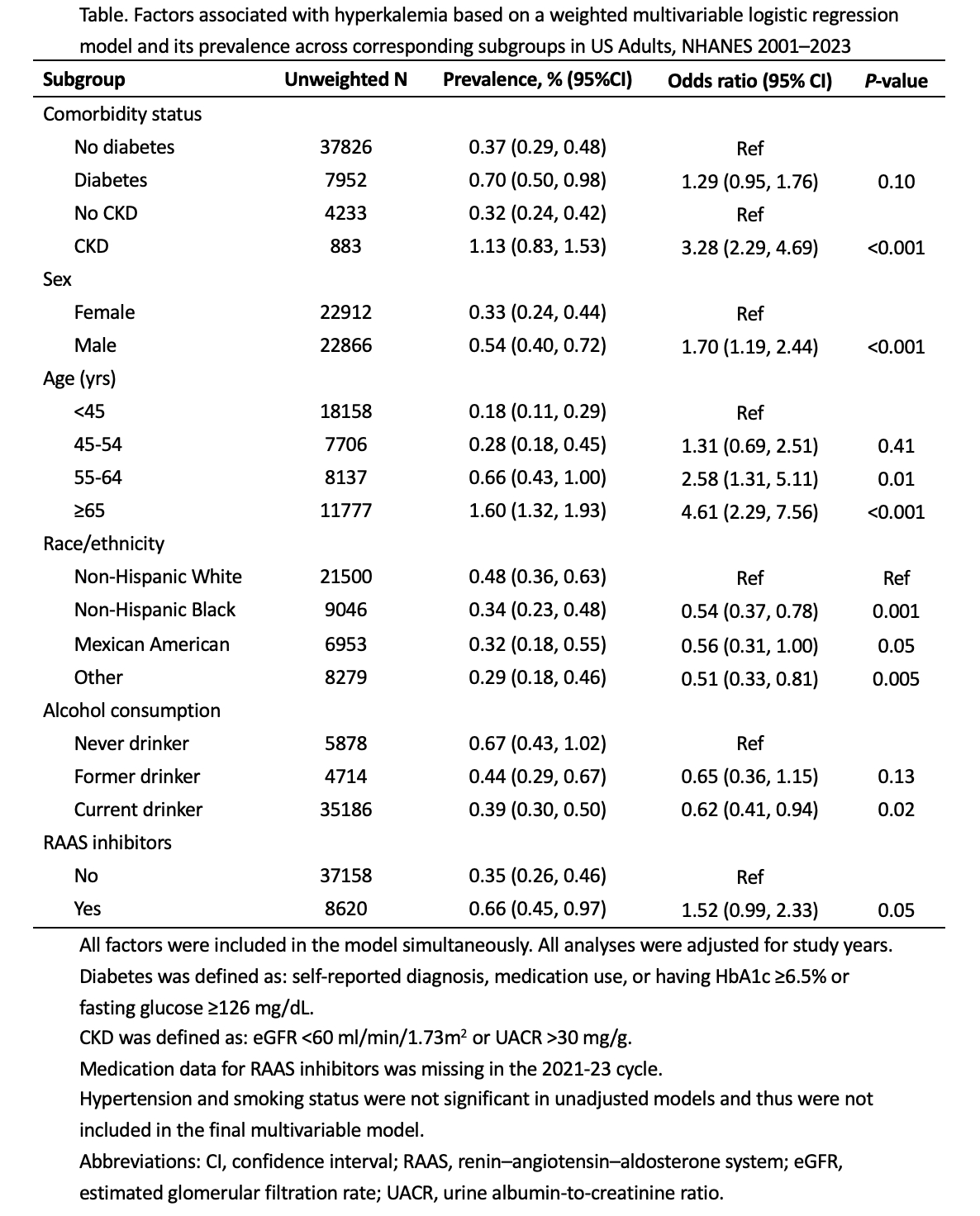
Abstract Body: Background Understanding the prevalence and risk factors for hyperkalemia is critical for public health policy, especially given the burgeoning interest in use of potassium-enriched salt substitutes as a means to reduce sodium intake. Importantly, data on the prevalence of hyperkalemia in the US are sparse, overall and in high-risk subgroups. Aim To investigate the prevalence, temporal trends, and risk factors for hyperkalemia in the US using nationally representative data. Method We analyzed data from the National Health and Nutrition Examination Survey (NHANES) from 2001 through 2023. Hyperkalemia was defined as a serum potassium levels >5.0 mmol/L. Prevalence of hyperkalemia was estimated overall and by survey cycle using logistic regression. Candidate predictors of hyperkalemia, including hypertension, chronic kidney disease (CKD), diabetes, sex, age, race/ethnicity, alcohol use, smoking status, renin–angiotensin–aldosterone system (RAAS) inhibitors, were examined in crude models. Then, significant factors were incorporated simultaneously in a multivariable model and presented, along with the prevalence of hyperkalemia in each relevant subgroup. All analyses incorporated sampling weights. Results Among 45,778 U.S. adults aged 20 years and older pooled across the 2001–2023 NHANES survey cycles, 373 had hyperkalemia. The overall prevalence of hyperkalemia was 0.46% (95% CI 0.29-0.71%). Although the prevalence of hyperkalemia appeared to be increasing from 0.16% (0.07-0.33%) in 2005-2006 to 0.75% (0.46-1.21%) in 2017-2020 (Figure), in the entire two decades, its prevalence was largely constant between 0.3% and 0.6%, with no clear temporal trend (P for trend = 0.07). Factors significantly associated with hyperkalemia included CKD, older age, and male sex (Table). Non-White racial/ethnic groups and current alcohol users showed lower prevalence compared to their counterparts. The only subgroups with the prevalence of hyperkalemia exceeding 1% were people with CKD and older adults (≥65 years). Conclusion The overall low prevalence of hyperkalemia without evident temporal trend supports the safety of promoting potassium-enriched salt substitutes among U.S. adults. However, careful implementation may be warranted for individuals with risk factors, such as CKD, older age, and male sex. In contrast, racial/ethnic minorities and current alcohol users showed a lower prevalence of hyperkalemia and could particularly benefit from potassium-enriched salt substitutes.
Guan, Wanjin
(
Johns Hopkins Bloomberg School of Public Health
, Baltimore , Maryland , United States )
Cao, Tianyu
(
Johns Hopkins Bloomberg School of Public Health
, Baltimore , Maryland , United States )
Rebholz, Casey
(
Johns Hopkins Bloomberg School of Public Health
, Baltimore , Maryland , United States )
Fang, Michael
(
Johns Hopkins Bloomberg School of Public Health
, Baltimore , Maryland , United States )
Appel, Lawrence
(
Johns Hopkins Bloomberg School of Public Health
, Baltimore , Maryland , United States )
Ishigami, Junichi
(
Johns Hopkins Bloomberg School of Public Health
, Baltimore , Maryland , United States )
Mok, Yejin
(
Johns Hopkins Bloomberg School of Public Health
, Baltimore , Maryland , United States )
Matsushita, Kunihiro
(
Johns Hopkins Bloomberg School of Public Health
, Baltimore , Maryland , United States )