Objectively-Measured Individual-Level Nighttime Light Exposure Was Associated With Increased Cardiovascular Disease Risk and Adverse Cardiovascular Imaging Phenotypes
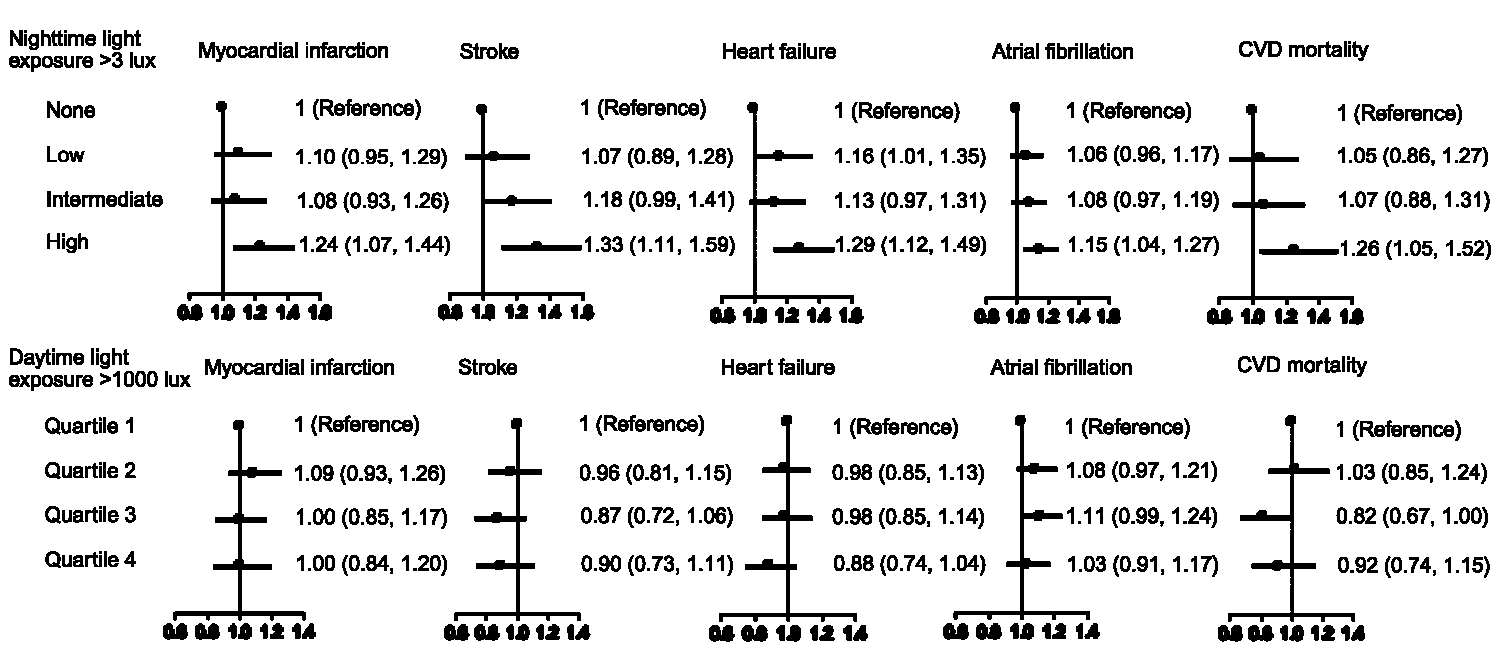
Abstract Body: Introduction: Circadian rhythm disruption has been implicated as a risk factor for cardiovascular disease (CVD). Yet, whether light, the primary circadian entrainer, affects CVD risk remains unclear. Prior studies relied primarily on satellite-derived estimates or self-reports that poorly approximate individual-level light exposure. Moreover, no study has evaluated whether light influences cardiovascular structural and functional phenotypes. Methods: We conducted a prospective cohort study of 73,286 adults in the UK Biobank who wore a wrist accelerometer with a light sensor for 7 days between 2013-2015 (baseline). Daytime light exposure >1000 lux and nighttime light exposure >3 lux were estimated. Incident myocardial infarction, stroke, heart failure, and atrial fibrillation was ascertained through hospital admissions and death registries to 2022, and CVD mortality through 2024. Participants also underwent cardiac magnetic resonance (CMR) imaging (n=11,071) and carotid ultrasound (n=13,937) during follow-up. Cox proportional hazards and linear regression models were used to estimate associations of light exposures with incident CVD and subclinical measures, respectively. Results: After adjusting for anthropometric, sociodemographic, lifestyle, environmental, and health-related factors, greater nighttime light exposure >3 lux (high vs none) was associated with a higher risk of myocardial infarction (hazard ratio [HR], 1.24 [95% CI, 1.07-1.44]), stroke (HR, 1.33 [95% CI, 1.11-1.59]), heart failure (HR, 1.29 [95% CI, 1.12-1.49]), atrial fibrillation (HR, 1.15 [95% CI, 1.04-1.27]), and CVD mortality (HR, 1.26 [95% CI, 1.05-1.52]) (Fig.1). These associations were partly mediated by behavioral markers of circadian rhythms, including lower rest-activity rhythm relative amplitude and shorter sleep duration (Fig.2). Consistently, greater nighttime light exposure was also associated with higher mean carotid intima-media thickness and adverse CMR-derived phenotypes, including larger left and right ventricular end-diastolic and end-systolic volumes, greater left ventricular mass, larger left atrial maximum volume, and lower left atrial ejection fraction (FDR-adjusted P <0.05) (Fig.3). Daytime light exposure was not associated with CVD risk or subclinical markers. Conclusions: Maintaining dark nights may offer a novel and practical avenue to promote cardiovascular health at the population level.
Dai, Jin
(
Tulane University
, New Orleans , Louisiana , United States )
Dai, Wen
(
TULANE UNIVERSITY
, New Orleans , Louisiana , United States )
Heianza, Yoriko
(
TULANE UNIVERSITY
, New Orleans , Louisiana , United States )
Qi, Lu
(
TULANE UNIVERSITY
, New Orleans , Louisiana , United States )