Association of the AHA’s PREVENT-HF score with Incident Heart Failure Subtypes in the REGARDS study.
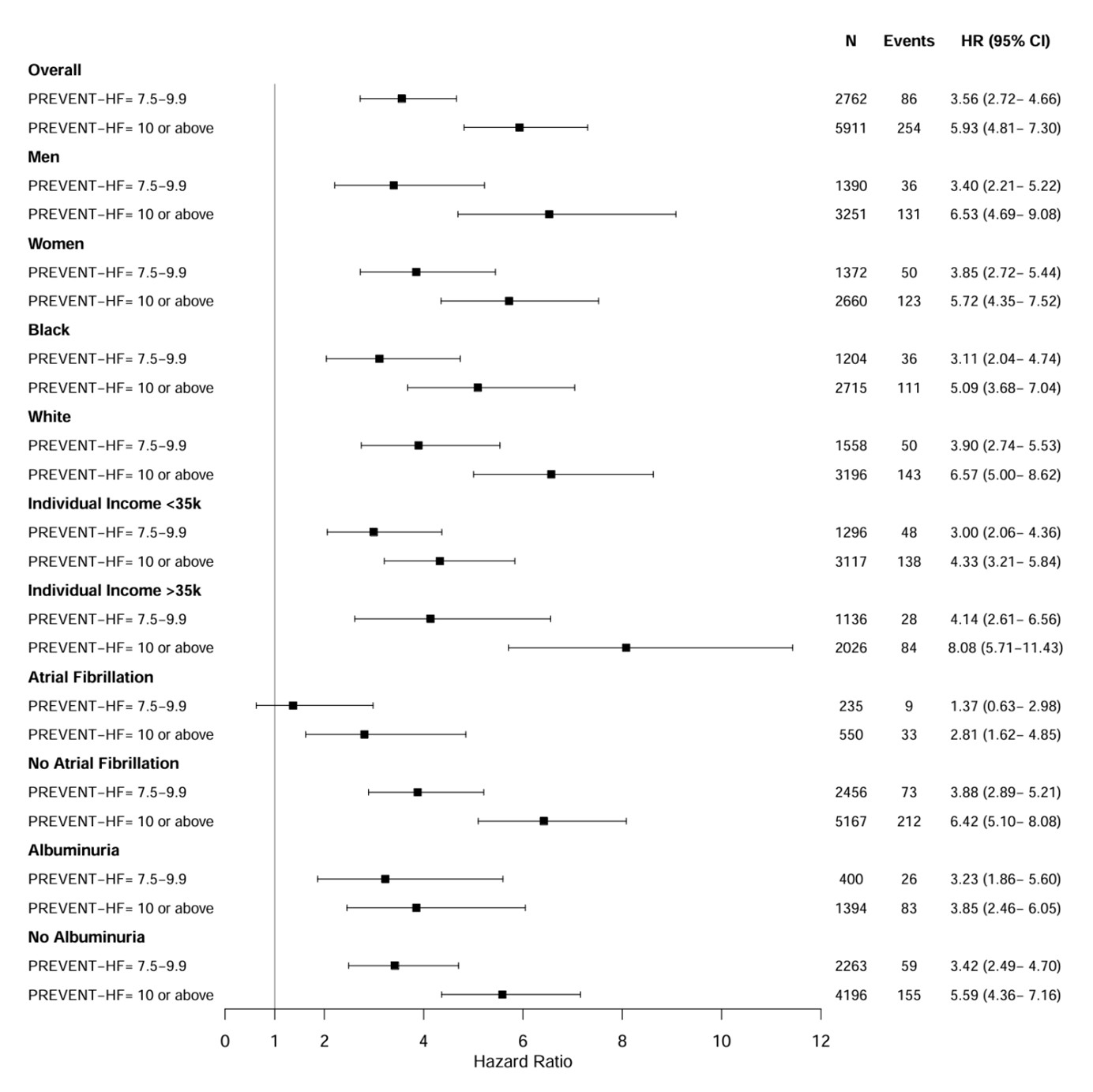
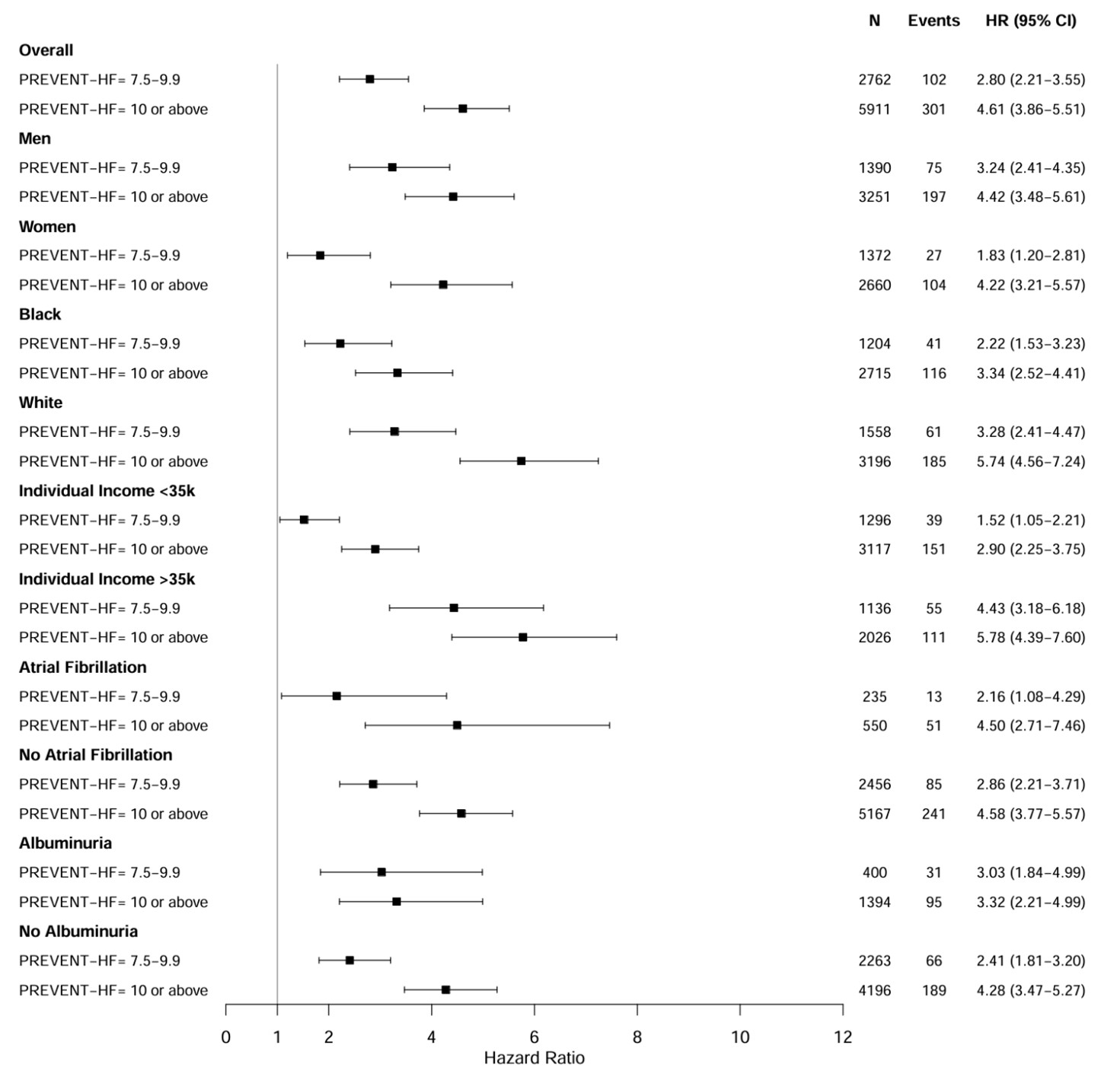
Abstract Body: Background: The American Heart Association’s Predicting Risk of cardiovascular disease EVENTs equations Heart Failure (PREVENT-HF) score estimates the risk of heart failure (HF), based on demographic and cardiovascular risk factors. Knowing if PREVENT-HF predicts the two major subtypes of HF, with preserved ejection fraction (HFpEF) and HF with reduced ejection fraction (HFrEF), could inform HF prevention strategies. Objective: To estimate the association between PREVENT-HF score and incident HFpEF and HFrEF hospitalization, separately. Methods: The PREVENT-HF score was calculated for the 23,043 participants, aged 45-79 years and without HF at baseline, in the nationwide Reason for Geographic and Racial Differences in Stroke (REGARDS) study. HF hospitalizations were adjudicated prospectively. The association between HFpEF and HFrEF and PREVENT-HF score was evaluated using the Cox regression in the overall sample, adjusted for the region of residence. Pre-specified subgroup analyses were performed by sex, race, annual household income, atrial fibrillation and albuminuria. Results: Over median follow up of 13.8 years, there were 478 incident hospitalizations for HFpEF (EF>50%) and 609 - for HFrEF (EF<50%). The mean PREVENT-HF score at baseline was 7.2 (SD 5.9). Sixty two percent of the participants were in the “low risk” category (PREVENT-HF score < 7.5), 12% - in the “intermediate” category (score =7.5-9.9) and 26% - in the “high risk” category (score > 10). For HFpEF, compared to participants in the “low-risk” category, the HR for participants in the “intermediate” and “high risk” PREVENT-HF score categories were 3.56, 95%CI [2.27-4.66] and 5.93 [4.91-7.30], respectively (Figure 1A). For HFrEF, compared to participants in the “low-risk” category, the HR for participants in the “intermediate” and “high risk” PREVENT-HF score categories were 2.80, 95%CI [2.21-3.55] and 4.61 [3.86-7.51], respectively (Figure 1B). PREVENT-HF score was associated with incident HF hospitalization regardless of HF subtype within all subgroups investigated, except for individuals with atrial fibrillation, where this association was less pronounced. Conclusion: Higher PREVENT-HF scores were associated similarly with both incident HFpEF and HFrEF hospitalizations. Prevention strategies, utilizing PREVENT-HF score, may prevent both HF subtypes.
Nordberg, Megan
(
University of Alabama at Birmingham
, Birmingham , Alabama , United States )
Cherrington, Andrea
(
University of Alabama at Birmingham
, Birmingham , Alabama , United States )
Arora, Pankaj
(
University of Alabama at Birmingham
, Birmingham , Alabama , United States )
Safford, Monika
(
WEILL CORNELL MEDICINE
, New York , New York , United States )
Goyal, Parag
(
Weill Cornell Medicine
, New York , New York , United States )
Levitan, Emily
(
University of Alabama at Birmingham
, Birmingham , Alabama , United States )
Muntner, Paul
(
University of Alabama at Birmingham
, Birmingham , Alabama , United States )
Khodneva, Yulia
(
University of Alabama at Birmingham
, Birmingham , Alabama , United States )