Genomic and Proteomic Analysis of Insulin Secretion Rate in Asian and European Populations: A Pilot Study
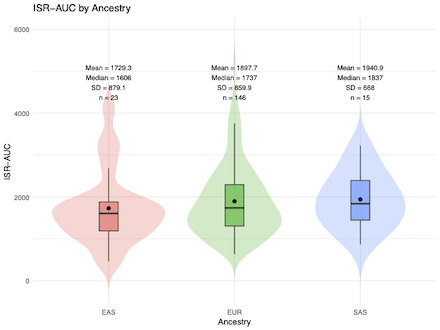
Abstract Body: Asians are at higher risk of developing type 2 diabetes mellitus (T2DM) compared to Europeans, and reduced rates of insulin secretion may mediate this excess risk. In a small pilot study involving 23 East Asians, 15 South Asians, and 146 Europeans, we assessed differences and similarities in insulin secretion among ancestries using the insulin secretion rate area under the curve (ISRAUC) during the graded glucose infusion test, a gold-standard test of beta-cell glucose-stimulated insulin secretion. We further assessed the relationship between ISRAUC with Partitioned Polygenic Scores (pPSs) for T2DM and plasma levels of 1461 proteins measured with the proximity extension assay. The ISRAUC was regressed on ancestry, adjusting for age, sex, and, in a secondary analysis, on steady-state plasma glucose (SSPG) concentration, a gold standard measure of insulin resistance derived from the insulin suppression test. pPSs were calculated using the PRSedm pipeline and then tested for association with ISRAUC within each ancestry group. Finally, the ISRAUC was regressed on each measured protein separately within each population. No significant differences were found in ISRAUC across the three ancestral groups (p = .49). However, the metabolic syndrome pPS was significantly associated with ISRAUC in South Asians (p = 0.04) among the 8 pPS tested, consistent with previous findings. In South Asians, the metabolic syndrome and beta-cell minus proinsulin pPSs were associated with higher ISRAUC, with attenuation after SSPG concentration adjustment, indicating partial mediation by insulin resistance. In contrast, obesity and body fat pPSs became stronger after adjusting for SSPG concentration, suggesting their direct roles in insulin secretion. A total of 35 out of 1461 protein levels were significantly associated with ISRAUC among Europeans and East Asians (p < 3.42 x 10⁻⁵), but none for South Asians. Some protein associations were only found in the East Asian group (SCARB2, TNFRSF10B, POLR2F, MFAP5). The number of protein-ISRAUC associations decreased to 15 after further adjustment with SSPG concentration. Three proteins (CTSZ, CD207, C1QTNF1) showed opposing ISRAUC associations in East vs South Asians, suggesting possible ancestry-specific biology. Despite similar ISRAUC levels across ancestry groups, we identified a few genetic and proteomic associations with ISRAUC unique to Asians. Further research is needed to draw more conclusive evidence using larger sample sizes.
Ali, Saif
(
Stanford Univ. School of Medicine
, Palo Alto , California , United States )
Kho, Pik Fang
(
Stanford Univ. School of Medicine
, Palo Alto , California , United States )
Panyard, Daniel
(
Stanford University
, Palo Alto , California , United States )
Gloyn, Anna
(
Stanford
, Palo Alto , California , United States )
Palaniappan, Latha
(
STANFORD UNIVERSITY
, Stanford , California , United States )
Abbasi, Fahim
(
Stanford University
, Stanford , California , United States )
Knowles, Josh
(
Stanford University FALK CVRC
, Stanford , California , United States )
Assimes, Themistocles
(
Stanford Univ. School of Medicine
, Palo Alto , California , United States )