EPI-Lifestyle Scientific Sessions 2026
/
Poster Session 3
/
The Weight of Stress: Examining the Association Between Perceived Stress and Body Mass Index (BMI) in The EPIPHANY (Equity in Prevention and Progression of Hypertension by Addressing barriers to Nutrition and Physical Activity) Study
American Heart Association
67
0
Final ID: TH945
The Weight of Stress: Examining the Association Between Perceived Stress and Body Mass Index (BMI) in The EPIPHANY (Equity in Prevention and Progression of Hypertension by Addressing barriers to Nutrition and Physical Activity) Study
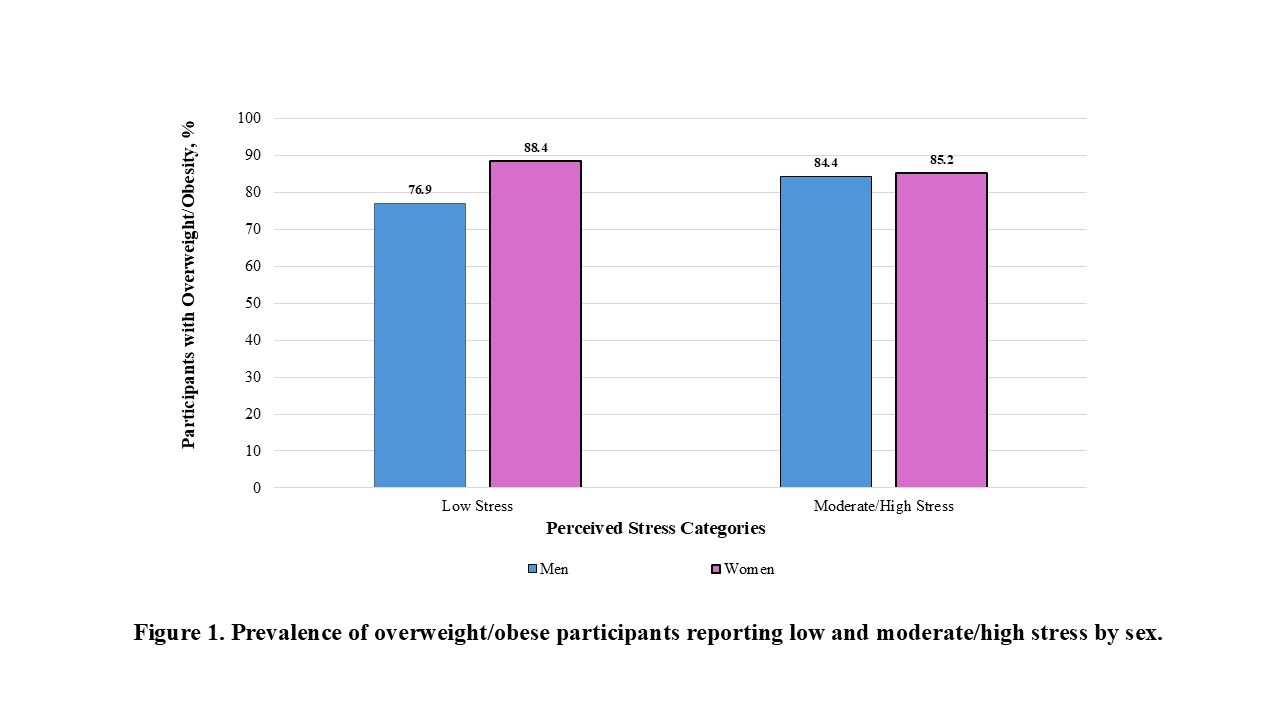
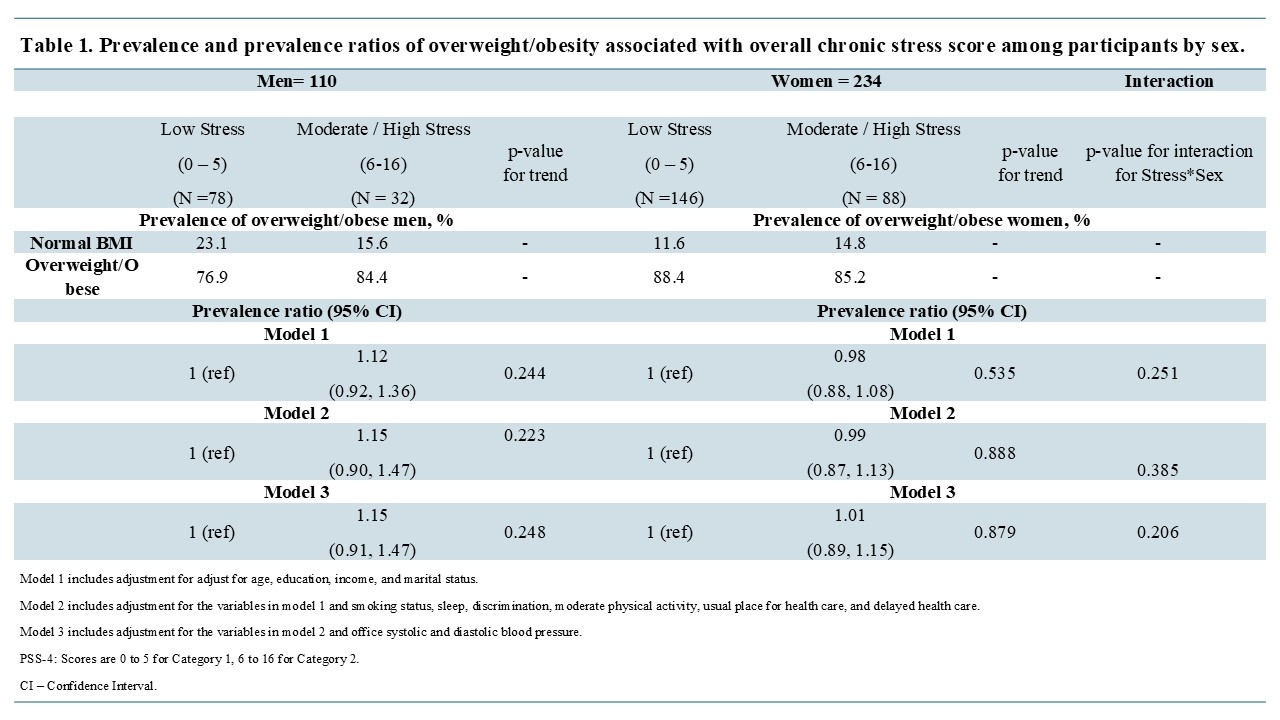
Abstract Body: Background: Black adults in rural areas have higher obesity prevalence (48.3%), lower socioeconomic status, and decreased access to health services contributors to poor cardiovascular health. Further, stress among Black adults have been associated with higher BMI. This work examines whether psychosocial stress is associated with higher BMI among Black adults in rural communities. Methods: Baseline data from 344 Black adults, ≥19 years older from the Black Belt area in Alabama fromthe EPIPHANY study (a multilevel lifestyle intervention trial to reduce systolic blood pressure [SBP]). Psychosocial stress was assessed using the Perceived Stress Scale (PSS-4). Total PSS-4 score was calculated, and participants were grouped into low (scores [0-5]) and moderate/high (scores 6-10 and 11-16, respectively) by sex. Weight and height were measured to calculate BMI. BMI was categorized as <25 kg/m2 (under-/normal weight) or >25 kg/m2 (overweight/obese). Adjusted prevalence ratios (PR) were calculated to evaluate the association between stress and overweight/obesity, by sex, adjusting for social determinants of health (Model 1), health behaviors (Model 2) and initial systolic and diastolic blood pressure (Model 3). Results: The mean age of participants was 41.4 (13.1) years and 68.0% were women. Men and women reporting higher stress were more likely to earn <$30,000 annually and reported higher levels of depression (15%, p=0.003 and 35.2%, p<0.001, respectively). Among women, those reporting higher stress were more likely to be younger (39.6 vs 43.9 years, p=0.014) and delay healthcare due to cost (29.7% vs 6.4%, p <0.001) vs those reporting lower stress. Men reporting higher stress were significantly more likely to be current smokers (40.0%, p=0.022) vs those reporting low stress. Men had higher prevalence of obesity in lower and moderate/high stress (76.9% and 84.4%, respectively (Figure 1). Multivariable adjusted PR found men with higher stress scores were 12% (Model 1) to 15% (Models 2 and 3) more likely to have overweight/obesity vs those with lower stress scores, yet not statistically significant. There was no evidence of an association among women (Table 1). Conclusion: Over 80% of both women and men reporting higher stress had overweight/obesity vs those with lower stress score, though not statistically significant. These findings support opportunities to address health behaviors, depression, and psychosocial stress among Black adults in rural communities.
Miles, Miriam
(
University of Alabama at Birmingham
, Birmingham , Alabama , United States )
Hall, Lanisha
(
University of Alabama at Birmingham
, Birmingham , Alabama , United States )
Foti, Kathryn
(
University of Alabama at Birmingham
, Birmingham , Alabama , United States )
Poudel, Bharat
(
University of Alabama at Birmingham
, Birmingham , Alabama , United States )
Nolan, Timiya
(
University of Alabama at Birmingham
, Birmingham , Alabama , United States )
Holmes, Shnese
(
University of Alabama at Birmingham
, Birmingham , Alabama , United States )
Hardy, Shakia
(
Univ of North Carolina Chapel Hill
, Mebane , North Carolina , United States )
Cherrington, Andrea
(
University of Alabama at Birmingham
, Birmingham , Alabama , United States )
Jiang Chao, Dong Jianzeng, Cai Jun, Anderson Craig, Du Xin, Tang Yangyang, Han Rong, Song Yanna, Wang Chi, Lin Xiaolei, Yi Yang, Rodgers Anthony, Ma Changsheng