EPI-Lifestyle Scientific Sessions 2026
/
Poster Session 3
/
Associations Between a Validated Dietary Approaches to Stop Hypertension (DASH) Diet Screener Score and Cardiovascular Biomarkers in the Stenting vs. Aggressive Medical Management for Preventing Recurrent Stroke in Intracranial Stenosis (SAMMPRIS) Trial
American Heart Association
98
0
Final ID: TH925
Associations Between a Validated Dietary Approaches to Stop Hypertension (DASH) Diet Screener Score and Cardiovascular Biomarkers in the Stenting vs. Aggressive Medical Management for Preventing Recurrent Stroke in Intracranial Stenosis (SAMMPRIS) Trial
Abstract Body: Introduction: Greater adherence to a DASH diet pattern is linked to lower cardiovascular disease (CVD) risk. However, it is unclear whether a brief DASH screener, validated in a healthy, nationally representative population, demonstrates predictive validity in secondary prevention settings.
Hypothesis: We examined the associations between 6-month (mo) Δ in DASH screener score and CVD biomarkers at 1-year (yr) and 2-yr follow-up in the SAMMPRIS trial. We hypothesized that improved 6-mo Δ in DASH screener scores were associated with higher high-density lipoprotein cholesterol (HDL-C), and lower systolic blood pressure (SBP), diastolic blood pressure, and low-density lipoprotein cholesterol, at 1-yr and 2-yr follow-ups, and that the associations were not modified by treatment.
Methods: This secondary analysis of the SAMMPRIS trial included a subset of 244 participants who did not develop stroke or die ≤ 30 days after enrollment and responded to 8 brief nutrition questions used to calculate a DASH adherence score at both baseline and 6-mo. The screener captures 8 DASH components. Each component was assigned a corresponding weight and summed to obtain a total score (0-100). Higher values indicated better adherence. Multivariable linear regressions assessed associations between 6-mo Δ in DASH screener scores and CVD biomarkers at 1- and 2-yr follow ups, adjusted for covariates. Effect modification by treatment arm was tested, and inverse-probability-of-censoring weight was used to account for informative dropout/death.
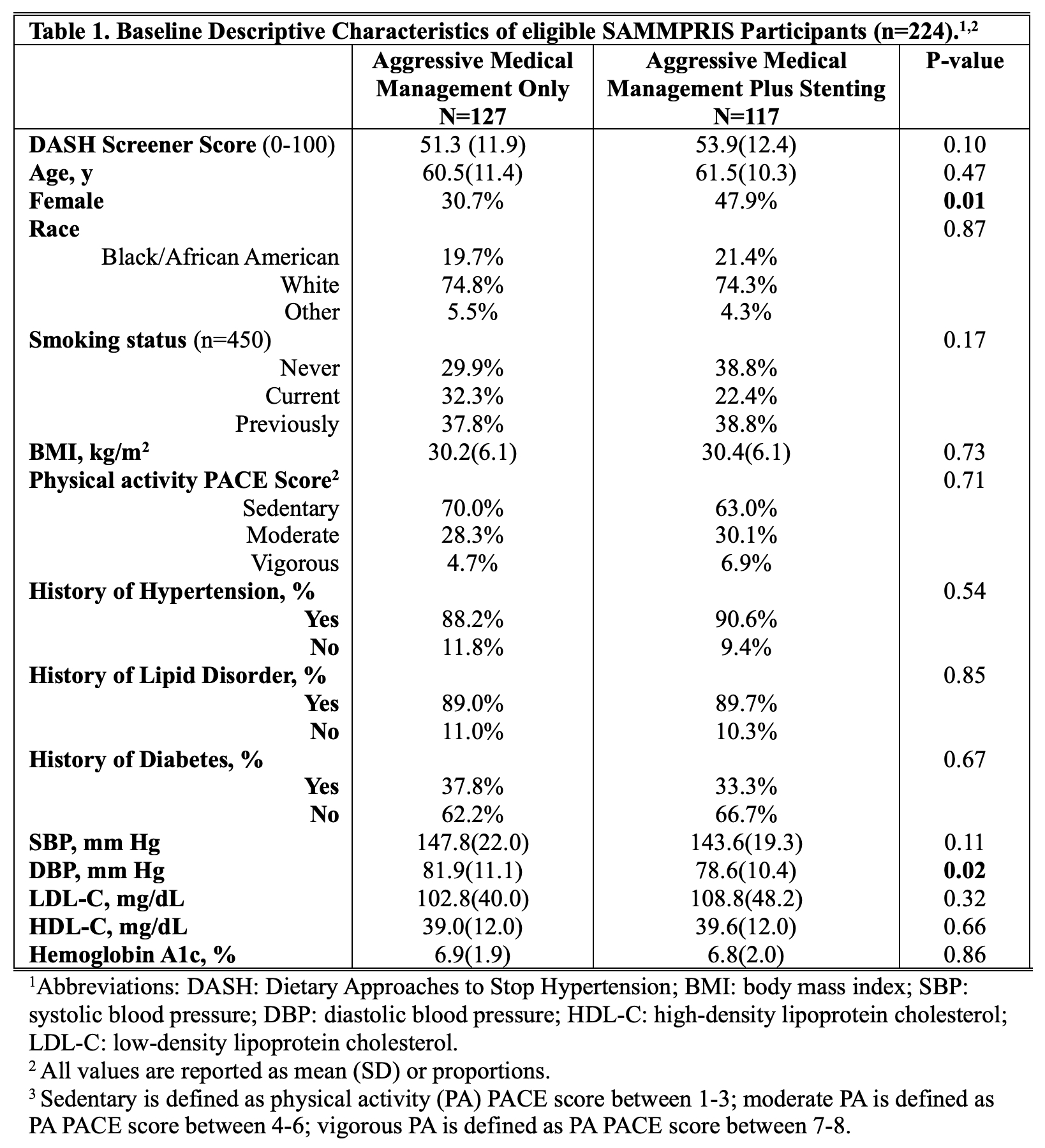
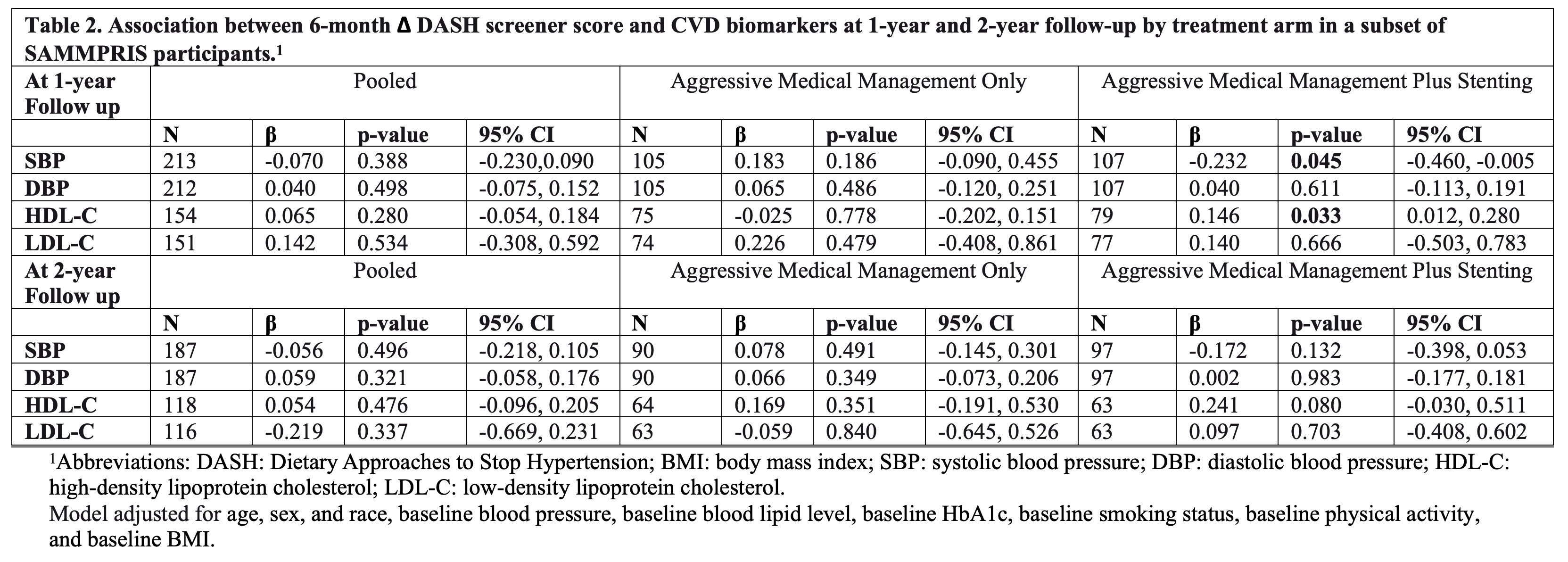
Results: Participants were on average 61.0(10.9) years, 75% White, 39% female, with a BMI of 30.3(6.1) kg/m2 and a baseline screener score of 52.5(12.2) (see Table 1). Preliminary results show that 6-mo Δ in the screener score comparably increased in both the aggressive medical management plus stenting arm (+3.2) and the aggressive medical management only arm (+4.8). At 1-yr follow up, associations differed by treatment, and 6-month Δ in DASH screener score was associated with lower SBP (ß =-0.23, p=0.04) and higher HDL-C (ß =0.15, p=0.03) in the aggressive medical management plus stenting arm only. At 2-yr follow up, no associations were detected between 6-mo Δ in DASH screener score and CVD biomarkers in either arm (see Table 2).
Conclusions: The DASH screener demonstrated short-term predictive validity with some CVD biomarkers in a high-risk clinical population who underwent aggressive medical management of vascular risk factors plus stenting.
Yao, Qisi
(
University of Rhode Island
, Kingston , Rhode Island , United States )
Cohen, Steven
(
University of Rhode Island
, Kingston , Rhode Island , United States )
Oaks, Brietta
(
University of Rhode Island
, Kingston , Rhode Island , United States )
Turan, Tanya
(
MEDICAL UNIV OF SOUTH CAROLINA
, Charleston , South Carolina , United States )
Gordon, Neil
(
INTERVENT International
, Savannah , Georgia , United States )
Salmon, Richard
(
INTERVENT International
, Savannah , Georgia , United States )
Vadiveloo, Maya
(
University of Rhode Island
, Kingston , Rhode Island , United States )