EPI-Lifestyle Scientific Sessions 2026
/
Poster Session 3
/
Associations Between a Validated Dietary Approaches to Stop Hypertension (DASH) Screener Score and Cardiovascular Biomarkers in National Health and Nutrition Examination Survey (NHAHES), 2009-2014
American Heart Association
84
0
Final ID: TH924
Associations Between a Validated Dietary Approaches to Stop Hypertension (DASH) Screener Score and Cardiovascular Biomarkers in National Health and Nutrition Examination Survey (NHAHES), 2009-2014
Abstract Body: Introduction: Despite being recognized as a critical cardiovascular disease (CVD) risk factor, diet is rarely comprehensively measured due to cost and time constraints. A valid tool with predictive validity would be helpful for providing dietary guidance in clinical settings.
Objective: This study aimed to determine the predictive validity of a previously validated Dietary Approaches to Stop Hypertension (DASH) diet screener by exploring the associations between the DASH screener score and CVD biomarkers in 3 two-year cycles of National Health and Nutrition Examination Survey (NHANES, 2009-2014).
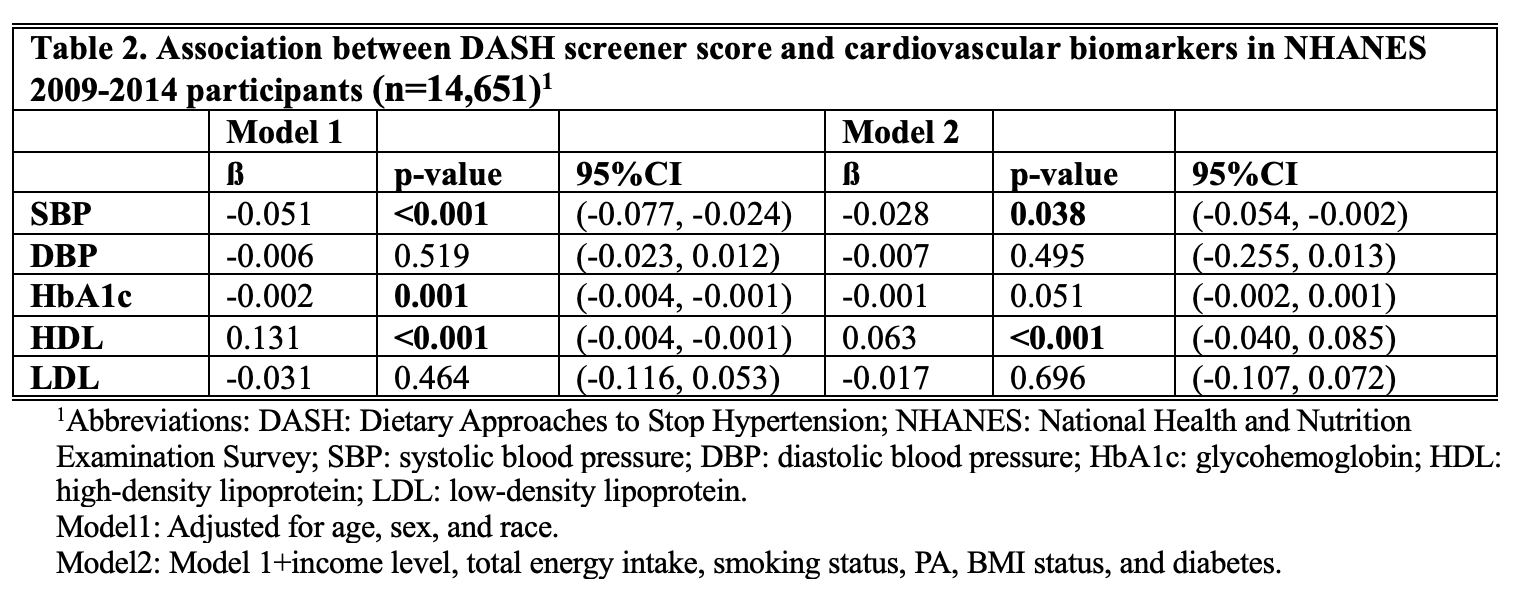
Hypothesis We hypothesized that higher screener scores were associated with higher high-density lipoprotein (HDL), and lower systolic blood pressure (SBP), diastolic blood pressure (DBP), low-density lipoprotein (HDL), and glycohemoglobin (HbA1c).
Methods: Created from 8 questions used in the Stenting vs. Aggressive Medical Management for Preventing Recurrent Stroke in Intracranial Stenosis trial, the DASH screener scores were calculated in a subset of 14651 adults ≥20 years of age with ≥1 reliable 24-h diet recall and plausible energy intakes. Briefly, each of the 8 DASH components was multiplied by a corresponding weight and summed to obtain an overall score (0-100), with higher values indicating better adherence. CVD biomarkers were measured following the NAHNES procedures. Associations between the DASH screener score and CVD biomarkers were evaluated using survey weighted multivariable linear regressions, with a significance threshold of 0.05.
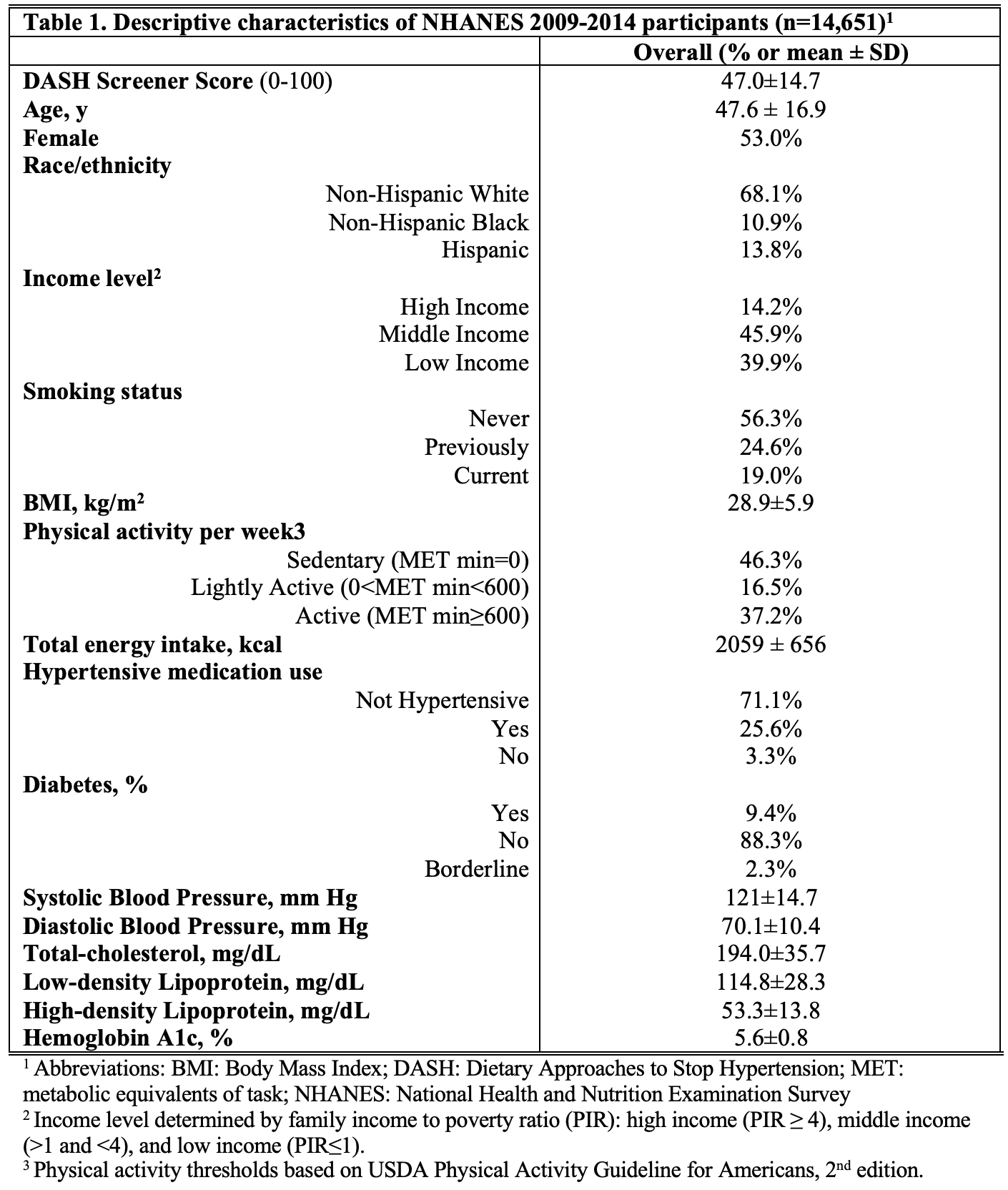
Results: Participants were on average 47.6(±16.9) years-of-age, 68% Non-Hispanic White, 53% female, and with a BMI of 28.9 kg/m2. The mean (SD) of the DASH screener score was 47.0 (14.7). The DASH screener score was associated with lower SBP (ß=-0.028, p=0.038) and higher HDL (ß=0.063, p<0.001), after adjusting for age, sex, race, income level, total energy intake, smoking status, physical activity level, BMI status, and diabetes. No associations were detected between DASH screener score and DBP or LDL, although the association between the score and HbA1c approached significance (ß=-0.001, p=0.051).
Conclusions: The DASH screener score demonstrated predictive validity with some CVD biomarkers including SBP and HDL among a cross-sectional sample of a generally healthy adult population. Future research is needed to evaluate the predictive validity of the DASH diet screener in high-risk populations with longitudinal design.
Yao, Qisi
(
UNIVERSITY OF RHODE ISLAND
, Kingston , Rhode Island , United States )
Cohen, Steven
(
UNIVERSITY OF RHODE ISLAND
, Kingston , Rhode Island , United States )
Oaks, Brietta
(
UNIVERSITY OF RHODE ISLAND
, Kingston , Rhode Island , United States )
Vadiveloo, Maya
(
UNIVERSITY OF RHODE ISLAND
, Kingston , Rhode Island , United States )