Vitamin E Intake May Mitigate the Risk of APOL1-Associated Kidney Disease Progression Among African Americans
Abstract Body: Introduction: Carrying two high-risk alleles (G1 and G2) in the apolipoprotein L1 (APOL1) gene markedly increases the risk of chronic kidney disease (CKD) and its progression. Due to evolutionary selection from Trypanosoma brucei, African Americans have a disproportionately higher prevalence of these alleles. However, only a subset of APOL1 high risk genotype carriers develop CKD or experience rapid progression, suggesting the presence of modifying factors. Vitamin E exerts antioxidant, anti-inflammatory, and endothelial-protective effects, which may counteract APOL1-associated kidney injury. Therefore, we examined whether circulating vitamin E metabolites modify APOL1-associated CKD progression among African Americans patients with CKD.
Hypothesis: Higher circulating levels of vitamin E metabolites attenuate the risk of APOL1-associated CKD progression among African American patients with CKD.
Methods: We analyzed data from 1,513 African American participants with CKD in the Chronic Renal Insufficiency Cohort (CRIC). Plasma levels of 12 vitamin E-related metabolites were quantified using the untargeted Metabolon platform. APOL1 genotypes were classified as high-risk (two risk alleles) or low risk (0 or 1 risk alleles). CKD progression was defined as developing end-stage kidney disease or having estimated glomerular filtration rate declined by 50% in up to 20 years of follow-up. Cox proportional hazards models were used to test APOL1-metabolite interactions while adjusting for age, sex, BMI[CL1] , total cholesterol, smoking, drinking, physical activity, education, diabetes, hypertension, and use of ACE inhibitors or ARBs. The 12 metabolites formed 4 independent clusters (pairwise ρ<0.5). So, a Bonferroni corrected significance threshold of P<0.0125 was applied.
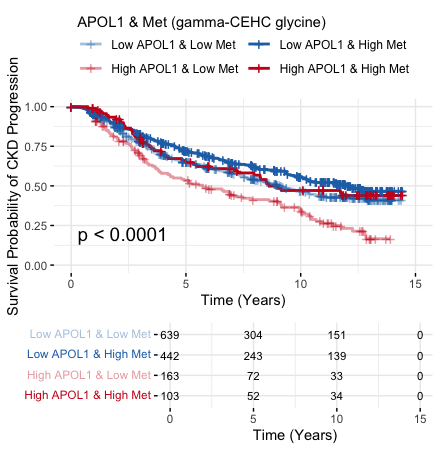
Results: γ-CEHC glycine significantly (P for interaction=0.01) and α-CEHC glucuronide nominally (P for interaction=0.04) modified the APOL1-CKD progression association. The APOL1 high-risk genotype was associated with faster CKD progression only among those with below-median levels of γ-CEHC glycine (HR=1.88, 95% CI: 1.47 – 2.42, P<0.001[CL2] ), but not among those with above-median levels (HR=1.31, 95% CI: 0.99-1.73, P=0.06). Similar patterns were observed for α-CEHC glucuronide.
Conclusions: Vitamin E metabolism may represent a modifiable pathway that mitigates APOL1-associated CKD progression among African Americans.
Rangel, Joseph
(
University of Texas Southwestern Medical Center
, Fort Worth , Texas , United States )
Zhang, Ruiyuan
(
UT Southwestern Medical Center
, Dallas , Texas , United States )
Liu, Yizhuo
(
University of Texas Southwestern Medical Center
, Fort Worth , Texas , United States )
Li, Mingyue
(
University of Texas Southwestern Medical Center
, Dallas , Texas , United States )
Chen, Jing
(
UT Southwestern Medical Center
, Dallas , Texas , United States )
He, Jiang
(
UT Southwestern Medical Center
, Dallas , Texas , United States )
Li, Changwei
(
UT Southwestern Medical Center
, Dallas , Texas , United States )