Heat and cold waves are associated with increased stroke mortality in Brazil
Abstract Body: Stroke is the second leading cause of death worldwide and a major public health concern in Brazil. Extreme heat is well recognized as a risk factor for ischemic stroke, but evidence on cold spells, event persistence, and their impact in tropical climates remains limited.
We conducted a nationwide, municipality-level time-series analysis of stroke mortality in Brazil (2003–2023). Deaths from all-cause, ischemic, and hemorrhagic stroke were classified using ICD-10 codes. Temperature (adjusted for humidity) from ERA5-Land was the main exposure. Municipality-level days at or above the 90th/99th or below the 10th/1st percentiles defined Extreme Heat (EHE) and Cold Events (ECE), respectively. Additionally, indicators were created to identify if these extremes occurred on 2 or 3 consecutive days (e.g., EHE_x_3). Associations were estimated using stratified conditional quasi-Poisson regression with distributed lag nonlinear models (lag 0–7), adjusting for PM2.5, O3, NO2, SO2, and CO. Results were expressed as relative risks (RRs) with 95% confidence intervals (CIs) and attributable deaths per 1,000 nationally and by region.
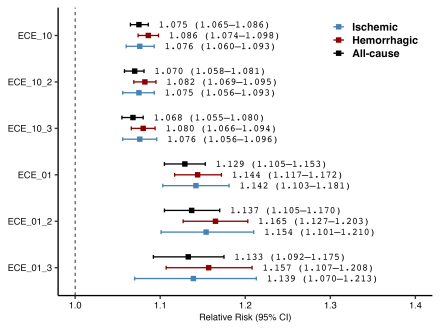
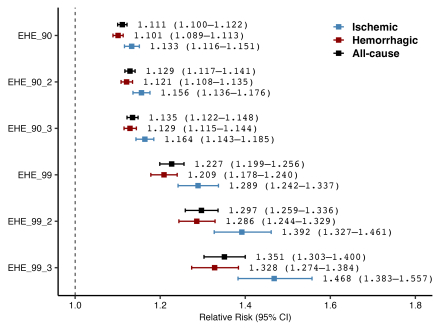
We analyzed 2,687,820 stroke deaths (827,930 ischemic; 1,698,904 hemorrhagic) from 3,610 municipalities. Extreme temperatures increased stroke mortality nationwide. For all-cause stroke, risk rose at the 90th percentile (RR 1.111, 95% CI 1.100–1.122) and 99th percentile (RR 1.227, 95% CI 1.199–1.256), and was amplified by persistence (EHE_99_3 RR 1.351, 95% CI 1.303–1.400). Cold extremes produced smaller but significant increases (ECE_10 RR 1.075, 95% CI 1.065–1.086; ECE_01 RR 1.129, 95% CI 1.105–1.153). Ischemic stroke was more heat-sensitive (EHE_99_3 RR 1.468, 95% CI 1.383–1.557), while hemorrhagic stroke was more cold-sensitive (ECE_01_3 RR 1.157, 95% CI 1.107–1.208). Attributable burdens reached up to 12 excess deaths per 1,000 person-days during persistent extreme heat. Regionally, risks were greatest in the South and Southeast, with ischemic stroke increasing under sustained heat (EHE_99_3 RR 1.664, 95% CI 1.433–1.933) and hemorrhagic stroke under cold (ECE_01_3 RR 1.747, 95% CI 1.426–2.139), while the North showed weak or null associations.
Extreme temperatures increased stroke mortality in Brazil, with ischemic stroke more affected by heat and hemorrhagic by cold. Risks were further amplified by persistence, particularly for heat, underscoring the need for climate adaptation to reduce the cerebrovascular burden in vulnerable populations.
Singh, Ayush
(
Case Western Reserve University
, Cleveland , Ohio , United States )
Xu Xiaohong, Preeti Preeti, Yu Ruoying, Shaykhalishahi Hamed, Zhang Cheng, Shen Chuanbin, Li Bei, Tang Naping, Chang Yan, Xiang Qian, Cui Yimin, Lei Xi, Ni Heyu, Zhu Guangheng, Liu Zhenze, Hu Xudong, Slavkovic Sladjana, Neves Miguel, Ma Wenjing, Xie Huifang