Small increases in temperature may increase mortality attributed to ST elevation myocardial infarction in tropical regions: A case-crossover analysis from Brazil.
Abstract Body (Do not enter title and authors here): Background: Prior literature has demonstrated that temperature variation is associated with overall cardiovascular mortality. However, while extreme cold temperature are associated with increased risk for ST elevation myocardial infarction (STEMI) data regarding the risk for extreme high temperatures is still unclear. Hence, we aimed to evaluate the association between temperature and STEMI mortality in a hot, tropical country.
Methods: Daily STEMI attributed mortality – from the Brazilian Mortality Information System (SIM) – and the corresponding mean temperature – from the National Institute for Space Research (INPE) – were collected between 2021 – 2023 from 8 large cities (Belo Horizonte, Belem, Brasilia, Curitiba, Fortaleza, Porto Alegre, Rio De Janeiro, and Sao Paulo) together comprising of a population of over 31 million inhabitants (15% of the total Brazilian population). A two-stage analysis was conducted. In the first stage, with a case-crossover design, a 7 day lag period, and fitting temperature as a natural spline with 3 knots, distributed non-linear lag models were fitted and the relative risk for STEMI mortality was calculated referenced to the median temperature in each city. In the second stage, a mixed methods meta-analysis was done to pool results from all cities, and the relative risk (RR) was predicted.
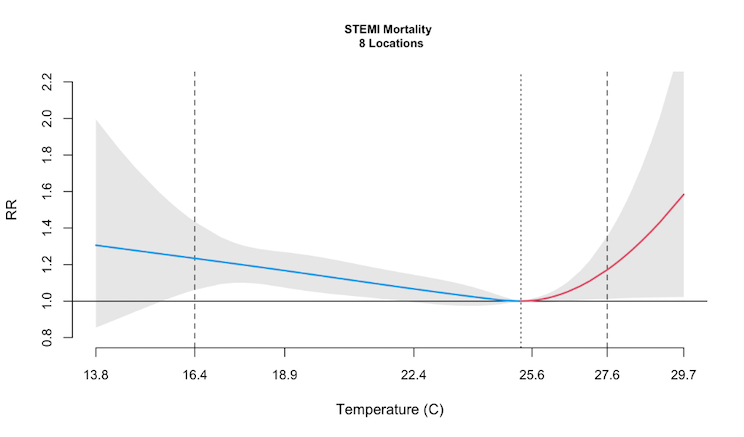
Results: Over the 4-year period, 45,653 STEMI deaths occurred; slightly more deaths occurred during winter (23,144) than summer (21,873), a 5.8% increase. The lowest and highest average daily temperatures recorded were 15.6 °C and 28.1 °C. On pooled analysis, the minimum mortality temperature (MMT) was 25.2 °C with numerically increasing RR with higher and lower temperatures. These effects were consistent across winter and summer (p-value = 0.23) with low heterogeneity (I2 = 15%). Compared to the MMT, at the 99th percentile temperature [29.6 °C (a 4.4 °C increase)] the RR for STEMI mortality was 58% higher (RR = 1.58, 95%CI 1.02, 2.45). Conversely, at the 1st percentile temperature [13.7 °C ( 11.5°C decrease) the RR for STEMI mortality was not higher [RR 1.3 (0.85, 1.99)].
Conclusions: Pooled analysis from 8 large Brazilian cities, comprising qualified mortality data from over 31 million inhabitants, demonstrated that even in a hot, tropical climate slight increases in temperature may lead to a higher relative risk for death due to ST elevation myocardial infarction.
Presswalla, Feriel
(
Case Western Reserve University
, Cleveland , Ohio , United States )
Salerno, Pedro
(
Case Western Reserve University
, Cleveland , Ohio , United States )
Teixeira, Renato
(
Universidade Federal de MG
, Belo Horizonte , Brazil )
Marino, Marcos
(
HOSPITAL MADRE TERESA
, NOVA LIMA , Brazil )
Ribeiro, Antonio
(
Universidade Federal de MG
, Belo Horizonte , Brazil )
Nascimento, Bruno
(
Universidade Federal de MG
, Belo Horizonte , Brazil )
Deo, Salil
(
Case Western Reserve University
, Cleveland , Ohio , United States )
Author Disclosures:
Feriel Presswalla:DO NOT have relevant financial relationships
| Pedro Salerno:No Answer
| Renato Teixeira:No Answer
| MARCOS MARINO:No Answer
| Antonio Ribeiro:No Answer
| Bruno Nascimento:DO NOT have relevant financial relationships
| Salil Deo:DO NOT have relevant financial relationships