Risk Factor Contributions Toward Incident Cardiovascular Disease Among Younger Adults With Short- and Long-Term Predicting Risk of Cardiovascular Disease EVENTs (PREVENT) Risk: The Reasons for Geographic and Racial Differences in Stroke (REGARDS) Cohort
Abstract Body: Background: The American Heart Association’s PREVENT risk equations estimate both 10-year and 30-year risks for cardiovascular disease (CVD) in younger adults aged 30–59 years. Recent analyses show that many younger adults have low short-term (10-year) risk but high long-term (30-year) predicted CVD risk. However, it is unclear which risk factors can be prioritized for the largest population benefit to mitigate long-term CVD risk within this PREVENT risk strata.
Objective: We quantified the contribution of risk factors for incident CVD in younger adults classified as having low short-term risk but high long-term risk by PREVENT within the national REGARDS prospective cohort.
Methodology: We included participants 45-59 years of age in the REGARDS cohort without prevalent atherosclerotic CVD (ASCVD) or heart failure (HF) recruited in 2003-07 from the continental United States. We estimated the sex-specific prevalence, age and race adjusted hazard ratios accounting for competing risk of non-CVD death, and the population attributable risk percent (PAR%) for incident CVD associated with hypertension, dyslipidemia, obesity, diabetes, current smoking, chronic kidney disease [CKD], high-sensitivity C-reactive protein (hs-CRP) ≥ 3 mg/dL, and a family history of ASCVD. The prevalence and PAR% were calculated for the low 10-year (< 12.5%)/high 30-year (≥30%) risk group of interest by PREVENT, and stratified by sex. A low 10-year total CVD risk threshold (<12.5%) was defined by a risk percentile method consistent with a low 10-year ASCVD risk (<7.5%).
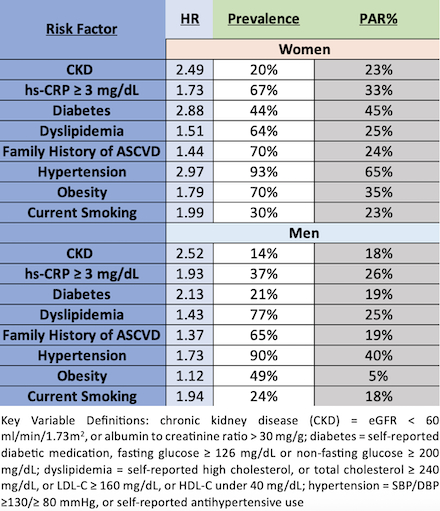
Results: Among 6,761 participants, 1,421 (21.0%) had low 10-year/high 30-year PREVENT risk (703 women and 718 men). Overall, there were 566 incident CVD events over a median follow-up of 14.4 years, of which there 194 incident CVD events occurred in the low 10-year/high 30-year PREVENT risk group. Within the low 10-year/high 30-year PREVENT risk group, the highest PAR% for incident CVD were for hypertension (65%), diabetes (45%), and obesity (35%) in women, in comparison to hypertension (40%), hs-CRP ≥ 3 mg/dL (26%), and dyslipidemia (25%) in men (Table 1).
Conclusion: Hypertension is the largest contributor to incident CVD among younger adults with low short-term but high-long term predicted CVD risk, and supports the role of early primary prevention strategies focusing on treating hypertension in this population.
Satish, Mohan
(
New York Presbyterian - Weill Cornell Medical Center
, New York , New York , United States )
Ringel, Joanna
(
Weill Cornell Medicine
, New York , New York , United States )
Jumonville, Ghislaine
(
Weill Cornell Medicine
, New York , New York , United States )
Quezada-pinedo, Hugo G
(
Duke University
, Durham , North Carolina , United States )
Walters, Ryan
(
Creighton University
, Omaha , Nebraska , United States )
Kini, Vinay
(
Weill Cornell Medicine
, New York , New York , United States )
Hardy, Shakia
(
Univ of North Carolina Chapel Hill
, Mebane , North Carolina , United States )
Muntner, Paul
(
UNIVERSITY OF ALABAMA AT BIRMINGHAM
, Birmingham , Alabama , United States )
Levitan, Emily
(
UNIVERSITY ALABAMA AT BIRMINGHAM
, Birmingham , Alabama , United States )
Safford, Monika
(
WEILL CORNELL MEDICINE
, New York , New York , United States )
Colantonio, Lisandro
(
UNIVERSITY OF ALABAMA AT BIRMINGHAM
, Birmingham , Alabama , United States )