Cardiovascular Health Across Childhood and Adolescence and Proteomic Biomarkers in Late Adolescence
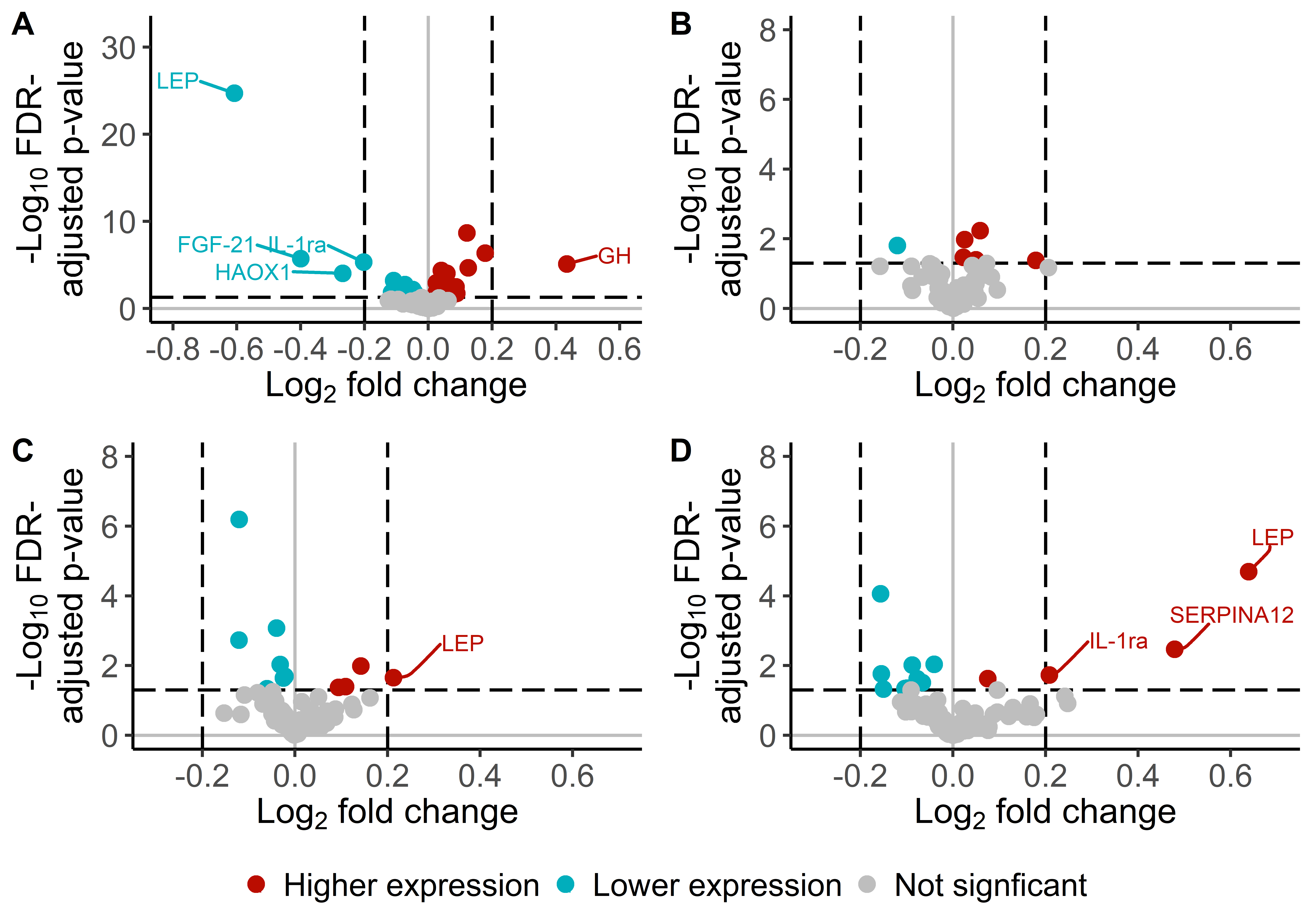
Abstract Body: Background: The American Heart Association’s Life’s Essential 8 cardiovascular health (CVH) construct strongly predicts cardiovascular disease (CVD). While recent studies have characterized CVH trajectories in children and identified their early life determinants, substantial knowledge gaps exist regarding biological processes underlying early-life CVH trajectories, which limits opportunity to guide CVD prevention and treatment efforts. Methods: Among 424 children (53% female) in Project Viva, we derived CVH scores (0-100 points) in early childhood (median age 3.2y), mid-childhood (7.7y), early adolescence (13y), and late adolescence (17.5y), and used segmented mixed-effect models to estimate three sex- and child-specific CVH trajectory parameters: timing of inflection when CVH declines, and slope before and after inflection. We assayed 92 cardiovascular-related proteins from plasma samples in late adolescence using a targeted proteomics panel. Linear regression models assessed cross-sectional (i.e., CVH score in late adolescence) and longitudinal (i.e., CVH trajectory parameters) associations of CVH with protein biomarkers, with false discovery rate correction via Benjamini-Hochberg method. Results: Mean (SD) CVH score in late adolescence was 75.5 (10.5). CVH slope before inflection was 0.6 (1.4) points/y, timing of inflection was 10.1y (0.7), and slope after inflection was -1.2 (1.2) points/y. In cross-sectional analyses, a 1-SD higher CVH score was associated with 29 differentially abundant proteins (DAPs), of which 5 had substantially altered levels with log2-fold-change (FC) ≥|0.2| (FGF-21: log2FC -0.40, 95% CI -0.56, -0.24; HAOX1: log2FC -0.27, 95% CI -0.40, -0.13; IL-1ra: log2FC -0.20, 95% CI -0.29, -0.12; LEP: log2FC -0.61, 95% CI -0.71, -0.50; GH: log2FC 0.43, 95% CI 0.25, 0.62). In longitudinal analyses, a 1-SD higher slope before inflection was associated with 6 DAPs (none substantially altered), while a 1-SD higher timing of inflection was associated with 11 DAPs, of which LEP had substantially higher levels. A 1-SD faster decline in slope after inflection was associated with 13 DAPs, of which IL-1ra, LEP, SERPINA12 had substantially higher levels. These DAPs implicated pathways such as lipid metabolism, inflammation, and oxalate production. Conclusions: This study identified novel biomarkers associated with CVH score and trajectories in children, which may inform risk stratification and treatment strategies early in life to alter CVD progression.
Lin, Zhi
(
Harvard Medical School
, Boston , Massachusetts , United States )
Rifas-shiman, Sheryl
(
Harvard Medical School and HPHCI
, Boston , Massachusetts , United States )
De Ferranti, Sarah
(
Harvard Medical School
, Boston , Massachusetts , United States )
Perng, Wei
(
University of Colorado Anschutz Medical Campus
, Aurora , Colorado , United States )
Hivert, Marie-france
(
Harvard Medical School and HPHCI
, Boston , Massachusetts , United States )
Aris, Izzuddin
(
Harvard Medical School and HPHCI
, Boston , Massachusetts , United States )