Logo

American Heart Association

  2
  0


Final ID: TU184

Polygenic Risk Scores That Uncouple Obesity From Cardiometabolic Risk Protect Against Longitudinal CHD and T2D Risk

Abstract Body: Body mass index (BMI) defined obesity is an established risk factor for cardiometabolic diseases, yet its cardiometabolic consequence is highly heterogeneous. We recently conducted genome-wide association analyses (GWAS) of 24 metabolically healthy obesity (MHO) traits in the UK Biobank, combining three adiposity (body fat percentage [BFP], BMI, and waist–hip ratio) and eight cardiometabolic (lipids, glycemic, and blood pressure) traits.
We hypothesized that polygenic risk scores (PRSs) derived from these MHO traits capture genetic predisposition to higher adiposity with protective cardiometabolic profiles, predicting MHO status and lower coronary heart disease (CHD) and type 2 diabetes (T2D) risk.
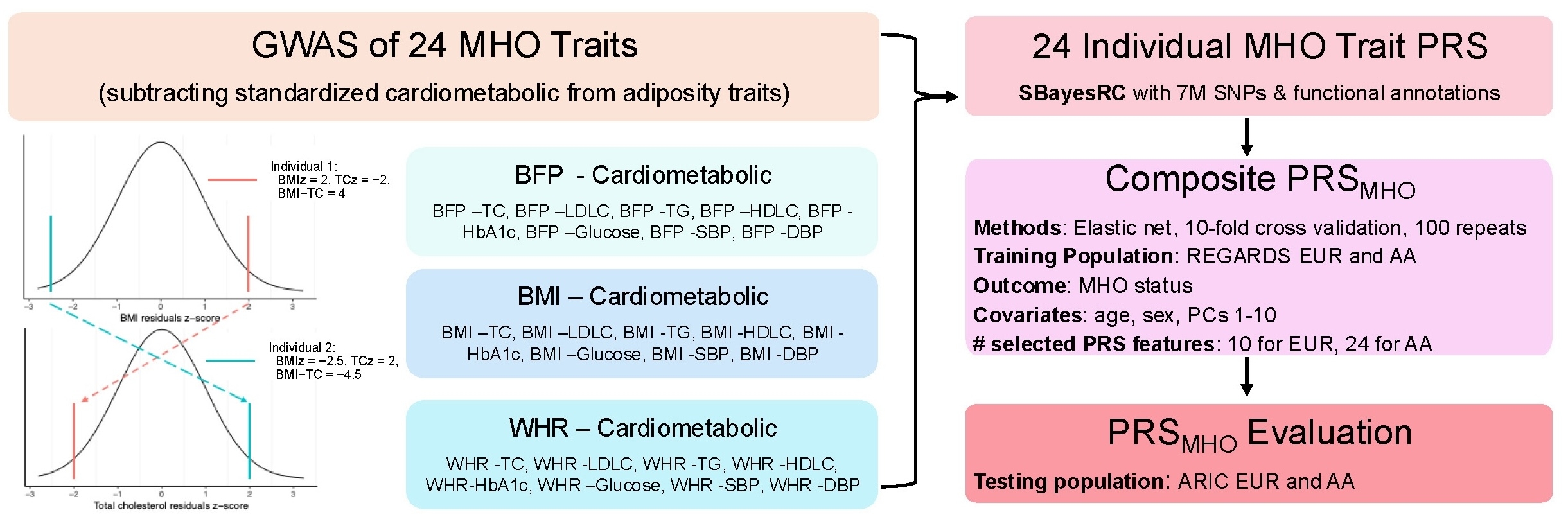
MHO status was defined as (abdominal) obesity without elevated BP, glucose, or lipids. Individual MHO trait PRSs were constructed using SBayesRC, integrating summary statistics with ancestry-specific LD and functional annotations (Fig. 1). Associations between 24 MHO PRSs and MHO status were evaluated in the REasons for Geographic and Racial Differences in Stroke (REGARDS) study (12,084 European ancestry [EUR]; 8,672 African Americans [AAs]). To optimize prediction, we trained a composite PRS (PRSMHO) using an elastic net model with 100x 10-fold cross-validations to combine individual MHO PRSs in REGARDS. The resulting composite PRSMHO and individual MHO PRS were tested for predicting MHO status, incident CHD and T2D in the Atherosclerosis Risk in Communities (ARIC) study participants (9,241 EURs; 2,822 AAs).
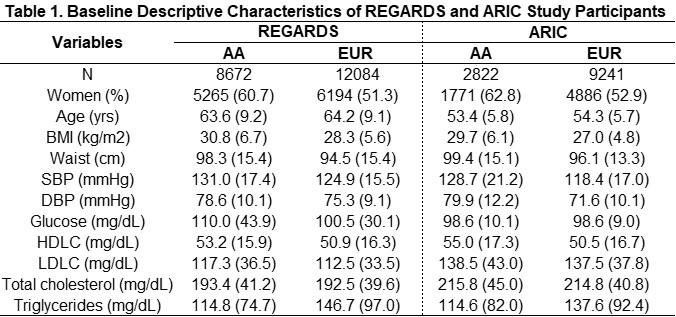
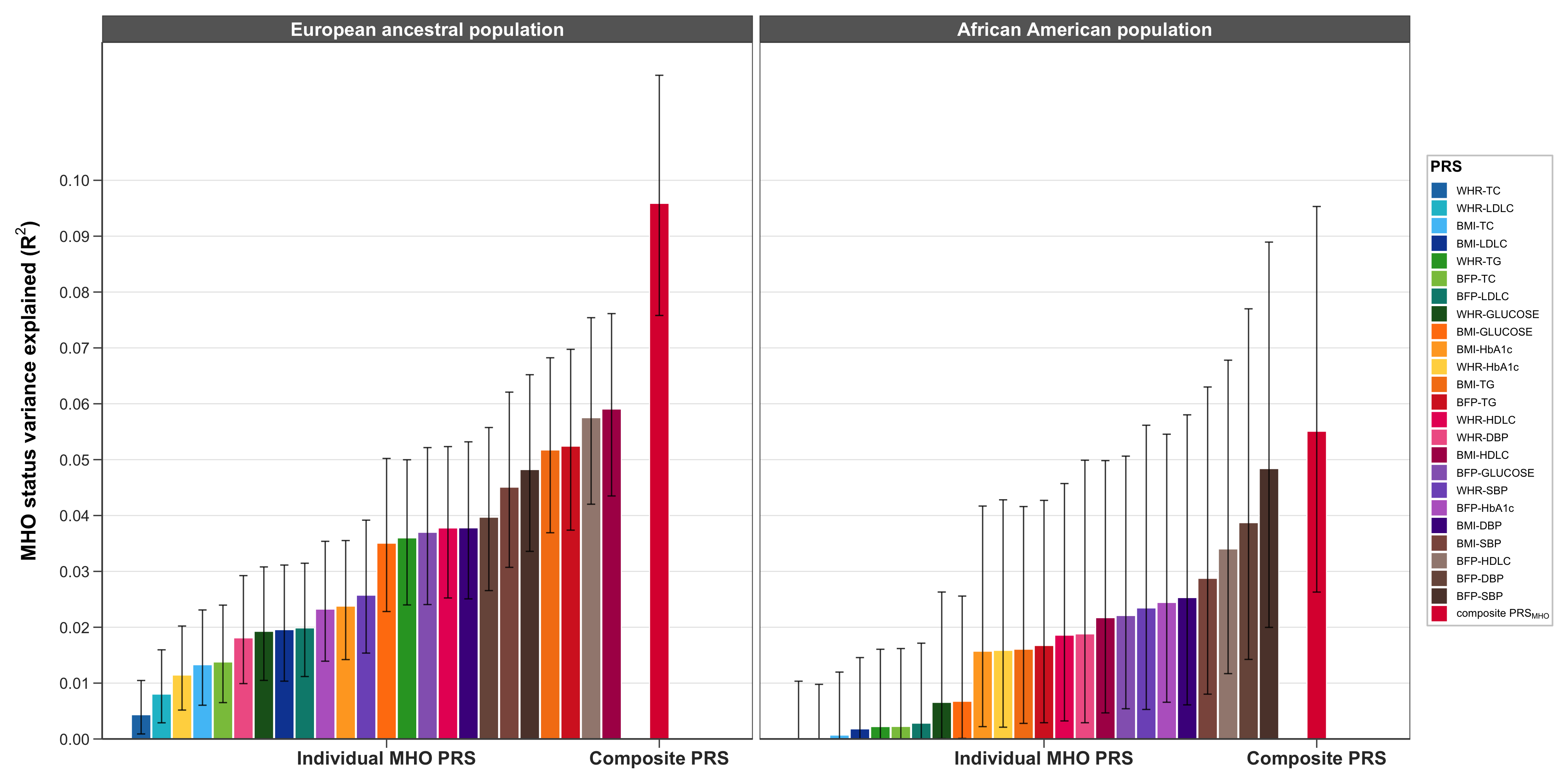
Descriptive characteristics are presented in Table 1. Most MHO trait PRSs were positively associated with MHO in both ancestries, but the strongest associations differed: ‘BMI–lipid’ PRSs in EURs and ‘BFP–SBP’ PRS in AAs. The odds ratio (OR) per SD increase in PRSBFP-SBP was over twofold greater in ARIC AA ([95% CI]: 4.01 [2.41–6.68]) vs. EUR (1.63 [1.51–1.76]). Individual MHO PRS explained up to 5.8% of MHO variance, while the composite PRSMHO explained 9.6% in EUR and 5.5% in AA (Fig. 2). PRSMHO was associated with lower 20-year risk of CHD and T2D, particularly in individuals with obesity. The protective association with CHD remained after adjusting for baseline MHO (HR [95% CI]: 0.92 [0.86–0.99] in EUR; 0.89 [0.76–1.06] in AA).
This study leverages genetics that uncouple obesity from its cardiometabolic comorbidities to predict MHO and its protection against CHD and T2D, providing potential targets for precision prevention.
  • Wang, Zhe  ( University of Alabama at Birmingham , Birmingham , Alabama , United States )
  • Armstrong, Nicole  ( University of Alabama at Birmingham , Birmingham , Alabama , United States )
  • Tiwari, Hemant  ( University of Alabama at Birmingham , Birmingham , Alabama , United States )
  • Graff, Mariaelisa  ( UNC-CHAPEL HILL , Chapel Hill , North Carolina , United States )
  • Judd, Suzanne  ( University of Alabama at Birmingham , Birmingham , Alabama , United States )
  • North, Kari  ( UT Health Houston , Brownsville , Texas , United States )
  • Loos, Ruth  ( University of Copenhagen , Copenhagen , Denmark )
  • Irvin, Ryan  ( University of Alabama at Birmingham , Birmingham , Alabama , United States )
  • Author Disclosures:
Meeting Info:

EPI-Lifestyle Scientific Sessions 2026

2026

Boston, Massachusetts

Session Info:

Poster Session 1

Tuesday, 03/17/2026 , 05:00PM - 07:00PM

Poster Session

More abstracts on this topic:
A Randomized Placebo-Controlled Trial of Pitavastatin Calcium to Treat Combined Dyslipidemia of Obesity in Adolescents – The Pediatric Heart Network Dyslipidemia of Obesity Intervention in Teens (DO IT!) Trial

De Ferranti Sarah, Cartoski Mark, Brothers Julie, San Giovanni Christine, Zachariah Justin, Pena Sandra, Mahle William, Peterson Amy, Magge Sheela, Raghuveer Geetha, Sharma Binu, Arslanian, Md Silva, Kazlova Valiantsina, Sponseller Craig, Freemon Dandrea, Stylianou Mario, Mccrindle Brian, Mietus-snyder Michele, Urbina Elaine, Ware Adam, Teng Jessica, Trachtenberg Felicia, Russell Mark, Shah Amy

A Loss-of-Function Missense Variant in ANGPTL3 Exerts Protective Effects Against Kidney Disease Risk

Zhang David, Ritchie Marylyn, Rader Daniel, Cuchel Marina

More abstracts from these authors:
Life’s Essential 8 Protection Against Heart Failure: Metabolomic Insights from the REGARDS Study

Armstrong Nicole, Kimberly W. Taylor, Irvin Ryan, Patki Amit, Judd Suzanne, Lange Leslie, Tiwari Hemant, Parcha Vibhu, Ament Zsuzsanna, Goyal Parag, Levitan Emily

Enhancing Ischemic Stroke Risk Prediction: Functional Genomic Insights in Black and White Participants from the Reasons for Geographic and Racial Differences in Stroke (REGARDS) Study

Armstrong Nicole, Limdi Nita, Keene Keith, Worrall Bradford, Tiwari Hemant, Irvin Ryan, Srinivasasainagendra Vinodh, Patki Amit, Aldridge Chad, Jones Alana, Broeckel Ulrich, Lange Ethan, Lange Leslie, Arora Pankaj

You have to be authorized to contact abstract author. Please, Login
Not Available